
Roland DürreThursday May 26th, 2011
Final Deposit – NO, THANKS!
 In reply to the change of opinion among the Bavarian CSU, the Federal SPD now demands that Bavaria also be again considered as everybody tries to find a proper “final deposit location” for nuclear waste.
Incidentally, I heard people with scientific background tell me it makes no sense at all to „finally deposit“ nuclear waste.
Instead, we should concentrate on locations where you can make a good guess or guarantee that they will be safe for the next 50 to 100 years, maybe, if things go well, for 200 years. And, above all, we should deposit the waste in such a way that it can be taken back.
To me, these considerations make sense. Firstly, it seems more realistic to go for safety in a time frame of fifty to two hundred years, rather than in one that covers thousands or even hundreds of thousands of years.
Secondly, there is still the hope that maybe technological advances will find a solution for dealing with the constant radiation. Maybe they can even come up with a way of using it as raw material?
If, however, the material is left to do damage deep under the surface in rusty barrels surrounded by brine (see: Asse), what you created is not a “final deposit”, but a dangerous time bomb.
In my opinion, this kind of final deposit can only be considered in an area where no people live. In other words: it can under no circumstances be done in Germany or anywhere else in Europe. Instead, we would probably have to find an uninhabited area in the Third World. In our perverted world dominated by hyper technology and huge industrial complexes, I would not be surprised if they started dissolving radio-active waste and then dumping it into the oceans. Both scenarios are quite realistic, even if they look egoistical, amoral and unethical to me.
As I see it, the best solution to get out of the dead end is probably a reversible interim deposit, including the hope for future technological advance. I would recommend that we shut down all radio-active facilities, turn them into interim deposits (since deconstruction cannot be financed, anyway), instal better protection against accidents, such as plane crashes (than we currently have in the facilities) and – above all – no longer produce radio-active waste.
RMD
(Translated by EG)
P.S.
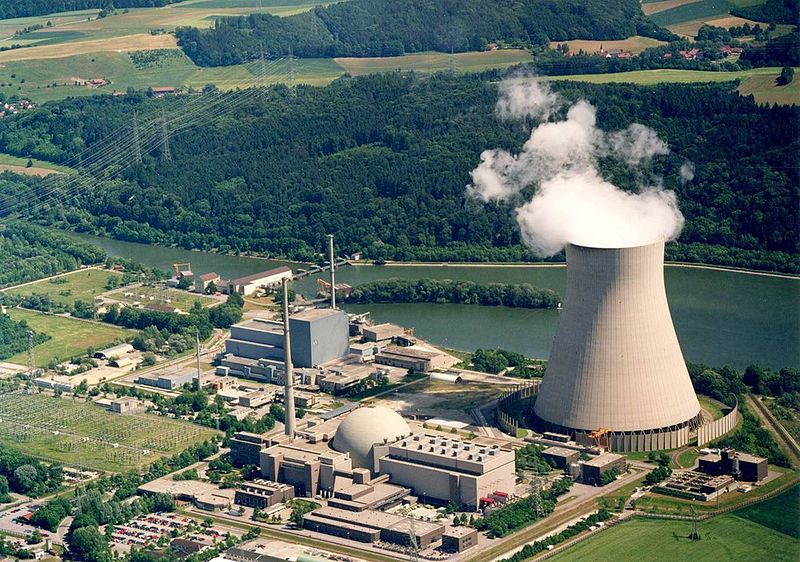
I took the picture of the Isar nuclear power plant from the central media archive Wikimedia Commons. Incidentally, you can reach ISAR I and II near Ohu in a little more than two hours by bike from Munich. If you are a fast bike racer, you will easily manage it in less than two hours.
1 Kommentar zu “Final Deposit – NO, THANKS!”
Kommentar verfassen


Roland, these arguments are fairly convincing. Old salt mines are a dubious solution. Their presence establishes dryness for millions of years. But the same argument shows that they can rapidly become unstable if water does break in.
But there are some problems. Old power stations are regarded as ugly. This negative image will be strengthened if they become rubbish stores. Nobody will want to live within miles of one. They will remain as monuments to short sightedness. No politician will want to be associated with such a thing.
Also, I am sure they were not built to last 200 years. The concrete will start to crumble before then.
I too hope that science and technology will find solutions to the problems of the next 200 years. But if we add to these problems it may all become too much.
This may be plausible for Germany, but loses relevance when other countries still expand nuclear power. Can the French or Americans develop a better solution?