
Roland DürreTuesday July 12th, 2011
The “Wisdom” by Rupert Lay
Now on the internet as a video recording
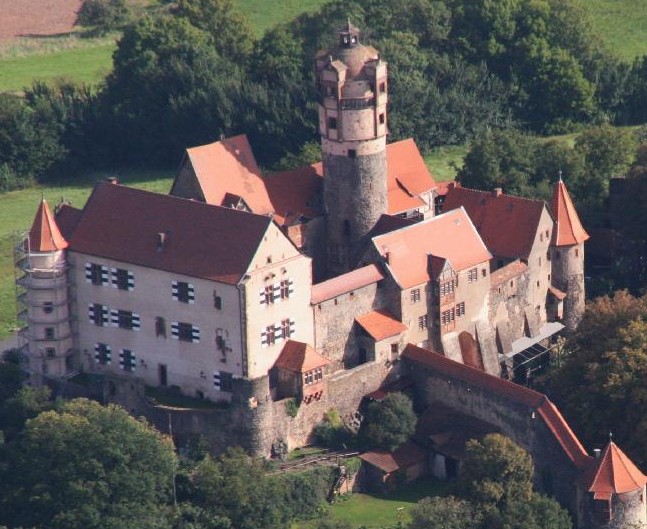 For centuries, the Ronneburg was a place of refuge for people who fled something. There were times when several thousand religiously or politically haunted persons lived on the castle. But the free castle also protected “business refugees” on their way to Bremerhaven.
In 1995, we founded an association that fights for ethics in politics, society and business. We named ourselves the: Ronneburger Kreis. We gave substantial support to the Ronneburg Castle development association. Thus, the Ronneburg Castle got a new roof and the substance of the buildings could be conserved.
Then we created the Ronneburger Sundays in order to meet there and listen to presentations on current topics with critical speakers. Rupert Lay spoke particularly often for us in the Ronneburg Castle.
For me, it always meant that I had to get up very early on a Sunday morning, along with Bernd Sielaff (our camera man and film specialist). We drove on the motorway to Frankfurt and then further north to the Ronneburg Castle. Camera and lights had to be prepared – and then in the evening we had to drive back to Nuremberg. Those were long nights.
In this way, many contemporary video recordings of Rupert Lay were made between 1995 and 2005. We are talking digital recordings in DV format (Digital Video). Now we converted them into modern formats and restored them. In the future, – with the authorization of the “Ronneburger Kreis” – I will publish a video with Rupert Lay on my youtube channel at regular intervals.
We will start with wisdom:
It would make me truly happy if, by doing this, I could contribute towards a future impact the works of my friend and mentor Rupert Lay might have.
RMD
(Translated by EG)
2 Kommentare zu “The “Wisdom” by Rupert Lay”
Kommentar verfassen


I listened to the first 20 minutes of Rupert Lay on “wisdom”. In this video, he shows certain signs of wisdom. He waves both arms, which is healthy. He shows good technique for talking to well-off managers. He talks fairly slowly, to get through without exhausting them. But he suddenly drops in strange words and paradoxes to keep them awake, and even interested. For instance he uses the word “euphily”, which normally is a cooperative venture between Europe and the Philippines, or botanic jargon referring to flowers. (Here it means “love of wellness”, reminding me of many articles in my TV magazine). He seems, wisely, to earn a good living this way.
He also seems to have partly broken away from his Jesuit upbringing, by severely criticising dogma. (But he seems not to notice the dogmatic nature of his talk). He does explain his use of the word “wisdom”, “the highest form of intelligence”, as having been agreed by some group, (perhaps philosophers). But he does not explain what that means. He does not mention scientific investigations showing that there is a general intelligence leading to good results in lots of sorts of tests, as well as specialist intelligences for particular areas, such as music or maths.
Right at the start, he makes clear that he is only interested in humanity. In a philosophical talk, this seems very short sighted. He looks back over 2000 years, but hardly looks forward beyond his own lifetime.
He praises Socrates for his admission that he knew nothing, and then condemns Plato for advocating ruling by “wise rulers”. I too used to think that Socrates was wise, but misunderstood by Plato. Later I learnt that Socrates was a figure of fun in ancient Athens, who corrupted the youth with fascist views, and whose importance derived from Plato’s good writing style and from the long-lived school founded by Plato. Incidentally Socrates advised rule by philosophers and held up Sparta, (where philosophy was prohibited), as having the best system of government! And by the way, it is pretty silly to advocate having doubt about everything. How can one get through life like that, worrying that the next mouthful may be poisoned? It is even sillier now, with better general education than in Socrates’ days.
So “wisdom is the top form of intelligence”, and recognises that “euphily is the top value”. Roland once gave me the wise advice “don’t try to optimise”. Hr. Lay seems to be trying to optimise. He also maintains that history does not know the past. This seems paradoxical only when one forgets that nobody knows anything.
Can somebody tell me whether “Kyberspace” is correct German, or is this mispronounced English?
We are all motivated by more-or-less enlightened self-interest. If I had been more enlightened, I would not have written this comment.
Lieber Chris, wenn Du Lust hast, dann geh doch mal auf meinen youtube-Kanal (rolandduerre). Da wären noch eine ganze Reihe von Videos, die Du kommentieren könntest. Roland