
Roland DürreTuesday May 8th, 2012
Matthias Keßler: Beer & Preservation of Raw Materials
The Blue Friday presentation is now available as a video!
On March, 23rd, Dr. Matthias Keßler gave a great Blue Friday presentation at Unterhaching InterFace AG. He spoke about nutrition and raw materials.
Here is his entire presentation: “Beer and Preservation of Raw Materials”!
It is well worth watching!
The video has been produced by Friedrich Lehn. For other great presentations, look through my channel (rolandduerre).
You will also find top speakers at www.if-agora.de.
RMD
(Translated by EG)
Roland DürreMonday March 26th, 2012
Do Not Forget: IF Forum
On April, 17th, (that is a little more than four weeks from now), the next IF Forum takes place.
This time, Frau Heidi Schiller will be our guest. She will speak about
Black – White – Multi-Coloured.
Some impulses for looking upon this one world of ours a little differently.
It is all about living (and surviving) sustainably!
As always, we will broadcast the presentation by Frau Schiller live into the internet and we will also make a recording.
To put you in the right mood, here is the video of our IF Forum EXTRA of January, 25th, 2012 with
Klaus-Jürgen Grün about “The Art of Negative Thinking”!
And here are the three videos with the presentations of 2011. The motto was “Humans&Knowledge(Science)”.
“Nano Technology – the Future of IT” with Dr. habil. Walter Riess (November, 18th, 2011).
“Evolution or Creation? – An Attempt at a Synthesis”, with Prof. Dr. Gerhard Haszprunar (July, 20th, 2011).
“The Sound of the Big Bang” with Dr. Stefan Gillessen (March, 1st, 2011).
Enjoy!
RMD
(Translated by EG)
Roland DürreSaturday March 24th, 2012
Work and BALANCE
Sitting on the podium at BALANCE – the conference about how work will be organized in the 21st century – I took part in discussing the following thesis:
Flexibility is a way out of the crisis. The crisis is stability.
Flexibility also includes the process of work getting more dynamic, for instance through “borrowed labour”.
The thesis has two sentences. I did (and still do) not agree with the first sentence of the thesis. After all, it assumes that we have a common crisis that also manifests itself in a work-life crisis. That is not how I see it.
To be sure, we perhaps have a social or a moral crisis, but there is certainly no work or luxury crisis. It may (and probably will) come in the future. Currently, however, we have a luxury problem. And many among us have a strange concept of work (and life). It is roughly:
After the housework in the design flat has been done (provided you have no cleaning service to do it for you), you take your extravagant Mini out of the underground parking and drive it from your home to the parking place at work. On arrival, you get into the lift of the even more extravagant “office tower” and ride to the upper floors.
All through the long day, you practice self-fulfilment in front of your PC and in all kinds of meetings – and in the process you even climb the career ladder (and as a by-product, you get rich). Since, however, the environment is so inimical, you suffer from monstrous ailments like stress and work pressure, so you have to recuperate from those in the evening by selecting various environments full of life style.
Except, that is not life and neither is it real work.
For me, however, the entire consideration is annoying for another reason. Basically, some things are totally neglected:
Work is a very special commodity
and
The “tenure working contract” is not at all something God-given in order to pay you for the work you did.
Work is a special commodity. The “generator” of work as we here understand it is the human being. Machines “do not work”. Well, you might call what some animals, such as horses, do work. In return, they get food. In order to achieve an optimum cost-usefulness relation with animals, you also have to give them a minimum of care.
All parties concerned agree that we do not wish such a systematization of humans as work products. Because with humans, it would be called “slavery”.
Let us still use another comparison of work with a “hard” product and look at the dairy cow. There is no doubt that it produces milk. Regardless, we often mean the farmer when we speak of milk, even if today he is often an agro-industrial enterprise.
During the endless years as a father of small children, I always went to the farmer by bike in order to get all the milk we needed. Due to the structural change in agriculture, this is no longer possible for me at reasonable cost. When I was a young boy, I took the milk can and fetched the milk at a branch of the dairy – it was called “milk shop”. That, too, is something you can hardly ever do today.
It comes down to me having to get my milk from one of the monopolistic merchants. More often than not, they only sell it extremely pasteurized in the tetra package. Getting fresh milk in the bottle – which is my favoured model – is quite hard.
The situation with the product work is not all that different. It rarely happens that the end user can get a service “legally” directly from the producer. If at all, it usually happens in the form of moonlighting or in a legally conspicuous and questionable way.
As a general rule, I, too, get work through a long chain of suppliers. Within this chain, the work comes more and more often as free-lance “employment”. These contracts are often “clandestine employments”, filling a grey zone that might easily be considered a violation of the AÜG. Incidentally, work is something that comes with some sort of “directive” and a dependency upon only one supplier is quite common.
But that, too, is not my main issue. Work is a special commodity, because the producer “human being” sells himself. He sells his conscience and his personal goals (system agent), his competence (expert), his experience and his knowledge (“innovation worker”), his health (physical labour) and in some cases even his body.
So the “labourer” gives away something of his own. And the really absurd thing about it is that the process of giving something away – except if an individual or a team do piecework (which in many cases is not possible and we do not want, either) – is measured in time units?!
Because we pay according to the TIME someone has spent doing something. During employment interviews, the income is always based on this aspect. The variable time components with target agreements – I personally consider them very deficient – do not change this. Basically, it is the working time account that determines your “achievement”. Incidentally, achievement is also a difficult term – try translating it.
To be sure, employment based on a working time account with respect to the income is certainly “better” than serfdom or slavery. But I am absolutely sure we still have a long way to go when it comes to “paying human labour”.
Let us think innovatively. Time is the relevant component.
In the highly civilized societies, time might even get the function of money. It might work like this: you can have my time, during which I do something for you. In exchange, you give me your time and you do something for me.
Here is what I feel about the second sentence of the thesis:
The crisis is stability.
I would like to improve a little on this sentence. There is no such thing as a life without crises. Not for humans as persons and not for humans in a society. The type, seriousness and frequency of crises, however, changes. But this does not mean that the crisis becomes stability (or even causes stability, as the sentence seems to suggest a little). No, there will be more and more serious crises – and they will get harder to overcome. And in the future, overcoming those crises will cost ever more real or so-called sacrifices. That is something we cannot ignore.
And do not let us forget: there is a chance in every crisis. My teacher – Dr. Baldur Kirchner – showed me that the great “CIC” can change even deep characteristics of a person’s personality. “CIC” is for catastrophe, illnesses and crisis. The same is probably true for societies.
But there is a second reason for us to be optimistic. We complain on a very high level. Because we have hoarded luxury that can be dissolved before we will have to pay the price with our own bodies.
I like to give the following examples for our hoarded luxury: individualized traffic, irrational consumption and eating habits (both with respect to quantity and quality), a life style that only allegedly makes us happy, in many cases very lavish living conditions…
In our society, we have wastefulness left, right and centre. A little Kaizen would certainly do no harm in our lives. Consequently, there is no reason to despair, because there are many things that do not really make us “happy” and that we can do without.
RMD
(Translated by EG)
Roland DürreFriday March 23rd, 2012
Life Sciences (not in the meaning of pharmacy)
I studied mathematics. Mathematics has a fairly easy structure and there is little dispute about it. The axioms, such as the definition of “whole numbers” seem to be “naturally rooted”; nobody can seriously come up with arguments against them. The rest of the work of a mathematician is deduction in a very formal and strictly logical way. Every statement has to be proved in a very restricted manner. You have to determine whether a statement is “true” or “false”.
In order to make this possible they invented their own “mathematical formula and symbol language”. It is supposed to avoid communicative misunderstandings as good as can be expected.
The not quite so pure natural sciences such as biology, chemistry and physics try to avoid speculations where possible. Instead, they want to describe and explain natural phenomena as correctly as possible. These sciences use mathematics as their tool.
Thus, mathematics, even though it is very abstract and theoretical, is a rather honest science. To be sure, there are probably a few exceptions, for instance in some of the game-theory approaches and in financial mathematics.
But they are not really relevant. Everything else is very reasonable and rational. The older I get, however, the more I enjoy learning about economic sciences, social sciences, psychology including neurology, but also philosophy and history.
This Tuesday and Wednesday, for instance, I attended BALANCE von Prof. Dr. Kathrin Möslein, an economy multi-conference focusing on “innovation” and the future of work-life in Nuremberg. I was even permitted to take part in the podium discussion, where they placed my right next to Prof. Dr. Peter Mertens.
I truly enjoyed the experience. This mixture of economy, social sciences and humanities sounds rather exciting to me and I made quite a few discoveries.
To be sure, from the perspective of a mathematician, there is much that sounds rather vague. Numerous models are designed, assumptions are created and then they are discussed at great length. And it is absolutely necessary to think inter-disciplinarily. This, however, also has the consequence that you will constantly discover ideas that have already been inrtroduced in other disciplines. Or else they have been clear for thousands of years. Regardless, you get a value that is not always directly recognizable or even felt.
I see mathematics as an “assisting science” for all other natural sciences. The “non-natural sciences” work differently. In my perception, they are on the same level and have to be very tightly interwoven in order to be practically useful.
For instance, I notice that economic science is not at its best if it tries to force economical facts into mathematical models. Eventually, those models mostly fail miserably.
For me, economic science will become a positive factor as soon as it connects with the “humanities”. Such as philosophy, but also psychology or social sciences. And perhaps also with natural sciences such as biology.
I would like to call the sum of all sciences “live sciences”!
And this is not an area where we are talking “right” or “wrong”. Neither will you get final results you can apply to politics or society “in engineering fashion”, thus improving the world. Consequently, there is no way I could accept them as “sciences that solve problems” that give us good advice for future behaviour and additional technologies.
It is more like “the journey is the reward”.
The value of life sciences is that they accompany us when we get active and when we make decisions. Also, they inspire us to get thoughtful! It is their task to carry the ideas of a permanently changing world into politics, society and basically all social systems.
RMD
(Translated by EG)
Werner LorbeerTuesday February 28th, 2012
Desert Tec #014: Too Much Energy!
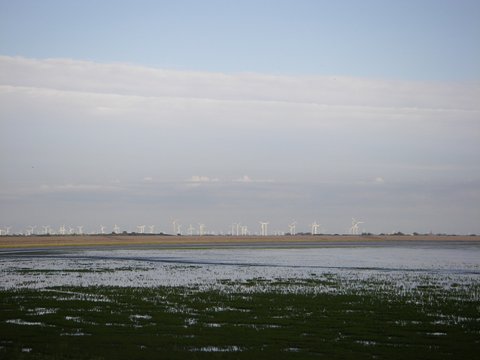 In 1992, when I first stood in front of the four Spannbüllhof windmills, I never stopped being amazed. It was a windy summer, the daughter had come down with whooping cough and I experienced the coast with its healing and windy powers.
Being a physicist, I automatically analyzed the function and energy output of the mills and my surprise knew no end when I realized what a business potential these four windmills, each producing 0.5 Megawatt, had. In a single year, they earned 60% of what they had cost.
If you want to do the calculations, here are the facts: Per installed megawatt, the energy output is around 2 to 2.5 gigahertz each year. (This is an important number for many Bavarian investors who currently want to make places with little wind happy through their investment capital. Keep in mind: there will be a time when you no longer get subsidies and then the cost will count. With grumpy greetings from the depleted objects in Eastern Germany to the nationally enthusiastic investor).
On the second day, my question, of course, was about the network and the energy storage – and even in 1992, two things were obvious:
- The conversion technology was not able to cope with the sudden “going-off-the-wind” of the windmill chains if there was too much wind;
- In Schleswig-Holstein, there is no water storage for taking up extra energy;
- And neither the windmill farmers nor any of the subsidy politicians could have cared less, because with subsidies, you never know why you get them, anyway.
Now, what a shock, in 2012, the energy is to be used – neither the subsidy granters nor the windmill park investors ever believed such a thing might happen!
After all, life was a lot easier when you got the premium even if the windmills were turned off because of too much energy flowing through the networks if there was too much wind.
Yes, it is true: they got a premium for switching off if the network got strained. We really learned a lot from the GDR. Today (Feb., 27th, 2012) our parliament rescues the “Euro” and tomorrow “the entire world”. At the same time, the production of carbon fibre composite for the BMW e-Mini is transferred to Lake Moses, USA, because the energy costs too much in this country.
Is there a way out of the dilemma.
Yes, there is!
It will be a plea for “power to gas“
wl
(Translated by EG)
Roland DürreThursday January 19th, 2012
The Art of Thinking Negative – Live on the Internet
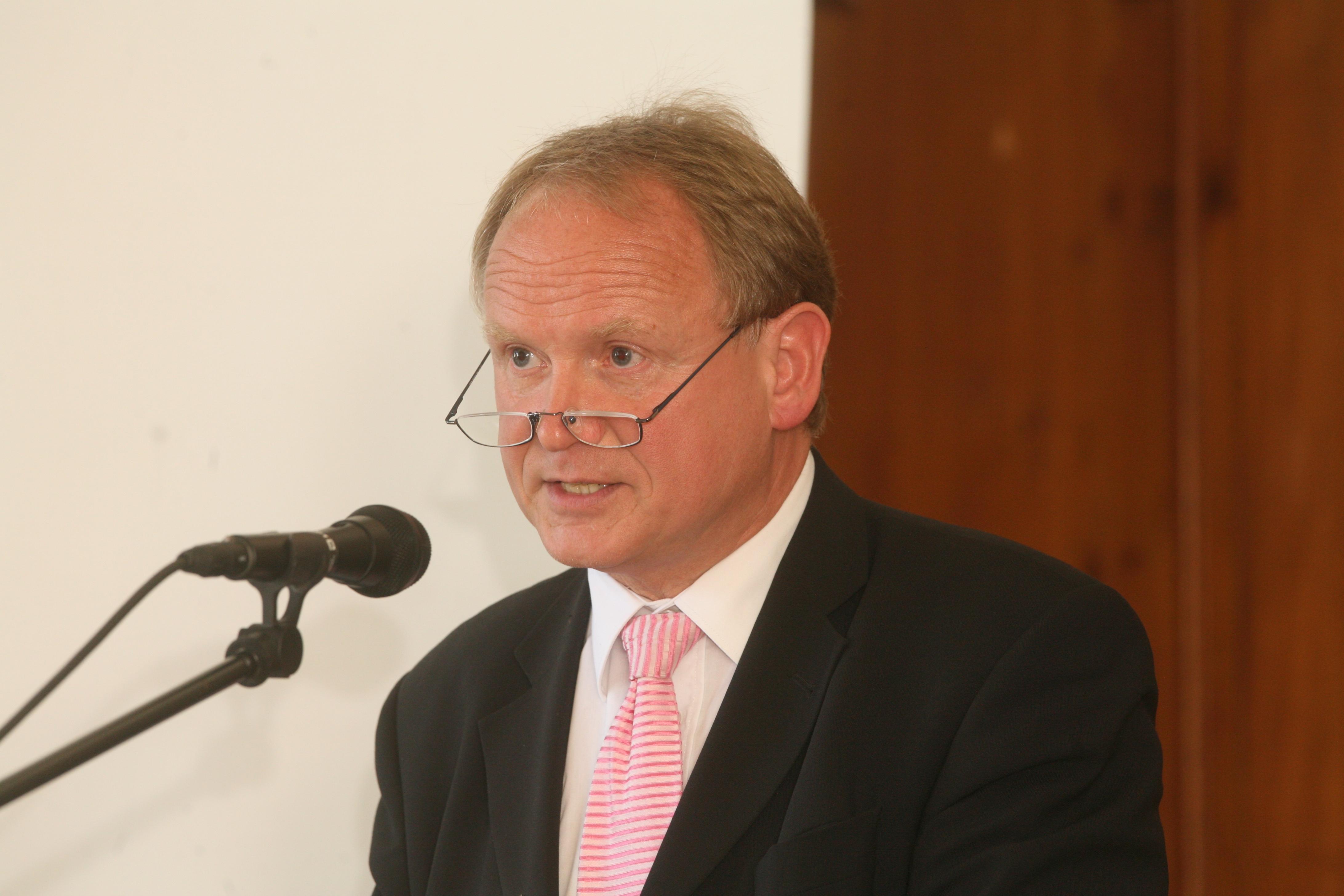 In our IF Forum EXTRA of Wednesday, January, 25th, 2012, we will get the chance to see and hear a very special presentation. Klaus-Jürgen Grün is our guest. He will talk about the
The Art of Thinking Negative!
Many already look forward to this event. Our big lecture hall in the seminar zone of the InterFace AG building at Unterhaching well certainly be very (perhaps too?) full. But so what? Because
we will broadcast the entire event live into the internet!
An internet presentation is most fun if you see it in a group. That makes it possible for you to discuss it at your heart’s content afterwards – maybe even until next morning.
So here is a piece of advice for our listeners on the internet:
Get some beer or red wine – dependent on what sorts of guests you invite – and store it in your cellar! Also get a cold “Bavarian Snack” or “Leberkäs”. If you can, get pickles. And not to forget the “Emmentaler” or the “Obatzten”, thee Brezen and the traditional farmer’s bread (and the sour herring for breakfast?). Put up a large screen and then invite as many guests as you can!
Shortly after 6 p.m. the “party” will begin. You can see the video stream of the entire presentation under http://www.ustream.tv/channel/IF-Forum. It is basically as easy to get it as most things on the internet. All you have to do is move your browser to the aforementioned web address and after less than ten seconds loading time, you will see the video image.
You can easily test of the video stream works on your browser. Just click onto the aforementioned URL. If you see the video player on the left side, you will be able to watch the broadcast.
If not, you should make sure that a current flash player is installed as a plugin on your browser. Read here (http://get.adobe.com/de/flashplayer) how you can install it. If the video stream is “noisy” or occasionally interrupted, that is probably due to the band width of your internet. We recommend a downstream bandwidth minimum 500 kbps. For more help and information, click here.
You were not able to see the live stream or want to see the presentation a second time? No problem: we will record it and make it publicly available. Details on this will, naturally, again be available on our “Corporate Blog” IF-Open.
I already look forward to having a huge internet audience.
RMD
(Translated by EG)
Roland DürreWednesday January 18th, 2012
Entrepreneur’s Diary #65 What Exactly Is – Project Management? (An Attempt at Definition-I)
In my last entrepreneur’s diary, I gave you a few citations from the article
Project Have a Detrimental Effect on Your Enterprise!
by Jens Hoffmann in 23actions.com.
On me, the article had an electrifying effect. Does project management still do justice to a modern understanding of enterprises and society – and to our concept of humanity?
Perhaps the “New World“ currently rising over the horizon needs totally different organizational patterns? With no projects and therefore no project managers, but instead an agile transformation of the entire enterprise?
Maybe we will have to solve all our problems together if we want to survive together?
If I am confronted with such difficult questions, the first thing I do is try to understand the terminology of the discussion.
As usual, I start with wikipedia. What is Project Management? Here is what I find:
Project management is the discipline of planning, organizing, securing, and managing resources to achieve specific goals (Projekten).
Well, I can see that this does not really help. Planning, organizing, securing and manageing. That does not sound too bad. But what is being planned, secured and managed? A project! In that case, it must be an entity that can be subjected to planning organizing and managing.
Now I know: everything that can be planned, secured, organized and managed is a project! Is that a definition which would convince you? For me, it is not much help. So I continue reading in wikipedia. It says:
Roland DürreMonday December 5th, 2011
Video of the IF Forum “Nano Technology –The Future of IT”
Here it is, the video of the fantastic presentation by Walter Riess at the IF Forum of November, 18th, 2011 in our Unterhaching office building.
“Nano Technology – The Future of IT”
Dear Walter – once more many, many thanks!
RMD
(Translated by EG)
Roland DürreWednesday November 23rd, 2011
Report: IF Forum “Nano Technology – The Future of IT”, Presented by Dr. Habil. Walter Riess
Our colleague Bernhard Maischberger wrote a report about the presentation given by Walter Riess at the last IF Forum in our series “Humans&Knowledge/Science”:
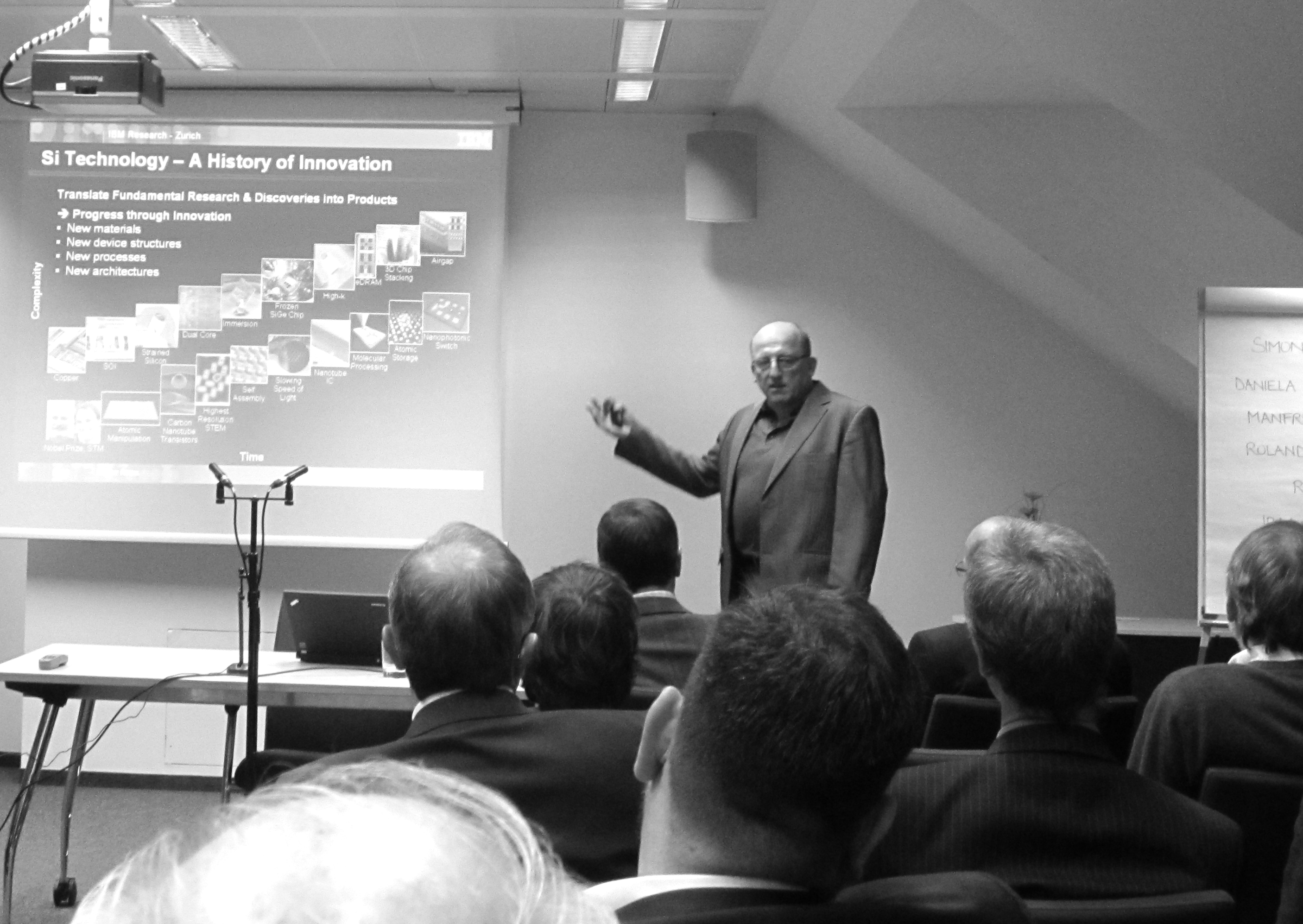 The last presentation of the 2011 IF Forum series promised to be very interesting and informative. After all, Herr Dr. Riess, a scientist from the forefront at IBM Research was our guest.
And, indeed, only a small part of all the flood of information and connections we were given can be dealt with in one article.
The first definition was:
What is Nano Technology?
Everything in the range between 1 – 100 nm!
This definition gives us the range we move in.
For your orientation:
A human hair with its cross-section dimension of 60,000 nm is already way beyond. At the top, we are talking of “only“ a few (to be precise, around five) C atoms “in a row“.
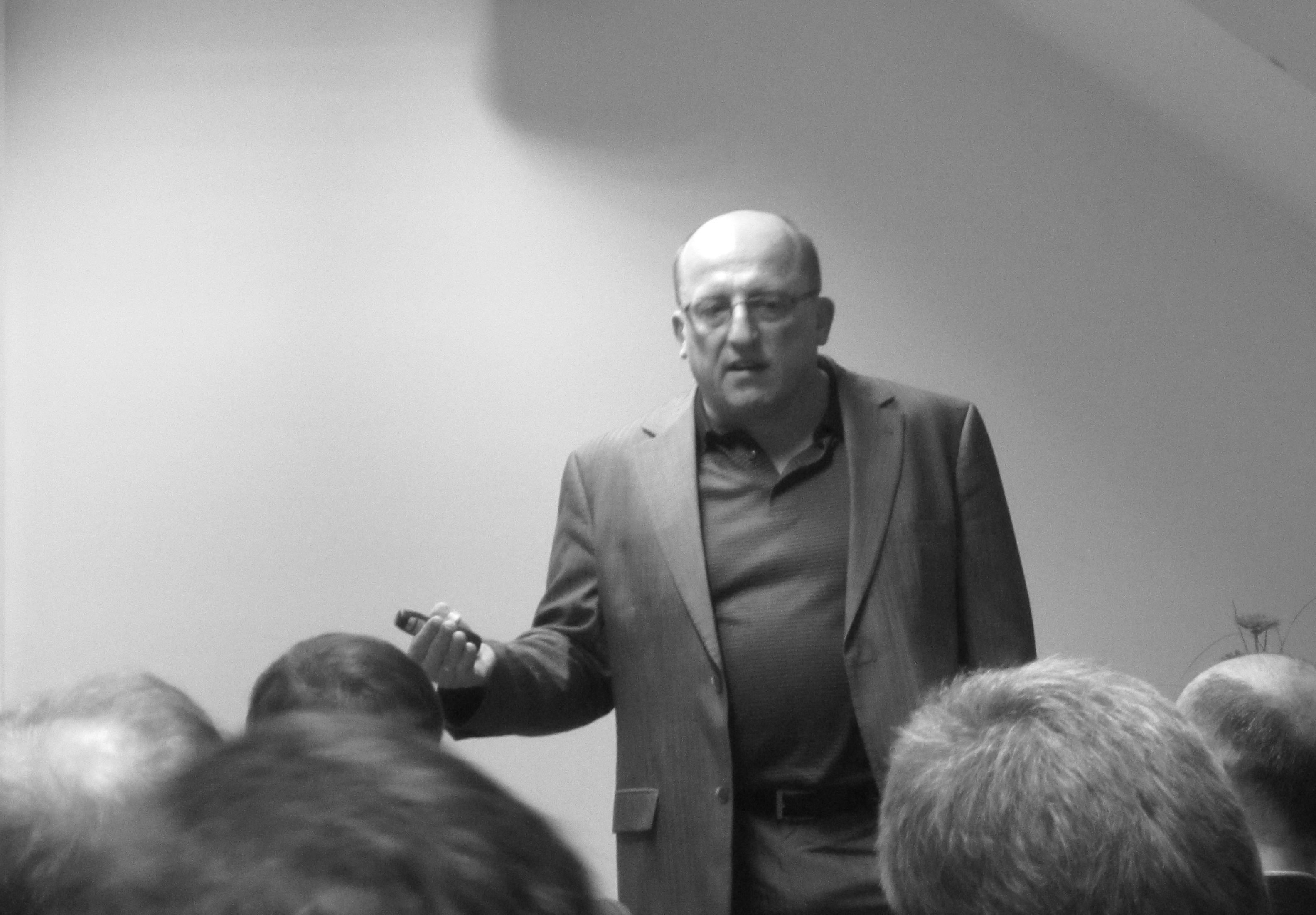 Nano Technology according to this definition has been around since about 1980 in IT, or rather in chip technology, which basically is what the presention was about.
The main issue of Nano Technology is that, due to the smallness of the considered structures, there are very special physical phenomena.
As a similar example in nature, you can see the much-cited lotus effect, where – due to the microscopically very uneven (= large) plant surface nothing will stick to it.
Today, this “technology” is also used for coating roof tiles or other materials. Or consider the “colouring“ of a butterfly wing. Basically, it has no colour. Only the refraction effect makes it shimmer breathtakingly “colourful“.
Back to technology:
Roland DürreWednesday November 16th, 2011
The Future and Waste
In the German alphabet, the words Future (Zukunft) and Waste (Verschwendung) are at the end. I wonder if that is the reason why nobody really seems to be willing to deal with those topics?
Personally, I am convinced that the future is important. And that the planet earth – which currently is our only future – is massively in danger. And that things might happen pretty fast. And that we therefore must start immediately and stop the destruction of our planet. We have to limit the climate catastrohpe, along with other damage that has nothing to do with the climate, and try to repair what harm has already been done. It is a question of reason and morality.
We have to reduce energy production through burning fossile raw materials to ZERO. I am sure we will need modern technology to achieve this. Without it, there is absolutely no chance. That is why I am in favour of wind energy, desertec and the like.
But I am just as certain that this alone will not be enough. Perhaps we have to stop the gigantic waste of resources that happens on a daily basis at all levels. Above all, it means that we will have to forego a lot. If we do nothing, we will be forced to forego very much. The process might be less painfull if we are prepared to change what is habitually going on in our society. Regardless of the fact that it is already 5 past 12, instead of 5 to 12!
Our social interactions, the way we keep house and enjoy ourselves, our basic assumptions and values: everything must be subjected to radical reform. A change in our lives that sounds unbelievable will be necessary. Yet this change can lead us towards a future that is quite lovable. To be sure, everything will be quite different from what we are used to now. There will be many seemingly grave constraints, but they need not necessarily be bad. In fact, they might even make us a little happier and more content.
Consequently, I will now start a new series – similar to “What Annoys Me“. In an unforced way, I will give examples of waste that is totally senseless and that is really painful for me to witness.
RMD
(Translated by EG)


