
Roland DürreSaturday July 6th, 2013
2nd IF FORUM 2013: “Jean Paul & Hypertext”
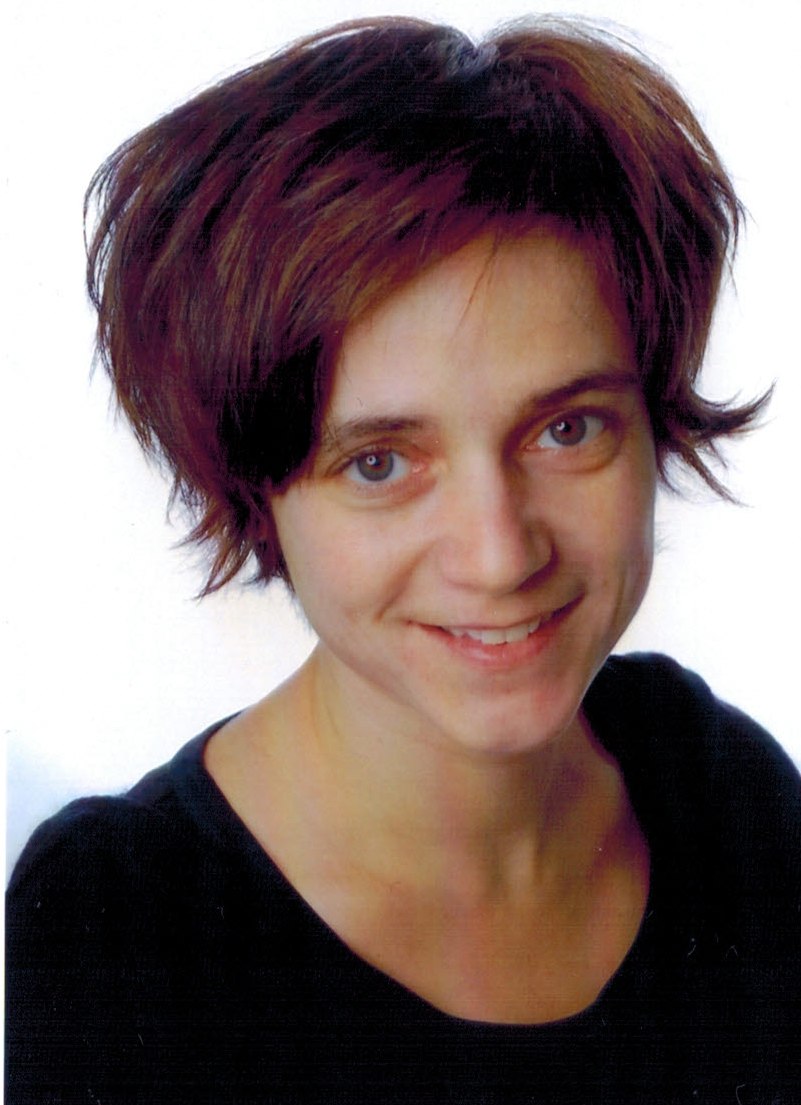 Frau Dr. Annina KlappertFrau Dr. Annina Klappert
is our speaker at the second IF Forum of 2013. She will tell us about:
Jean Paul and Hypertext
On July, 11th, 2013, she will give an entire IF Forum presentation at our Unterhaching InterFace building.
Here is a short outline:
During the 20ieth century, the data volume kept increasing – and along with it the problem of data access.
Well, considering when he lived, Jean Paul actually was quite a “professional” when it came to collecting data. Also, he was already confronted with the same problems, though on his own scale. Using his special excerpt technology, he not only collected knowledge, but also linked it in an intelligent way.
So we can actually ask today as Jean Paul asked then: how can data be stored and linked?
And how can we acquire new knowledge from those data?
A short glimpse at the aesthetics of Jean Paul can show us his concept of wit and also teach us possible linking technologies. On the whole, the method of writing as theoretically overloaded in Jean Paul’s ‘pre-school of aesthetics’ and practiced in his poetic works can show us why today’s hypertext systems are so helpful, how they function in their structuring of knowledge and what are their challenges.
About the speaker:
Frau Dr. Annina Klappert wrote her dissertational thesis at Bonn University on: “Die Perspektiven von Link und Lücke. Sichtweisen auf Jean Pauls Texte und Hypertexte” – The Perspectives of Link and Gap. Views on Jean Paul’s Texts and Hypertexts. Between 1999 and 2004, she worked at the Köln Forschungskolleg SFB/FK 427 “Medien und kulturelle Kommunikation”.
Frau Klappert is currently an employee at the chair of General and Comparative Literature at Erfurt University. Her interests and special fields of research are: virtual theories, hypertext theories, slip boxes as knowledge technology and digital practice, as well as modern literature.
Registration:
The If Forum will take place at our Unterhaching headquarter building in the seminar zone on the top floor. We start at 18.00 hours. We look forward to welcoming our guests! As always, you can register for the IF Forum by sending an E-Mail.
Here is an overview of the three “Jean Paul presentations” of the year 2013.
A Visit to the Present
Jean Paul presentations at the IF Forum
In 2013, our IF Forum will be about how modern Jean Paul’s topics and ideas actually are.
With presentations on entrepreneurship, hypertext, wit and new media, we want to project new perspectives and questions to the Here and Now. Why don’t you join us?
Jean Paul the entrepreneur
Jean Paul was one of the first German authors who actually made a living out of his writing. Mind you, he did so regardless of a start under very difficult circumstances. He visited the intellectual centres of his time: Leipzig, Weimar, Berlin – and his books were a success to make Goethe envious. When Jean Paul married, even the Prussian Queen invited him for tea and gave him a silver tea set.
Jean Paul did not owe his ascent and success to accident, but to careful planning with entrepreneurial instinct. Even when times turned bad and the Napoleonic wars devastated half of Europe, he still was able to maintain his position. The way Jean Paul combined success and sustainability looks still remarkably modern today. .
Our speaker Bernhard Echte, scientific literature expert, exhibition organizer and publicist, worked many years as director of the Zürich Robert Walser archive. Today, the entrepreneur has his own publishing company: “Nimbus, Kunst und Bücher”.
The presentation will be on: April, 11th, 2013 (Thursday) | Starting at: 18.00 Hours | At InterFace AG, Unterhaching
Jean Paul and Hypertext
Even before he called himself Jean Paul, young Johann Richter read everything he could lay hands on: hardly any of the books actually belonged to him. Whatever he read, he excerpted in notebooks. In those same notebooks, he also commented ideas currently coursing through his head. Jean Paul added catch phrases to his entries, now called tags. In this way, he created a huge private encyclopedia. It was structured like a modern database and was the foundation of his literary work. Only through his database, Jean Paul was able to realize his unique style. A style that is at the same time erratic and precise. He managed to turn the financial misery of his youth into a virtue the result of which surprises us to this day.
Our speaker Annina Klappert, is a scientist at the seminar for General and Comparative Literature at Erfurt University. Her dissertational thesis is a structural comparison of Jean Paul’s texts and hypertexts. Her scientific research is mainly concerned with media, references and virtual reality.
The presentation will be on: July, 11th, 2013 (Thursday) | Starting at: 18.00 Hours | At InterFace AG, Unterhaching
Jean Paul, wit, post-modernism and the new media
He was a “God-Denier” and an “intellectual disintegrator”, a fervent cosmopolitan, sceptic and joker. His educational theory “Levana” is highly praised, since it advertises wit and irony against the strict no-nonsense attitude of Fichte’s oratory as the basis of a healthy personality. In his policy of “the third person between Germandom and Bonapartism”, you can anticipate the post-modern indecision between the opposing poles of “the truth”. With his aesthetics of straying, he already uses the interruptive and jumpy hypertext aesthetics of the internet. Who was this man who hardly ever left home and still intellectually and mentally was way ahead of his contemporaries?
Our speaker Roberto Simanowski is professor for media sciences at Basel University. He is concerned with the changes in writing caused by the digital era and publishes the online journal dichtung-digital – journal for digital aesthetics.
The presentation will be on November, 7th, 2013 (Thursday) | Starting at 18.00 Hours | At InterFace AG, Unterhaching
RMD
(Translated by EG)
Roland DürreSunday May 5th, 2013
brand eins in May
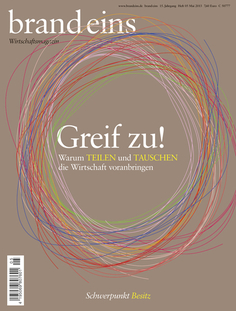 On time for the first day of the Month of Delight, the May “brand eins” edition was delivered. But it took until Saturday, when I sat in the train EC 391 back from the PC camp 2013 (tag not only in twitter: #pmcamp13str) until I was first able to take a closer look at it. After all, life is hard for a PM.
Incidentally, after what I experienced in Stuttgart, I now see PM as an abbreviation for “People Manager”. This is definitely a better term for the job that was still called project manager a short time ago.
And to me, this “brand eins” seems as dignified as my thoughts. It looks totally golden. Along with a multi-coloured, ellipse-like line design. At first sight, I almost could have taken it for a “Haute Couture” magazine. Or at least for a magazine that represents the upper-class high society life style.
But be not afraid: the title alone makes it “cool”:
Seize the Day!
The sub-title is:
Why SHARING and SWAPPING will promote business.
Of course, this is exactly how I feel. Once again, they hit on my favourite topics! And it gets even better: Frau Fischer gives her editorial the simple heading:
A New Dimension!
(
The exclamation mark is from me)
She actually admits in the editorial:
“that she found all the fuss they used to make about sharing economy rather annoying.…”
And then she continues to say:
“The Sharing Economy might well be a fashionable concept – but the development behind it has a rather huge dimension”.
Well, I am delighted. Isn’t this fantastic news? And it gets even better – in the closing line of her editorial, she even calls the predictions made at the turning of the millennia by Jeremy Rifkin “a hopeful utopia“. Which is again something that confirms my own personal opinion.
Consequently, I undertake a “small research trip” into the inner pages of the magazine. And I notice that it is about quite a few sectors and continents. It includes many multi-facetted and diverse articles.
There is “looking for oneself” (on Siemens, page 22), “ownership will become virtual” (small IT story, page 92), “the bank in the palm of your hand” (a future without banks, page 96) and much more. And in particular, the entire focal point – absolutely magnificent in my opinion!
I will not tell you more – instead, I recommend that you, too, go on a trip equipped with the May “brand eins” copy.
RMD
(Translated by EG)
Roland DürreFriday December 28th, 2012
It Could Have Come Straight From My Heart!
Again and again, I read wise books. There are many of them, and new ones appear all the time. And more often than not, I close them and put them away after only having read a few pages or chapters. Regardless of the fact that they actually sound quite interesting. Basically, it is because it always seems to me that they are not saying anything that is news to me.
Whenever I attend conferences, congresses or conservatively structured scientific events where knowledge is presented to me by way of speeches from the pulpit, I often get this uneasy feeling.
If then as terms like success, ethics, leadership, morals, planning, strategy, entrepreneurial culture, values, goals and goal-agreements, future,… become part of the presentation delivered with a huge amount of self-righteousness, I often wonder at all the things people know or profess to know. And then my stomach starts rumbling. Despite the fact that I, too, like talking about these topics. But I do it in the full knowledge that I, do not know the answers, either. Consequently I talk about these things because I want to motivate people to think about them. You could say I want to question other people’s – and my own – certainties.
Then I meet people who want to “profile” everyone and put everything, no matter if it is alive or dead, into “Balanced Scorecards”. And they speak about the “Human Capital” of an enterprise or a community. That gives me pause.
And whenever I sit in a circle with people who want to make all the difference, who approach the topic in a terribly modern and strategic way, who formulate huge goals, who dance from one utopian idea to the next and where “a mountain is in labor but all you get in the end is a small mouse” (“der Berg kreisst …”), then I feel really poorly. Those are the times when I think I really could have made better use of my precious time.
One evening, I was, again, discussing one of these topics from the world of economics with a very cherished female friend via email. Here is her reply:
… when all is said and done, we also miss the link to craftsmanship, apprenticeship, making, experimenting, piloting (this is where I see my personal interest), because basically economics are always some sort of mental game based on hypotheses, rather than a creative approach towards re-structuring the world. …
And suddenly I feel great. This is exactly what I want! So there are actually some people who are not only highly esteemed by me but also can spontaneously formulate well and in a concise way what I feel. Many thanks to my friend – whose name I will intentionally withhold.
To make up for it, I look forward to the next BarCamp – such as for instance the PM Camp. Because this is where you talk about your problems and ideas in a truly sincere way, where you exchange experiences and underlying ideas, share knowledge on a market place and acquire knowledge from practical applications for practical applications.
RMD
(Translated by EG)
Roland DürreTuesday November 20th, 2012
Data Security and Industrial Espionage …
When discussing data protection and security, you often hear the term “industrial espionage”. Federal agencies or our oh-so-important business associations keep warning us:
Over the last few years, industrial espionage increased dramatically!
And, of course, the focus of said espionage is on German enterprises and their know-how.
The same sentences can also be read in a survey done by “CORPORATE TRUST – Business Risk & Crisis Management GmbH”.
You can access it through the following link . It is rather worth reading, especially with respect to how you can make people fearful?
You will find the warning that “cyber war has become reality a long time ago” and that it “has arrived in the middle of our society”. Neither can the “computer worm Stuxnet“ be ignored. After all, it was “probably developed especially in order to sabotage the control mechanism Simatic S7 – which controlled the frequency converter of the motors in Iranian nuclear programs.”
(Note the word “probably”).
To be sure, the exact goals of the customers were unknown, but the complexity of the attack shows that we went from an era of script kiddies and crackers towards a new dimension of danger – etc.
 Mind you, these are all original sentences taken from the study. The very choice of words in its martial character already makes me sceptical.
Regardless of this, I take the subject of data theft a lot more seriously than, for example, the fear of personal data being abused. I also believe that “stolen” data will help you to reach your goal faster than having to develop “something new”.
I have a vivid memory of a project we did a little less than 30 years ago. We were asked to develop something totally new. Except that we did not have the slightest idea how the “new” could be done. In those days, studying the sources the competition used was quite helpful. And to this day, I do not know if we made use of said sources legally or, maybe, in a certain shady area.
Still, I do not think industrial espionage is quite as menacing as it is projected – and not only in the internet. One of the reasons I give for this is that these fear-inspiring studies originate with firms which want to sell special counter-espionage services and products. And, of course, federal agencies and business associations are quite ready to chase the pig through the village. After all, there is nothing else they are busy with. What a nice idea to employ James Bond! Isn’t it a beautiful shiver you feel whenever you hear how evil the world is and how you yourself are absolutely powerless?
But let us remember what it used to be like!
 When I worked for Siemens, we were absolutely prohibited to take any secret documents with us when we left the building complex. And almost everything was secret. Consequently, there was a random generator at the portal. Occasionally, it lit up. When it did so, you had to open your briefcase and show what was inside. It went without saying that taking pictures on the factory premises was not allowed.
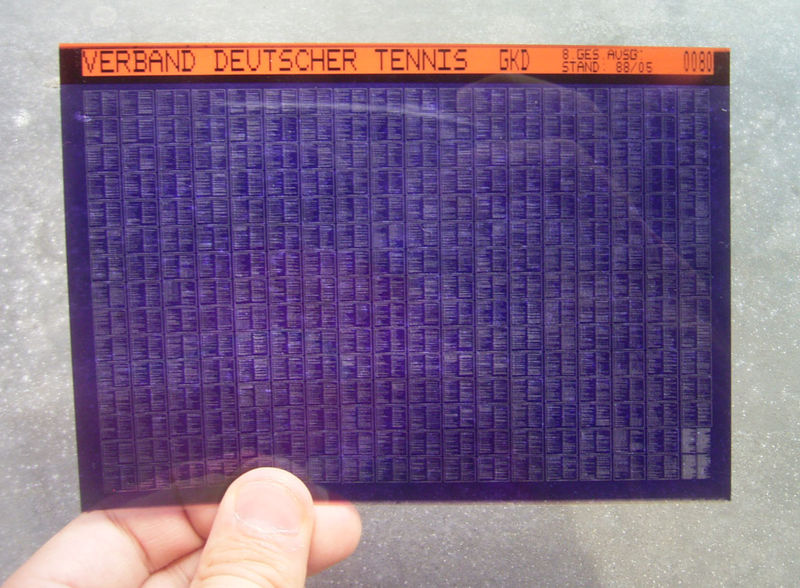
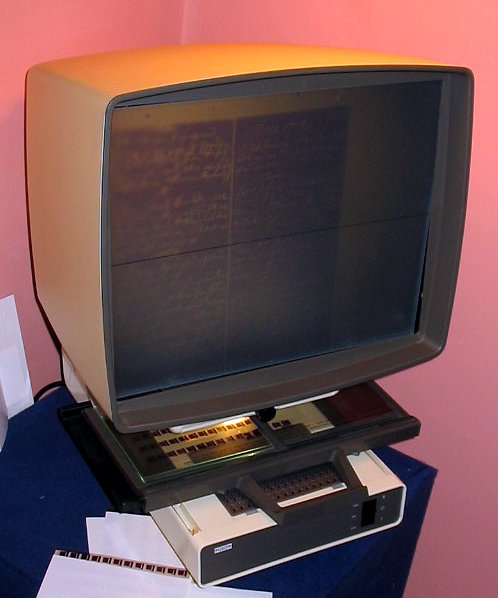
Those were also the times when we used those blue “Micro-Fiche-Films”, along with the reading devices that went with them. Micro-Fiche, or rather microform is the first technology I know which you could use for storing many data on little material. For us, it was usually sources of complete operating systems that were stored on a small square of film so we could carry it around with us in our briefcases.
Of course, it was not realistic that the secret papers were never leaving the factory premises. For one thing, our firm was quite distributed. Some data were needed when you went to see a customer. And once in a while, you also wanted to do some work at home. Consequently, we had permission papers. If you had this paper, you were permitted to take any secret paper you needed. The higher echelons – I do not remember up from which AB or GB level you qualified – were also permitted to take secret documents without the permission paper. I also do not remember if AB truly was short for “departmentally authorized“ and GB for “generally authorized“.
But then what a strange (and totally stupid) kind of firewall was that? It was certainly no more secure than the modern firewalls offered by IT?
Incidentally, the first two colleagues from the former GDR we employed directly after the re-unification confirmed this opinion. They came directly from Robotron Dresden. And they told us that, naturally, at Robotron, they always had the latest plans of the Siemens chip developers on their desks the moment they were made. Except they were not able to put them to any use. The necessary raw material (purest Silicium) could not be obtained in the GDR. Neither did they have the necessary tools to even produce the prototypes.
To be sure, I do not know if our ex-GDR engineers were just after spinning us a good yarn, but I can easily imagine that this is actually how it happened. Basically, I believe data will always end up where they should not be. But mostly it makes not the slightest difference, even if, perhaps, you get quite annoyed, and justly so.
But I also believe the methods changed. And the new methods are a lot more efficient, even though they have nothing at all to do with IT. Let us take a look a China, where, allegedly, the enterprises want to spy on Western firms. Do they really need to do that? Or are there, perhaps, far easier methods?
Here is what you can read in “invest in Bavaria” at “China in Bayern”
Currently, more than 130 Chinese enterprises, for instance Huawei Technologies, Pearl River Piano, ZTE, Yingli Solar, ET Solar and a little under 11,000 Chinese citizens reside in Bavaria. About a third of them live around Munich. Approximately 3,000 Chinese students at Bavarian universities further attest to how attractive the Bavarian universities are.
I also know that there are Chinese branches in the “regions with weak infra-structure“ in Bavaria that have such lovely scenery. Those Chinese branches specialize on R&D (research and development). Actually, these enterprises are quite heavily subsidized by the Bavarian authorities – and accordingly, their moving here is celebrated quite bombastically. Because, as a general rule, F&E is a clean sector. It does not damage the environment and attracts intelligent engineers.
And what is the first thing a Chinese F&E enterprise will do? No question! They lure away the German engineers formerly employed by their German competition. And the best ones at that! Those with exactly the kind of know-how most urgently needed in China. And the German engineers are happy to come. They are quite attracted to live cheaply in a nice place, do some F&E in a modern laboratory and mostly even be paid better than before. This is how the Chinese can choose from the best persons with the right knowledge. Now isn’t that a lot more efficient than having to crack networks and servers?
Neither can I find any fault with it. After all, we live in a globalized world and I rather like the Chinese with their friendliness and tasty cuisine… And I seem to remember “knowledge is the only raw material that grows as you share it“!
After all these ideas, I read the aforementioned “study” with totally different eyes. “Installing fear“, is, after all, a very successful marketing strategy…
RMD
(Translated by EG)
P.S.
I took the pictures from the central media archive Wikimedia Commons. They were taken by Nichtich and Tomasz Sienicki [user: tsca, mail: tomasz.sienicki at gmail.com]
Roland DürreSunday November 11th, 2012
VDE, VDI, GI, GChACM, GPM, GfWM, BITKOM …
The Dornbirn PM Camp made me thoughtful in various ways. For instance, I remembered something I experienced early in November.
Felix Köbler, a young and highly motivated computer scientist who is also doing research but will probably soon “take the plunge and become an entrepreneur“, gave a presentation for the VDE (Electrical Engineering Association) on “Crowd Sourcing”. It was a well-advertised contribution on an exciting future-oriented topic.
The presentation was held at TUM. I was interested in watching the presentation for various reasons and consequently rode my bike to the old and dignified TU building at Arcisstrasse 21 on the evening of November, 5th.
It was a truly great presentation. He gave a very nice description of the diverse and substantial potential for change by future tools, applications, as well as interface and user strategies. Consequences on the social level were described using an example, before the potential for the use of modern technologies offered by Web 2.0 was outlined. And he also told the audience all the things you can do with “Apps” and “Gamification” using “Mobility and Cloud Applications”.
So here is the bad news: there was hardly an audience! I knew most of them personally and therefore could safely assume that they mostly came because they wanted to hear the speaker. Those few among the audience who had come on the instigation of the VDE university section were few and far between. Moreover, this (small) group of visitors were rather over the top in terms of demographic development.
Mind you, this is Munich. We are not precisely talking the smallest German city, are we? Besides, Munich very much wants to be High-Tech oriented. Considering this, the attendance was rather a disappointment.
In Munich, you can also find many great things. Young engineers and entrepreneurs of the IT sector actually like coming to Munich. For instance, a short time ago there was a Barcamp for “Games”. Allegedly, it went quite well and a surprisingly high number of (happy) visitors were there.
Which means that the lack of enthusiasm for the presentation was not due to the fact that our “global” Munich has now suddenly turned bourgeois and saturated. The real reason is that the associations that at one time were so great and strong get less and less accepted in the age of the web.
Yesterday, at our Dornbirn PM Camp 2012, I met a “true” engineer. He told me he still held a membership at the VDI (Association of German Engineers). A short time ago, they sent him a letter offering the badge of honour for his 25 years of membership. So he decided it was about time to attend one of the VDI events. He returned with the feeling “never again – this is not what I can identify with”.
To be sure, associations like the VDE and VDI have attractive websites. They look quite nice. Nevertheless, these associations are on a downward spiral. One indicator is the high average age. The events have a low attendance and the publications are rather dry. The members are usually passive and only remain members because they are so used to it or because they are sentimental about it – after all, the “good old times” want to be remembered.
But then, this is something we (older) computer scientists know quite well from our associations: GI and GChACM. Those, too, can make as many efforts as they want. They are on the downward spiral. And whenever I ask my young students, they either do not even know what the GI is, or else raise their eyebrows. Neither does anybody read the GI Informatik Spektrum. Even if they try to artificially improve it by using strange posters that show persons like Steve Jobs.
Apparently, Steve is a great German computer scientist.
Basically, all that remains to be asked is which way the new associations will go, since they are dealing with current topics such as knowledge or project management. The GfWM (Society for Knowledge Management) or the GPM (German Association for Project Management), for instance, are absolutely “in” at this time. The GPM even managed to install itself as a “standardising and normative institution for project management”. Thanks to its certifying power, it seems to have an almost market-dominating position.
Incidentally, I believe that this, too, will not last long. They will get the funny stuff for a few more years, and then the downfall will come, along with the slow process of misery. Just like the other associations have already experienced it.
I only hope those associations the only purpose of which is lobbyism will meet the same destiny.
For us computer scientists, there is, for example the BITKOM (Federal Association for Information Business, Tele-Communications and New Media, e.V.). Just look at the term “Information Business”. Nomen est Omen. BITKOM is “our” lobbyist. Above all, they want to promote the IKT (Information and Communication Technology). In other words, they want to convince the politicians to spend a lot of money on IT infra-structure. However, to me it seems that BITKOM is not particularly successful. Just compare it with the nuclear and airplane industry in former times.
Even though Bitkom calls itself “The One And Only Hightech Association“, we do not really need them.
RMD
(Translated by EG)
P.S.
If you are among those who are looking for alternatives, here is some advice.
P.S.
The first is a Barcamp, Open Space or some such. Having the right kinds of seminar rooms is a necessary requirement. One of my next articles will be about seminar rooms and rooms in general.
Roland DürreWednesday October 31st, 2012
Why So Many Conferences and So Many Presentations Are No Good!
A short time ago, some of my friends attended a forum conference on project management. Their reports when they came back were not too enthusiastic. Occasionally, there was a keynote that really made a good impression on the listener. Some streams, too, obviously were high enough quality. But all in all, most of the presentations had been rather a disappointment – dominated by insignificance, lack of practical applicability, self-importance and adverts. Besides, many presentations were rhetorically deficient and often just manuscripts read aloud.
This is no exception from the rule. Especially with expensive conferences that have a very good reputation, I have started noticing quite some time ago that the quality of the presentations deteriorates. Consequently, I only attend these kinds of events if I absolutely have to. Basically, this is regrettable, because it is really important to attend conferences and meet others. You want to contact people, make friends with them and communicate with them. However, they are also time-consuming. And who, nowadays, is keen on wasting two or three days in a row if the result is less than satisfactory?
I have an explanation for this doubtlessly existing phenomenon of poor presentations at conventional conferences. As I see it, one of the reasons is how the presentations are selected.
At regular intervals, I receive “calls for papers”, often quite personal ones. Many of these events actually have titles that I find rather interesting: business, leadership, management, projects, change, innovation, agile methods. Actually, I could even well imagine myself contributing with an interesting presentation once in a while. But in order to be on the list of speakers, I would have to hand in a paper. A paper in which I would have to make up my mind what to talk about half a year in advance.
To be perfectly honest, I find this a little too stupid and time-consuming. Even the extra motivation of being permitted to attend the conference without having to pay for it does not make a difference. Just like, basically, I do not have two days at my disposal for listening to more or less unattractive presentations.
Besides, I have enough invitations to speak at all sorts of events and institutions. That is more than satisfactory for me. If a group who asked me for a presentation is to my liking and I have time, I agree to speak for them. If it is a university and/or non-profit or “modern” forum, my presentation is always “for free”. I consider itt part of the policy “sharing knowledge”.
My friends and the good speakers I know follow the same principle. None of them needs to hand in a paper, just in order to present themselves at a conference or in order to advertise his or her enterprise. If the event is for a good purpose, they talk for free or ask for a donation for some charitable organization (I mostly choose AI). Or else, they demand a honorarum, sometimes even as high as Mr. Steinbrück.
So what kinds of people do typically hand in their work following a “call for papers“? I often find people working at the university who wish to see their work being noticed outside their direct sphere, employees of firms who want to improve their marketing. Their maxim is: the boss said “Mayer, why don’t you give presentations at conferences A, B and C?“. Sometimes you also find people who are fanatically in the grip of a topic. Or super theoretical persons who want to spread their personal theory like a Messiah. Mostly, however, you will find persons who I am sure do a good job, but basically want to earn their merits, because by improving their reputation, they hope to gain professional standing. Which is definitely not reprehensible.
Since there is usually a limited number of papers submitted, all those who have sent a paper will actually be permitted to speak. After all, the organizers will be happy to have names to put into the stream slots. If there are more papers than slots, we have the next problem. As a general rule, the selection follows the paper situation. There is no correlation between the formal quality of a paper and the competence of the speaker. Consequently, it is quite possible that even the good speakers will fail to qualify.
I can imagine solutions to this problem. For example, the committee might want to see a presentation? If this is too much ado, you could send a recorded video tape. Or, even better, a link to Youtube. To be sure, you will not have the live-effect, but at least you get a pretty good idea. It would be even better if the committee were to meet the presenters personally. They might arrange to talk about the presentation and thus be able to get a rounded picture of everything.
Here is a very pragmatic and perhaps innovative idea of mine: invite many people to attend a conference, look at all the registrations with a big team and ask those participants you know personally, directly or indirectly to give a presentation. Of course, this causes a hen-egg problem, because the attendants must be convinced it will be a super conference and the right kinds of people will attend.
But even this will not make a difference about one fact: those who actively take pains to give a presentation are usually not the good ones. The good speakers are those who are asked to speak all the time, anyway. This impression of mine got confirmed when I attended the GSA (German Speaker Association) competition. At regular intervals, the GSA does some sort of “Germany is looking for the super model“ for speakers. If you are a member or wish to become one, you can introduce yourself with a presentation. Most of the applicants are “professional speakers” who (want to) make a living as speakers or trainers. The appallingly low standards shocked me. Most of the “professional speakers” I saw could not hold a torch to the people I know from Barcamps or Jam-Sessions.
No, the good speakers are definitely those who get asked to speak, they never have to apply. Or else, they sit among us silently, just concentrating on their competence. So the trick is to find them! Or they spend a weekend at a Barcamp where they exchange knowledge. Conferences are actually the only places where you usually will not find them.
My closing remarks in this article are to advertise our PM-Camp at Dornbirn between November, 8th and 10th. (Unfortunately, it is already almost completely full).
RMD
(Translated by EG)
Roland DürreTuesday October 16th, 2012
Video: Dr. Marcus Raitner at the IF Forum “Project Coaching”
After the introductory presentation by Dr. Stefan Hagen at our technological IF Forum, Dr. Marcus Raitner (Esc Solutions) saw to the second part of the first section. It was quite exciting and very impressive to watch how the arguments and explanations of the two speakers complemented each other. The presentation by Dr. Marcus Raitner, too, is now available on Youtube.
The Third Technological IF Forum is about “Project Coaching“, which included “Best of PM-Camp“.
I would also like to, again, thank Marcus very much for his presentation. He contributed hugely towards our IF Forum becoming a success. Marcus is also the author of what is, in my opinion, the most beautiful blog for project management world-wide – misc.raitner.de.
RMD
(Translated by EG)
Roland DürreSaturday August 4th, 2012
We Are Informatics.
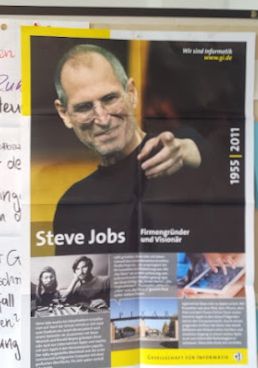 This poster in DIN A2 format was included in some of the GI Informatik Spektrum Volume 35/4 editions of August 2012.
Of course, the first thing I did was hang it on a Metaplan board in my office. Now I am eye-to-eye with Steve Jobs whenever I look up from my desk. And he always points toward me in a friendly manner as I sit at my big Apple Pro.
For all those of you who do not know it: the GI is the Gesellschaft für Informatik e.V.. Their slogan is “We Are Informatics“ and the Informatik Spektrum is the official organ of this association and their associated organizations.
I do not know what exactly the GI is. As I understand it, it is the association of German computer scientists. To me, its purpose is not conclusive. It does not seem to be an association of professionals or interests. Wanting to develop some social relevance, it still does not do any lobbying. Perhaps they see themselves more like an academic circle that wants to publish computer science topics and organize events on a regional and national level.
At least, the GI has the domain gi.de. That is doubtless some achievement, since two-letter domains were really hard to come by until recently.
Besides the GI, we also have the GChACM (German Chapter of the ACM) in Germany. That is the regional association of the big (American) ACM (Association for Computing Machinery) with the slogan Advancing Computing as Science & Profession. As it happens, the GChACM has the domain informatik.org.
In their charter, the German Chapter makes it their obligation to promote informatics by translating English articles into German.
Then there is the Bitkom – Federal Association of Information Business, Telecommunications and New Media e.V. It calls itself “Hightech Association” and is perhaps an interest association of enterprises of the IKT industry (IKT = information and communication association). Perhaps it is the lobbyist of informatics enterprises.
I do not know. But that is irrelevant. After all, I am skeptical as a matter of principle when it comes to associations, because I doubt that these institutions can still contribute significantly to either the well-being of their members or the general public.
But back to the poster:
Why does the GI now pay homage to Steve Jobs with a poster saying “We Are Informatics“? To be sure, Steve Jobs was a relevant person. Of course, he, too, had dark spots.
His first product was a device you could use in order to make free calls, because it created a signal that simulated the “service call“ at the telephone company Bell, thus making it possible to call for free. So you see: it was a device the use of which was definitely a crime. As a businessman, it was not a good joke to be working at Pixar at the time. And if you want to believe his biography, his first relationships with women were not something to be proud of, either. When all is said and done, Steve Job was only human, after all. You have to respect him and might either love or hate him.
But was he a computer scientist? And on top of this, was he one who actually fits the bill of the highly academic GI with its attempted social relevance and standards? Or is this poster just elegantly camouflaged advertising of a sponsor named Apple?
But I do not wish to foul-mouth the GI. After all, I am quite happy that the GI, a few decades ago, did not recognize the ideal moment and jump on the bandwagon of “certifications”. Because if they had done that, we would now have a GI that became really prosperous and powerful through standardizing and norming the numerous technologies of the IuK.
In this light, let us happily join in when they cheer: “We Are Informatics“! This is certainly better than the alternative: “We Certify Informatics”
RMD
(Translated EG)
Klaus HnilicaMonday July 16th, 2012
The Divine Particle – and Other Heavenly Problems
Absolutely impossible. There is no way this could be true!
I mean the news about the ’divine particle’ that, allegedly, has been found in Switzerland: in Switzerland of all places, which, after all, is paved with dirty money, they now say they found the ’divine particle’? Now this is hard to believe, isn’t it? …
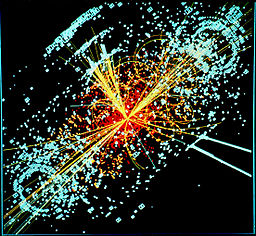 Well, let us just – purely hypothetically – assume that the ’Higgs – Boson’ they claim to have separated early in July at the CERN (the European Centre for Particle Physics) is actually the ’divine particle“ the media say it is. Would it not, according to the ’Susy-Rule’ – that is the super symmetry rule – at least as said ’Susy ’ is commonly understood and if all is above board (which, incidentally, can be expected when we are talking ’divine particles’ can’t it?) – be reasonable to expect an ’Higgs – Böson’, as well? The logical conclusion, of course, being that said ’Böson ’ can only be a ’satanic particle’! What else could it be? Such a ’Böson ’ can only come straight from hell!
And, naturally, the fact that said ’divine particle’ was found first in the Geneva ’Large Hadron Collider’ (LHC) – thus beating said ’satanic particle’’Böson’, – must also be considered a heavenly symbol! That is pretty clear, isn’t it? And with the exception of some communist or Islamic fundamentalist, nobody will be particularly surprised. After all, this expensive technological miracle, this LHC, can be found not in North Korea or in some Mosque in Iran, but in the middle of the Christian Occident, namely in Switzerland. Which, despite its neutrality and beneficial cornucopia of dirty money accounts, is a country still closely connected with the Christian – Jewish cultural area!
On the other hand, it is admittedly a little upsetting that this alleged ’divine particle“, according to the ’standard model theory’ , is perhaps the smallest of all the ‚Higgs – Bosons’ , which might be the reason why those guys at LHC found it before the hypothetical ’satanic particle’ , the ’Higgs – Böson’! And they probably paid no more for the necessary electricity than a ridiculous 16 million Euros! For a ’divine particle“, that is certainly a ridiculously small price. After all, a ’Ronaldo’ alone, who is only the ’eleventh part of Royalty’ costs easily ten times that much! You really have to come to terms with those facts, you know. Something is definitely a little rotten, isn’t it?
But it actually gets worse! What will happen if, perhaps in three or four months, perhaps at the price of 20 million Euros or more for electricity, suddenly one of those evil ’satanic particles’ will get stuck in the Atlas and CMS detectors of the LHC? Then what? Is something as unfathomable as this conceivable at all? Can it be permitted to happen at all inside our Christian-Occidental value system that a ’divine particle’ is less expensive than a ’satanic particle”? Would such a thing not make everything we ever believed in tumble down on us? And, mind you, on top of this we are talking something that was financed by our unsullied tax money?
Can we really allow this to happen – that after three years of modification that cost more than three billion Euros a machine that has a diameter of 27 kilometres found a Boson called ’Higgs’ after a hundred and fifty trillion proton collisions and for an electricity bill of a ridiculous 16 million Euros? I mean ’Higgs’ of all names – not ’Gottschalk’ or ’Benedikt’ or, well, even, God willing, ’Schavan’? There is no doubt that Germany, again, paid most for the ’Boson’, is there?
But no, they must name it ’Higgs’, this ’Boson’! Higgs – like you are burping in a state of alcoholic stupor! And this is what they call a ’divine particle’? No – absolutely not! Well, now that they fucked up the naming of this ’Boson’, all that is left for us to hope for is that, maybe, the CERN people will, by the time they will eventually find the ’satanic particle’ – with the ’Higgs – Böson’, they will delete the ’Higgs’ and instead put a nice satanic, German name before the ’Böson’? I could give them quite a list of candidates…
KH
(Translated by EG)
PS:
The wonderful picture was taken from Wikipedia!
Roland DürreFriday July 13th, 2012
IF Forum 2012 – Advance Notice – Wilfried Bommert – Catching Up On Good Soil!
By now, we have also agreed on the day for the 3rd 2012 IF Forum of our series “Living (and Surviving) Sustainably”.
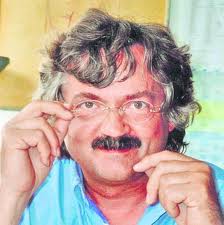 Herr Wilfried Bommert will speak on Tuesday, November, 13th, 2012.
His presentation will be about “How to Feed the World“. For a title, he selected:
Catching Up On Good Soil!
How we might avoid the world food crisis.
Here are a few preliminary ideas by Herrn Bommert:
Ever since 2008, the price for food world-wide only knows one direction: up. The global financial crisis and the dwindling oil reserves further push the price spiral up. Concerns selling energy, raw materials and money reach for the fields of the world. They buy or rent huge areas in Africa, Asia, Eastern Europe and South America, thereby again causing massive price increases for food. Consequently, we get famines, revolts in more and more countries that cause political instability and a collapse of world food affairs.
This vicious wheel would not turn if we did not actively contribute by our consumption habits. Our longing for biological fuel and our hunger for products from industrial farming, our money invested in farm and soil stock, they all support the global hunt for the fields of this world. It is up to us to put a stop to this mania currently prevalent in food and soil markets.
Dr. Wilfried Bommert has been working as a WDR journalist since 1979. He is head of the environmental sector at the WDR-radio station and also wrote the book: “Kein Brot für die Welt – Die Zukunft der Welternährung”, 352 pages on paper, first edition published on October, 5th, 2009 at Riemann Verlag (QUERDENKEN) .
RMD
(Translated by EG)


