
Roland DürreSunday October 16th, 2011
Turnover and Profit – or – Economy for Beginners
Due to the very complex structure of real enterprises, discussions concerning them often end in chaos. Instead of technical questions, you get dogmatic questions. Even the most basic relations get jumbled up into philosophical and almost bellicose disputes. Instead of added insight and more knowledge, you get frustrated and de-motivated.
I myself often witnessed it. Especially the (theoretical) question: “What profit is adequate for an enterprise?” caused me quite some frustration in my entrepreneurial life. That is why I came up with the Kiosk Parable:
Imagine a very small railway station kiosk. Only one person can enter at a time. The room for products is limited. Customers are served through an open window, just like at a counter. The kiosk salesperson does all the work single-handedly.
You can buy two kinds of products at the kiosk. Small bottles of Jägermeister and cigarettes. Since the salesperson buys the Jägermeister for 1 € and sells it for 2.50 €, the extra money the customers pay for the Jägermeister is 150 %. The margin for the cigarettes is not quite as good. He buys them for 4.50 € and sells them for 5 €, which means 0.50 € more. In other words: a margin of 10%.
Chris WoodWednesday October 12th, 2011
Solar Diesel
I read an article that suggested that cars in future will be fuelled with hydrogen. So I have written up my doubts about this. I am no expert, but some of my arguments may be useful for other non-experts.
My younger daughter recently bought a (used) car driven by natural gas, proud to be doing something for the climate. She was surprised when I told her this fuel is little better than diesel, if at all. Hydrocarbons have similar calorific value per gram, and the weight is largely carbon. And diesel motors are rather efficient.
Sabine SammerSaturday October 8th, 2011
(Deutsch) Die Qual der Wahl …
Klaus HnilicaThursday October 6th, 2011
Fatal Steps…
 … as I hear someone walking towards my door, I am immediately awake!
It does not matter if it sounds noisy or noisless, hollow or hard, fast or hesitant, whether someone comes towards my door, stops for a moment or goes away! If the steps seem to dance energetically, scuttle, scurry or seem aggressive…
No matter how they sound, I always hear them!
You cannot fool me! You cannot surprise me! I am always alert and will discover every message hidden behind the steps I hear in front of my door! And I will adapt to it from one second to the next. With every fiber of my body! With all my strength…
I know that the entire purpose of those steps in front of my door is one thing: to destroy me in an agonizingly slow way!
In fact, it might even have been myself who defined that purpose!
You cannot possibly top the absurdity of it all, can you? I am being liquidated according to my own re-educational and destruction program!
It all starts – I can disclose this much – quite harmlessly with a constantly increasing degree of intimidation of the traitor who is to be liquidated.
mehr »
Roland DürreSaturday October 1st, 2011
Federal Debt and Debt Limit
According to the Federal Agency for Statistics, our Federal Debt Clock keeps running at high speed. Regardless of the debt limit and our – by European standards – so exemplary budget management.
 Pretending our own debt is not enough, we added an additional burden by agreeing to the EURO emergency chute. Now we give guarantees for half of Europe, as well. And because the current chute is too small, we even want to extend it.
Mind you, this all happens regardless of the fact that nobody believes any longer that Greece will be able to pay back its debt. Not to mention that Italy and other countries are in a similar situation, because their national debt is even higher than ours (I wonder if there is a comparative and superlative form of “bankrupt”).
Roland DürreFriday September 30th, 2011
Some Mercantile Considerations …
Well, I happen to know a huge medium-sized company in our region. It has a modern logo and excellent marketing. It is owned by the public authorities; the Bavarian Capital City also has a share.
It is considered very important for Bavaria that the enterprise delivers good value. With respect to the climate catastrophe, however, you have to grade it at least “questionable”.
The business is very sensitive and almost every kind of crisis has a detrimental effect on it. No matter if we are talking global economic recession, fear of epidemics, natural disasters of all kinds, higher prices for raw materials, or simply some employees of partner companies going on strike: everything will influence the result and growth of this enterprise to a more than proportional extend.
Results as shown on balance sheets of the enterprise cannot be clearly evaluated. They are still indebted and the debt may sometimes rise erratically after a balance correction. Relative to the capital, the profit is not satisfactory. Even though the enterprise grew quite impressively over the years, it constantly suffered backdrops – for instance last year.
mehr »
Chris WoodTuesday September 27th, 2011
Energy Forum
On 10/9/2011, from 9:30 till 18:00, I attended a Burger Conference in the Deutsches Museum (Munich), on the subject of Energy Technologies for the Future. It was commissioned by the Federal Ministry of Education and Research and organised by Bonn University. (This is a strange ministry; according to the Constitution, education is entirely a matter for the Provinces)! Each “Burger” received in advance a well written 4 page summary on the subject. The only dubious aspect was the implied assumption that the German decision to quickly abandon nuclear power was a rational decision in view of events in Japan (Fukushima).
Roland DürreSunday September 25th, 2011
brand eins in October
 Last week, the new “brand eins“ arrived at my home. On the title page, you see a matchstick man – minus nose, mouth and eyes. Instead, a few letters are written on its face. As it is, it cannot grin at me. Still, it looks quite amusing.
It literally has a message written into its face:
I WANT MORE!
Here is what I think:
“WHAT” is it you want more of?
More money, more power, more sex? Or just more peace and sleep? Or more growth?
Then I continue reading. At the bottom of the this time simply black-and-white cover – except the green letters brand eins – there is a red line saying:
Looking for the Meaning
Immediately, I get curious again. Is that meant as an instigation to “simplify your life” and do without all the things you do not really need? Is it a plea to stand against the growth mania and instead concentrate on the pursuit of those things in life that really make sense? And then maybe propagate recess as an alternative to growth?
Well, it is not something you consider possible. After all, a business magazine cannot ruin the economy, can it?
On the other hand, one can also ask for meaning. For instance by finding out what is hidden at the bottom of the beer mug on the “Wiesn”.
My curiosity is aroused, so I open the October edition at Oktoberfest time.
mehr »
Roland DürreWednesday September 21st, 2011
Free Public Transport?
Now that the “Pirate Party” won some seats in the Berlin Senate, I heard it again:
The cry for free public transport.
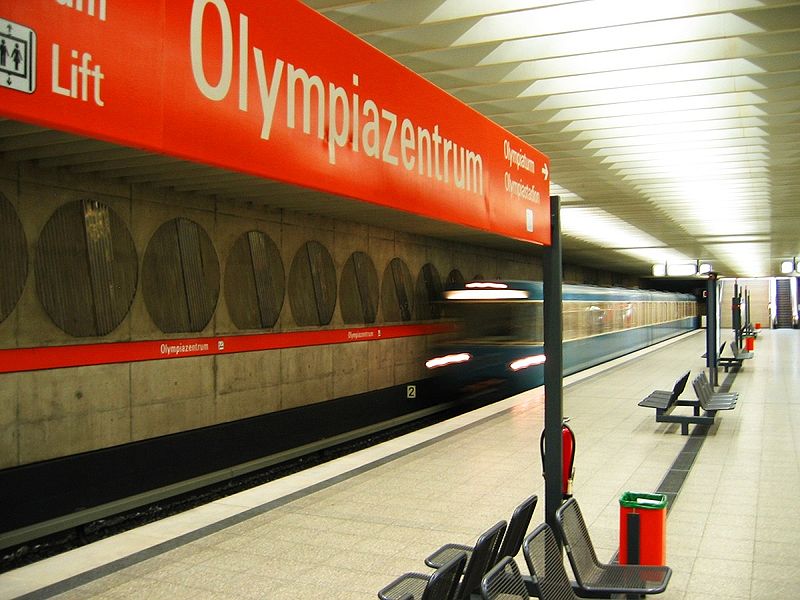
Auch die U-Bahn gab's zu Olympia
The Underground Trains were also something they installed because of the Olympic Games.
I still remember the year 1972. Munich hosted the XXth Olympic Games of Modern Times (Spiele der XX. Olympiade). The S-Bahn trains were new; Munich got a nice Olympic stadium and many other beautiful things. In those days, my father worked at the revision department of the “Deutsche Bundesbahn” and whenever schools were closed, I worked at DB service, staffing the information desk at platform 26 for guests from abroad.
The revision department had to determine if the railway system had cost-efficient structures on various levels. My father was in charge of analyzing the Munich S-Bahn train system.
Well, he made surprising discoveries. The cost of just running the trains was less than half of the total cost. The necessary federal and state subsidies, however, amounted to more than half of the entire cost of the Munich S-Bahn system.
That means the subsidies were higher than the S-Bahn operating cost. Passengers paid exclusively for the privilege of being permitted to pay.
Roland DürreSunday September 18th, 2011
About the Moral Obligation to Declare Yourself Insolvent
If a system is so stuck that it will not even be able to save itself in the long run, it has to face the consequences. That is true for enterprises, countries, communal departments and also for private citizens.
Consequently, there is a moral/ethical obligation to accept the bankruptcy situation. Mind you, we are talking both sides: the one who is indepted and the environment.
The damaged system must be courageous enough to declare itself insolvent and accept the consequences.
The environment must be prepared to accept the bankruptcy and give the failed system a fair chance towards righting itself.
I see only one exception to this rule. If, for instance, out of ten systems nine are totally healthy and only one is ailing. That is a situation where I could imagine the wealthy and generous nine saving the tenth. Still, I am not really sure if this would be a good solution, both for the tenth and the nine others.
For our financial crisis, this means:
If Greece is indebted to an extend where all help is in vain, then they must be courageous enough to declare bankruptcy. And they must be prepared to face the consequences. And the other countries must accept this insolvency and give Greece a chance to make a fresh start.
This can, however, certainly never happen in a Europe with one currency and without protective customs duties or similar concepts, because otherwise countries like Greece have no chance. The structural differences and success criteria in the various European countries are just too huge. Besides, the additional achievement parameters, such as mentality, climate, education, infra-structure, technological standards and many more, are also too diverse. Perhaps you have to start thinking about ”special economic spheres with their own currency“ or similar concepts in cases like these.
But still, it would not be possible for us to “save” Greece. Because in the EU, circumstances are not such that the majority of countries are rich and without debts and thus can afford to be generous and gratious towards Greece by ”saving“ it. And, as I see it, guaranteeing for Greek debts and assuming that they will economize enough to some day be able to pay back their debts seems a concept that is beyond reality and therefore both naive and native.
According to Wikipedia, there are 23 EURO countries. Three of them are “passively“ using the Euro and three more are associated Euro users with their own Euro coins. Greek is one of those. The 16 ”true“ EURO-countries, however, are all but rich and wealthy.
On the contrary. All EURO countries, with very few and not really relevant exceptions (Estlonia and Monaco) are hugely indebted. Even the highly-praised Austria and the very respected Netherlands suffer under their national debt and the interest rates they have to pay. The situation in the bigger countries, such as Italy, Spain and France, is even worse. To be sure, they still manage to pay their interest rates, but it is totally utopian to assume they will be able to repay the debt.
The main guarantor (and absolutely major debtor) Germany is not so well off even without considering the guarantees we have given. Even as it is, we cannot sufficiently invest into education and infra structure. The next economic weakness can (and will) have very undesirable consequences for us. And even today, our business life looks like a permanent tight-rope stunt with constantly shorter cycles of “ups” and “downs”.


