
Klaus HnilicaTuesday September 22nd, 2015
Is ‘Social Justice‘ just a Misunderstanding?
Yes – if we continue to hold onto what we have been considering the definition so far! /1/
According to this definition, everybody, strangely, thinks him- or herself socially just yet at the same time laments about the growing injustice in this world.
It seems that this discrepancy is insurmountable.
 We are simply too much in love with our unclear terminologies. In fact, we actually wallow in the concept that ‘social justice‘ has to be some kind of ‘moral, egg-laying wool-milk-sow‘, rather than just a minimum standard for human behaviour consisting just a few rules even evil persons have to stick by!
If, however, we accept this definition, we soon find out that ‘social justice‘ tends to have little in common with ‘romantic equality‘. Instead, it has a lot to do with not-so romantic ‘voluntariness‘. And that this is why politics in general have an inherent structural problem when it comes to generating ‘social justice‘, even if it very industriously tries to find and remove ‘legal loopholes‘. It is easy to show this in three steps. All you have to point out is:
A) the common principle of ‘exchange justice‘,
B) the principle of ‘equal treatment and equality of results‘ and
C) the particularly apparent ‘distribution justice‘.
Let us take a closer look at all three of them:
A) After all, we basically have a very special form of ‘exchange justice’ when, in the name of ‘social justice‘, people demand fair prices and fair incomes!
For instance when it comes to: here the aromatic Alp Butter, there the ridiculous one-euro-eighty; or here the super manuscript and there the low fee. If we were to demand ‘equality of values‘, then we would need the general ‘principle of exchange justice‘! But how to objectively determine this ‘equality of values‘ for every individual exchange process?
For instance: would one ounce of gold be too much for a bucket of water in the Sahara if it means the difference between life and death? And are 50 cents too much for two litres of milk if someone has a lactose incompatibility? Or what is the adequate fee for a manuscript which, later, will only be pushed underneath the one too short table leg?
Doesn’t this mean that the ‘evaluation‘ of an exchange object is by nature a very subjective thing and that this value has nothing to do with equality? Especially since said exchange only takes place because all the parties concerned see the object of exchange differently, which is why each considers his own deal profitable.
Naturally, this ‘exchange profit‘ is just as unprovable as the ‘exchange value‘; but it is also clear that any profit can only exist and be proved if the exchange has been voluntary! Which means that an exchange is always ‘socially just‘ if none of the parties concerned has been forced to accept it!
Of course, this voluntariness in an ‘exchange‘ does not guarantee that both parties can get what they hoped to achieve. Neither is it a protection against erroneous decisions, such as for instance the imprudent purchase of low-price milk regardless of lactose incompatibility. But this is not necessary, either. Because the evaluation of the ‘exchange profit‘ is subjective, which means that it cannot later be forced into a wrong equality measurement just because someone had erroneously and intuitively assumed that this ‘equality‘ in an ‘exchange profit‘ is closely related to ‘social justice‘!
Consequently, we can conclude that prices and incomes are always socially just when they can be accepted without one of the parties having been forced to accept!
B) Now let us discuss the allegedly socially just ‘equal treatment and equality of results‘!
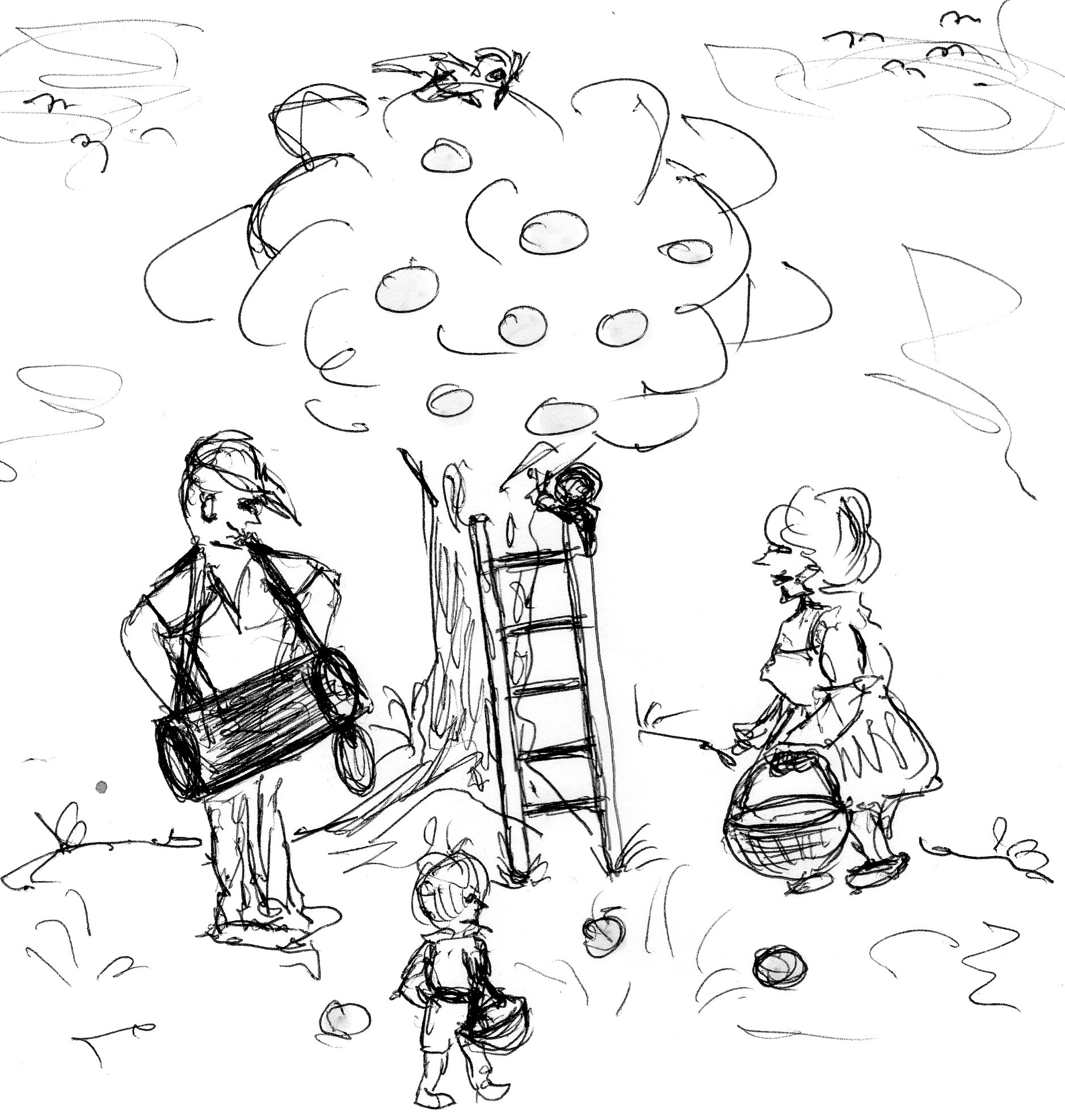
Again, our equality mania brings us into a similar logical one-way road, as can be easily shown with a simple example: If, under the aspect of equality, you ask a retired lady, a sportsman and a six-year old boy to pluck apples from a four metre high apple tree with a ladder standing at its trunk, you will get considerably different results; the help you will have to give will, indeed, be rather diverse, before all three candidates will have plucked the same amount of apples – which means they have equal results.
Since, however, there are no two identical individuals on this earth, you will never get equal results if you treat them equally, and vice versa!
And regardless of this fact being absolutely obvious, we keep demanding equality along with social justice. But if equality were really socially just, then the state of affairs where all persons are poorly off would, according to justice theory, be the best that could happen, wouldn’t it?
Luckily, nobody believes this! But still we insist that the logical consequence cannot be to stop seeing equality as a manifestation of social justice.
C) The tendency towards equalization is particularly apparent when it comes to discussions about ‘fair distribution’!
To distribute something means to hand out from a supply. Fair distribution demands that this has to done following certain rules. However, the fairness is most obvious when the owner does the distributing him- or herself, because then it is his or her will alone that counts. To be sure, it might be reasonable to consider the expectations of third parties, but that is not demanded by social justice! Social justice is served by the protection of ownership rights.
But it gets truly difficult when you cannot clearly define ownership, as it is the case with all political systems because the spheres of interests of the distributors and the recipients will often be identical. Conflicts are unavoidable and the ‘just solution‘ of said conflicts are not just a theoretical challenge, but mostly no more than a noble goal!
Compared to this, private persons and enterprises have a rather easy life, don’t’ they? All they have to do is not cheat, not steal, not use violence and not break contracts – and already they are just. They need not abide by more rules than that!
When all is said and done, this consideration not only generates a theory of justice, but also a surprising solution for economic and social politics: why not move as many decisions as possible to the private sector – since this is where you have clear and, according to what has been stated above, ‘socially just‘ circumstances?
Well, I assume this will remain wishful thinking, because many will still refuse to abandon the inacceptable ‘equality saturated‘ definition of justice! And they will be even less willing to forego the potential increase in power derived from this ‘usurpatory definition of equality‘!
KH
/1/ Dagmar Schulze Heuling; „Was Gerechtigkeit nicht ist“; Nomos – Verlag Baden – Baden
Werner LorbeerSaturday August 1st, 2015
Energy Transition is Germany’s Hobbyhorse
 Well, I admit the headline is a little polemic. I also admit that it is high time for us to “start”. In my definition, however, it involves more than just enjoying windmills and photovoltaic modules or swarm power stations.
Taking your pencil and doing the calculations with the unobtrusive FAZ article of July, 30th, will show you that the renewable energy production in Germany amounts to less, 00002 % (2 times 10 to the power of -5 per cent) of the world-wide coal-based energy consumption.
Compared to the global energy level, our energy transition is a technological children’s playground, some kind of lucrative hobbyhorse the progress of which is far too slow and that is far too expensive for broader use.
India, China, Africa, America, Australia will not forgo their rights to use coal. It depends fundamentally on implementing processes of civilization and technology in order to separate the standard of living from the carbon dioxide output. What we need globally is an economical, cost-efficient solution. Because the very bad news was written in the same FAZ issue:
 The world population continues to grow – and faster than we had anticipated.
Personal Opinion:
Once again, it will pay to think about the relation between investments and carbon-dioxide reduction. There is no doubt that there are better processes with respect to the carbon dioxide efficiency quotient than the ways favoured by us through the EEG. Just remember the filters for dust, NOx, SOx and also CO2? Quick, efficient, cheap! Or the possible green-linking of CO2 through suitable agricultural and forestry-related measures – which would at the same time be beneficial for Africa and South America.
Personally, I would rather pay an EEG extra fee that finally ends the abuse of our atmosphere as the rubbish heap of human civilization and that is internationally available as a development aid than continue to feed German wind and solar barons.
wl
(Translated by EG)
Klaus HnilicaThursday November 13th, 2014
Blessed be the Unhappy…
Carl and Gerlinde (XXXVII)
Oh my God – why did it have to happen after this heavenly steak with champignons and broccoli of all times? Even the Riesling had been exactly the right temperature. Which was not a matter of course with Gerlinde. But today: perfection – the temperature! And then this…
Well, it all had started going wrong as soon as Carl had returned from the office: totally unexpectedly, Gerlinde sulked and pursed her very red small mouth after the fleeting welcoming kiss, remaining in front of him and not uttering a single word. The demanding stare she gave him during this mute gesture was actually a little embarrassing. Eventually, Carl ended this grotesque prologue, pretending he needed the restroom!
However, he was well aware of the fact that the culmination of the drama still lay ahead…
Mind you, this was on a day when the company, too had been catastrophe city! To be sure, the ever-enthusiastic sector leader Dr. Osterkorn had initially shown the seventeen Power Point slides with their display of permanently decreasing orders in all sectors of the TRIGA underwear sector without comment, but then he had continued by without any warning projecting in the most brutal way the full dimension of the ’Russian Underwear Catastrophe’ on the screen like lightning had suddenly struck!
After all, since Putin had decreed an import, production and sales ban for all lace underwear in the entire Eurasian Economic Zone earlier this year, there had been practically no more orders from the two Russian underwear wholesalers ’ARMED’ and ’Suwen’! The entire business exchange with Russia had broken down from one day to the next. And all this just because Papa Putin believed he had to take care of both the Ukraine and the health of his compatriots! After all, those non-perspiration-absorbing lace panties and satanic high-heels gave his already terribly vodka-stricken people such unexpected suffering: basically, the fascist scourges of humanity ’inflammation of the bladder’ and ’foot deformity’ were even threatening to decimate the number of Russian females …
Carl hesitated!
Should he really start complaining about all this shit from the company in front of Gerlinde and thus spoil her mood? After the very strange stiffness when she welcomed him home, she was now actually again very lively, parading in front of him and teasing him with delicious snacks. And most likely she was also wearing one of her entrancing lace panties, such as Putin did not like at all – well, he was pretty sure…
No, he was definitely not going to spoil her mood!
He was far too tired and washed-out!
In fact, the most attractive idea at that moment would have teen to not utter another word and not have to share anything with Gerlinde – not even this delicious Riesling – and spoon up this superb meal while listening to Country Music… However, the red lace panties were unstoppable: Carl had only just given the tender steak its due between his teeth, added his saliva, moved it into his stomach and extinguished its fire with three glasses of Riesling, when Gerlinde assaulted him with the question: Are you Happy?
Carl toasted her, trying to appease her and ignore the question! In fact, he – regardless of actually now being absolutely incapable of swallowing another bite – even went so far as to ask her if, maybe, she still had a ’Little Something’ to surprise him with by way of dessert.
”Of course”, Gerlinde impishly said, “I would like to know if you are happy, Carl”?.
“Does that mean my dessert is something to bite into? Meaning the question ’Am I Happy’?“ Carl was now intrigued.
”Yes!“
”Whatever makes you ask such a thing?“, Carl irritably said.
”Well, you know, I just would like to know? In fact, Hannelore is not happy!“
”But then, this is hardly a surprise with this eccentric cow“! Carl enthused.
”Why are you so aggressive all of a sudden“?
”Because I suddenly get the impression that, again, someone wants to plant disharmony somewhere! It would not be the first time, would it?“ was his acid reply.
”Carl, you must not be so supersensitive! Can I not even ask a simple question?“
”Ok, Gerlind. Fine. Ask as much and as long as you like to about ’happiness’! But please do not expect me to literally drown in ’happiness ’ while you go on about it! To be perfectly honest, I would find it a pity in view of the wonderful steak inside me. In fact, I actually do not know what this ’happiness ’you are inquiring about is supposed to be, or not to be?”, Carl was now annoyed.
”Maybe you could be a little less theatrical?“
”Of course! Yet I truly have no idea what you mean with ’Are you Happy’?”, Carl said indignantly while in vain seeking consolation with his now room-temperature Riesling.
”How should I know? But then, in adverts, all people are always happy, too, aren’t they!“
”Do you mean this heavenly ’purgative happiness’ of the no-longer-quite-young blond woman whose intestines are de-knotted ’giving her happiness’ in each one of her advert appearances?”, Carl provocatively asked.
“Yes, that is one of them!“
”Or do you mean the beaming grandmother who, thanks to Voltaren, suddenly re-discovers her grandchildren, because now she is able to go down on her knees?”, Carl continued.
”Her, too…!“
”Well, I am sure you are aware”, Carl went on, “that in all these examples, it is always women who become spontaneously happy – never men?“
”Carl, as always, you tend to simplify! In fact, there is actually ’happiness ’ beyond adverts which also very much concerns men?“
”I am all ears …?“ Carl pointedly.
”For instance the often thematised happiness of love?“
”Hm“ grumbled he.
”Or, to put it bluntly: are you now happy with me – or are you not?“
”Oh my God – Gerlinde, now what is this about? I assumed this topic was one we really had dealt with once and for all?”, Carl lamented.
”Then why don’t you just say ’Gerlinde, I am happy with you’!“
”Certainly! Don’t you know this by now”, Carl was getting bored.
”In that case, you actually know the meaning of ’happiness ’?“
”I probably have a vague idea, Gerlinde! And I am sure it has a lot to do with security and contentedness, if you like the sound of those words”, now Carl’s words sounded almost ceremonial.
”Does that mean that you are at least content with what I have to offer?“
”Yes – if that is how you want to call it! But then, I am content with everything around me, my dear Gerlinde”, Carl added sentimentally, “among other things also how nicely you keep everything clean, also with this half-empty bottle of Riesling which will soon be empty, and, of course, also when we will afterwards go to bed… “
”Are you saying it in that order – cleanliness, Rieling, bed – randomly, or is that something you chose very deliberately?“
”To be perfectly honest: I rather like this order”, Carl was now surprisingly self-confident, “somehow or other, it is just correct and also important for me if I am supposed to feel something like ’happiness ’!”
”And do you think your order could cope with a slight variation?“
”What variation do you mean …?“ Carl hesitantly asked.
”What I mean is the slight variation: – cleanliness, bed, and then Riesling! If you chose that order, I could actually also find a little happiness once in a while!“
”A-h-a“, Carl moaned. This was the moment when he started regretting that the meeting about the poor TRIGA ordering situation was no longer under way…
KH
(Translated by EG)
Roland DürreFriday August 15th, 2014
Start-up (1) – Failure
As during many summers before, I am currently camping at Porto Ageranos. The campground is situated on the Peloponnesus, on the middle finger, about 10 kilometres south of Gythio, shortly before the mild climate of Mani. From our tent, you have only 10 metres to go before you reach the ocean. The first night was truly great. And since we know the region quite well, we have been feeling really at home from the outset!
I take advantage of the time I spand at this place for relaxing, contemplation and, not least, for making plans. And, of course, I also do a lot of swimming and bike-riding, I eat well and simply spend quality time with my beloved family and friends. And, naturally, I also write some articles (for the IF Blog).
This time around, my main topic is start ups.
I know many people. With some of them, I am good friends. Among them are also quite a few young colleagues. It seems to me that I am actually doing quite well when it comes to getting along with the young generation.
A few years ago, I started getting interested in the foundation of new enterprises. For instance, I am constantly asked to sit in the jury for a business plan contest. As a mentor, I counsel persons and enterprises, sometimes intensely, sometimes sporadically. Consequently, I know a little about what is going on.
Most of the teams I know and acompany are truly great teams. They are industrious and creative and they try to lead their lives independently and to build up an enterprise, investing the utmost personal enthusiasm on many levels based on an exciting idea.
And then they fail.
Some of them fail at the very outset, others as soon as promotion programs, such as EXIST are over, or else after the first financing. More often than not, the period of suffering will continue for some time. Once in a while, they find an “emergency exit”. And only very few of them will be a success – and those mostly in a totally different way than they had originally planned.
Most of those who fail leave behind a huge amount of strength and also money. The only consolation for them is that they learned a lot, in other words: they “failed successfully”. Yet this is not much of a consolation, is it? After all, if they had taken up an alternative life line, for instance through a good job with a medium-sized company, they could probably have learned a lot more for their personal future.
As I see it, this is a gigantic waste of capital, creativity and industriousness (“waste” in the sense of Kaizen). Also, the frustration and disappointment many of the young persons concerned suffer is painful. And I often think that this frequent failure might have been avoidable in many cases.
Because the mass-failures are easily explained. Mostly, the founders work just like the expertise of a past epoch tells them to. And this pattern never really worked very well. Today, it generally does not pan out at all. How are the success patterns of yesterday supposed to work in the world of tomorrow, anyway?
And the very few exceptions – incidentally, they are all due to the accumulation of particularly lucky circumstances – only prove this rule.
Why is failure normal?
The answer is simple: for instance, big concerns, too, constantly try to throw new products onto the market. These concerns have everything you need for a new product idea: capital in masses, a well-known brand, excellent marketing, strong marketing organizations, world-wide access to the markets, great engineers and providers, and much more. And above all: they know their market, because more often than not they have been “learning” and “working towards it” for decades.
And still their new product inventions often fail. If they are lucky, as few as 10 % of such new inventions will become more or less a success on the market. Make your criteria for the definition of “success” a little stricter, and you get an even lower number.
Except how is a young team that has none of these things supposed to compete? Just with their young light-heartedness and creativity? This is nonsense!
One conclusion might be that young founders will only have a real chance on totally new markets. That would mean young founders should shirk (almost) all business ideas around existing technologies and solutions. The current development seems to justify this argument. Well, perhaps I can give a first tentative piece of advice to start-ups:
Be careful if you wish to enter into markets where others already have their standing.
To be sure, great concerns with their organization and processes are their own stumbling block when it comes to creative topics. Their success has the negative side that they will always think in old patterns. They know this and consequently look for innovation outside their own walls. The foundation of “acceleration“ departments and their looking for cooperation with start-ups is their way out of it. After all, this is also the latest idea of “UnternehmerTUM” of Munich Technical University. The same is true for the new first mayor of our state capital Munich, Mr. Reiter.
The magic word “cooperation between concerns and start-ups”, however, will not work, either. Firstly, the old enterprises intensely live the rejection from outside as in: “not invented here“. I witnessed this quite frequently and also made the experience myself in strategic cooperation with big firms – more than once. And I could also name quite a few examples where the results of XXX acceleration or XXX invest failed.
But the “old methods”, too, are only successful in few exceptional cases. Let me exemplify this with almost all “tax-saving models”. For many years now, we have witnessed this not only in sectors such as “film”, “realty”, “shipping”, or “alternative energy”. The huge losses suffered by investors in projects around railway and canal building are also good examples.
Mostly, their failure was not because they fell victim to fraud or untrustworthy businessmen. To be sure, those also happened. But mostly the reason was that the underlying business models and plans were just wrong. Regardless of the fact that they had been made by experts in a “professional” way. Experts who really knew their markets. And regardless of having been controlled critically by other experts, for instance in banking. Mind you, those banking experts were really serious, because, after all, they had a share. Here, too, I could write about very personal experiences: in one case, the Sparkasse München, which I hold in high esteem, lost a few million Euros – in my own case, we are, luckily, only talking something in the middle five-digit range.
But if even projects written by experts and validated by many other experts do not work, how can you then expect a young team of founders without any experience and knowledge of the market to steer their enterprise successfully into a non-predictable future?
Seen under this light, founding a new company is basically a hopeless or at least very courageous adventure. An adventure no sane person should by any rights let himself be drawn into.
However, I think that it is possible to improve the chance of success for a start-up from what feels like 1 : 100 to something that perhaps even comes close to 1 : 1 (success versus failure ratio)..
I know that this is a rather courageous announcement of mine. Consequently, I plan to use my two weeks on a campground at the southernmost end of the Peloponnesus on Mani for writing a few articles about “start-ups” here in my IF Blog. This is both for the start-ups I myself counsel and all others.
RMD (Translated by EG)
P.S.
I will start with my own experiences as a young entrepreneur in the next instalment. As I see it, you can already learn quite a bit from it.
Roland DürreTuesday June 3rd, 2014
June, 20th, 21st, 22nd – PM Camp in Berlin #pmcamp14ber
”Cooperation in the 21st Century” and „Wisdom and Intuition of the Multitude“
Those are the two focal points of the Berlin PM Camp between June, 20th and June, 22nd, 2014 – which means from Friday evening until Sunday afternoon.
Doesn’t that sound exciting!
Consequently, late in the evening of my birthday, I will board the sleeping compartment of the night-train from Munich to Berlin and leave it to said train to bring me to my destination. And I already look forward to meeting many friends and in particular Heiko (Heiko Bartlog).
Heiko is a member of the organization team of Berlin PM Camp and put enormous energy into preparing for this event. He asked me if I would like to supervise a session about the two exciting topics of the Berlin PM Camp. Isn’t that nice of him?
Well, I would certainly always like to do just that. Consequently, I now start thinking about it. There are certainly a lot of topics. Here is a list of what comes to mind:
- Target Agreements
In 30 years as “The Boss” of InterFace AG (and even before that in my more passive role as employee at Siemens AG and Softlab GmbH) I made a lot of surprising experiences with goals and target agreements. I learned that target agreements are very problematic in many respects. Consequently, I believe it is quite possible that more and more of these “control mechanisms for humans by material rewards” will be abolished in the future.
For instance, I could tell my life story, including paying models and target agreement design as an entrepreneur and in projects.
- The Change in Management
In the early 1980ies, Hans Ulrich, perhaps the founder of the St. Gallen Management Model, wrote a wonderful essay on “8 Theses on Change” in management. By now, we already have the Version V4.0 of the St. Gallen Management Model. We did a review of this model with Professor Dr. Johannes Rüegg-Stürm and many Swiss enterprises. In the process, we discovered how unique and modern Hans Ulrich’s theses are still today.
- Leadership – Principles and Values
Being an active participant in a Blog Parade initiated by Bernd Geropp, I have recently been made aware of how diverse the answers to the simple question: “What are your three relevant leadership principles?” are. I took quite some time thinking about it, and then suddenly, it was very clear to me: I am an ALO man (agile, lean, open). But how does this translate into daily practice? Or why will this often not be possible? And what could we do in order to use this principle more frequently?
- Leadership is Communication!
Another topic is communication. Communication has always been a difficult issue. But here, too, humans and their values, expectations, interests and needs changed. And I mean radically. Similar to “basic beliefs” and “basic behaviour”. Except that some bosses, project managers, managing directors and superiors did not notice. And consequently, many of them communicate like in times long past – which is true in several respects. There is really a lot you could improve – and in fact, you have to improve on these things if you wish to make the “future” a success.
- “The Future Cannot be Predicted”
and all decisions will always have an “uncertainty factor”.Well, this is just how it is. And in managerial circles, the awareness that this is how it is now also is being heard. So this would be another exciting session topic.
I think a team cooperating at eye-level is better equipped to distinguish between “good” and “evil”, for instance when it comes to a project. And this is how, with a shared effort, more “right” than “wrong” decisions can be made than, for instance, if an isolated project manager has to make them.
- Discovering Collective Constructs!
Projects or enterprises are social systems, mostly with a decided goal. Social systems, however, tend to develop collective constructs which increase by themselves in a very special way, often also when those who are normatively and strategically responsible become system agents. Social systems can then easily make themselves independent and de-personalize.
The only way to prevent this phenomenon is to have a culture of civil courage lived by the majority in the enterprise or project, thus making it possible to fight back against a perversion of collective system constructs in constructive disobedience. In other words, an immunity guaranteed by a “Crowd” inhibits the social system.
These are all topics I find extremely fascinating. I also have lots of personal experience with these topics and learned much from my mentors. It is my pleasure to share my experiences. However, this kind of thing always has to be in harmony with the barcamp and consequently, with the PM Camp. That is why I always wish to decide at short notice what exactly I will talk about. For instance after having digested the impulse presentation and the feedback in the discussion. Or maybe after the first PM Camp day.
Besides, I am quite ready to let others do the speaking, only getting active when I notice that there seems to be a shortage of volunteers for session. Except if I find something really incentive :-).
So I look forward to being in Berlin. And as to the rest: let us wait and see. In other words: instead of planning, I just let things develop.
There is no doubt that the Berlin PM Camp will be a first-class event. I can promise!
RMD
(Translated by EG)
P.S.
At this time, I would also like to inform you about the next two PM Camps:
The PM Camp Rhein-Main is all about “project communication” It will be from the evening of June, 26th, until the afternoon of June, 28, in Bad Homburg #pmcamprm and #pmcamp14rm. Unfortunately, I cannot be there, because on June, 27th, we have our big 30-year-party – all PM Camp fans are invited.
In July, Munich will host an event between the 24th and the 26th (again Thursday evening through Saturday afternoon). The motto of the PM-Camp München is: “sharing knowledge – increasing knowledge”. And that certainly also sounds familiar: #pmcampmuc or #pmcamp14muc. Of course, I will again be one of the participants at the PM Camp in my home town!
Roland DürreWednesday May 14th, 2014
What Electric Device is the Most Reasonable one in My Household?
Sometimes, I really come up with strange ideas.
For instance, one evening, I start wondering which of the many electronic devices in our household is the most useful. And I try to determine which of them I actually really need.
Well, the ironing machine seems to make some sense. But then, I could also let my shirts be cleaned by a professional service. The shoe-shine machine, the electric tin opener, the electric coffee mill and the huge beer tin cooling/dispensing head cannot be among the number. After all, those were the devices that – along with some others and the electric Christmas candles – were thrown away when we moved.
The fridge certainly makes more sense when it comes to cooling beer. But then, I could also drink my beer in one of the numerous pubs situated around our house – where I would have company at all times.
On the other hand, there is still a small cool box. However, it is no longer as full as it used to be, because I prefer eating fresh food. And I try to make a general rule of eating less. Besides, the children are almost all out of the house. Consequently, I do not find it a good idea to store food. It constantly puts me under the obligation to control how long they can be kept and then I need to eat what will soon be past its “best before” date.
This is where our integrated water shaker and cooler comes in. It is a great thing and was the pride of the entire family for a long time. But now it has been out of working order for more than two weeks – because the “Grohe” company no longer replies as fast as they used to – and what do we notice? – You can do without. Because you can actually also drink your water directly from the tub.
Let us remain in the kitchen. We have the cooktop (induction with virtual cooking field) and the stove, the steamer with water supply, the dishwasher and the bread cutting machine, the ESGE miracle rod, the food processor(s), the electric lemon and orange squeezer, the grain mill, the cream whipping machine – they are all electric. And in our basement, we also have a microwave.
Back to soft drinks. The electric coffee machine is used a lot. I really enjoy my coffee and (probably) too much of it, too. But still, I cannot say I really need this machine badly. After all, you can easily cook Arabian coffee in the pan, can’t you? I still have a filter for the coffee pot, a coffee stamp and a small Italian espresso machine which, like the two old coffee mills, actually work totally without electricity.
The yoghurt device is sitting among the flea market things. I really do not need it. I do not like using the vacuum cleaner, because it is rather noisy. I prefer disposing of the dirt on the ground with my broom and shovel. In our household, wall-to-wall carpeting is a “no-go” and carpets belong in the fresh air, where they need whipping, rather than vacuuming. The electric razor is just for emergencies, because I prefer shaving wet. To make up for it, I rather appreciate the electric toothbrush. But do I really need it?
Suddenly, I remember something very important – my laptops, tablets, the router and the printer! And not to forget: the small electronic device that produces the “Tans” for bank transfers. All these things seem to be absolutely essential for life, regardless of the fact that once there was a time when we lived without. In those days, we had telephones, radios and TV sets – all of which we still have, but in several rooms at the same time. Apart from the fact that, today, they are more like huge tablets which can also be used for watching TV. And basically, I no longer watch a lot of TV. In fact, I prefer listening to the radio. Or else I use the sound system, which I really enjoy.
We also have another beautifully exotic device: the electric ice machine. Barbara sometimes uses it in order to make particularly tasty ice cream (cinnamon or mango, because our son brings those fruits back from India). But this, too, happens far from often. In fact, it happens almost as seldom as me setting up and letting run my electric toy railway in the basement (never). But then, this is something I keep for my grandchildren (despite modern children having no inclination at all to play railway – after all, they have computers).
There is also an electric drill in the basement. We actually used it when we moved. Even though I once learned that the average time of usage for a German drill can be counted in minutes. Diverse electric saws, glue-pistol and more similar do-it-yourself equipment can also be found in my basement. It makes me think of “shared economy”. And immediately, I think of the house technology (heating, solar energy for heating water, and photovoltaic), all of which are, naturally, also electric devices. Mind you, it is quite reasonable to use “solar” energy.
But then, what is truly the most important electric device in our household? The electric clocks cannot be the solution, because the problem might easily be solved mechanically. Perhaps the lawn mower, because it keeps me from having to perspire. But then, this, too, is something they solved differently in former times – just look at the scythe, which is a word you hardly even know today. And then, is it not “out” to be kept from perspiring.
The electric gate could just as easily be worked manually. Electric bikes – so-called e-bikes – are something I, luckily, do not yet have. Otherwise I would be burdened with all the maintenance and uploading. To make up for it, I have several bike computers (one per bike) and two GPS systems – well, they, too, are electric systems, aren’t they? And I also have a video supported supervision system in order to discourage bike theft. This is in order to have the evil thief filmed while he does his robbing.
Lamps, too, are electric – and quite basic – devices. Especially in the evening, it is rather nice to have light.
🙂 Suddenly, I remember the shoe horn. It is a truly wonderful device and I used it every morning – but then, it is not an electric device. Maybe we have an idea for a start-up here?
Isn’t it just scary how many electric motors work – or rather do not work – in our homes? As I think back, I seem to remember that, in the year 1950, when I was born, we had “ZERO” electric motors in our household. And speaking of electric devices, the only ones that come to mind in those days are the lamps and the radio.
🙂 But then, you have to take into account that I am a leftover from the last millennium.
So here comes the quintessence: do we really need all those things? I will soon take a closer look at all the pairs of shoes I own and for what purpose I use them. Or even better: all the things I buy although I do not really need them…
RMD
P.S.
Barbara is looking over my shoulder and she has a spontaneous idea: the washing machine! Accepted with gratitude.
Roland DürreTuesday March 18th, 2014
Aren’t We Just the Greatest…
A call for humility.
Currently, Germany is again totally in control. Everything is just nice in our country. We give all kinds of good advice all over the place, we threaten others with sanctioning. And we even have a(n almost and/or soon) balance federal budget. The sun smiles upon Germany and everything is rosy.
Except: is that really so?
Well, there is the ESM, which is currently again predominant in the press. “The Federation” (Germany) guarantees to the tune of 190 billion Euros (link). And so far, nobody could explain to me how this is supposed to work out. Mind you, I can actually well imagine that the amount of money will increase before long. There was a time when 280 billion Euros were discussed.
Unfortunately, I found no listing of all guarantees made by the Federal or State Administrations, for instance for “financial service providers”, or even for the total extent of guarantees. The sum total is probably quite a huge number.
As far as I know, guarantees are not mentioned in the fiscal budget (just like they are not mentioned in an enterprise balance sheet) of the FRG. Regardless of the fact that you need not be a merchant in order to know that giving guarantees is something that seldom works out well. But there is more to get thoughtful about.
I heard from Herrn Ramsauer – when he was still minister of transport – that one in every three bridges in Germany is already or will soon be in an acute state of disrepair. Well, this is nothing special, because, after all, infra-structure has to undergo maintenance and renovation. Except that we have an awful lot of infra-structure. Just think of all our streets. Then there are the ancient railroads and an ailing energy supply network. And I never heard of any extra money saved for this kind of emergency. Neither did I ever hear of our technological debt being taken into consideration.
Not to mention that our “external balance” (for instance if costs are shifted to the detriment of our environment) have never been taken into account at all. But then, this, too, will no longer function in the foreseeable future. Just think of the detrimental effect of nuclear energy, for instance the “nuclear disposal zone” at Schachtanlage Asse. In comparison, the “all-time costs” (Ewigkeitskosten) resulting from coal mining almost seem negligible.
Talking about a “balanced budget” in this situation is something I find rather infamous. And I feel that I, as a citizen, am being made fun of! And I ask myself if the politicians who praise themselves and their policy so self-pleasingly simply do not know better or if they actually want to “play me for a sucker”. Have they really not understood how serious the situation is – or is it just that they do not want to see? Because, after all, the earth is a disc, isn’t it?
RMD
(Translated by EG)
Roland DürreTuesday February 11th, 2014
What Annoys Me #33 – Again Someone “Taking Responsibility” Afterwards
Now, yet again, someone “took total and political responsibility” – and then he resigned, before his club excluded him.
Politicians, too, like to “take responsibility” after something has gone awry. Or if something was made public knowledge that was basically “strictly confidential” and not at all meant for publication. Except that, today, politicians no longer resign. That was in former times. Today, if they have become truly unacceptable, they will wait for a lucrative offer to change careers.
The term “taking responsibility”, more and more often also “full” or “political” responsibility, has become mere lip service. Not much will happen afterwards. The best you can hope for is a few new compliance rules to be sanctioned and publicly sworn to. And then they will instantly be secretly circumnavigated.
We all have already done something stupid in our lives. I know the feeling well. But then I admit to what happened and try to control the damage or see if things can be put right again. It would not be appropriate for me to lament about the consequences or to come up with excuses, or else to point towards the “true culprit”.
And then I would be well advised to keep quiet, because nobody needs a public “taking the responsibility”. Nor does it help anybody.
RMD
(Translated by EG)
Roland DürreSunday February 2nd, 2014
Between “Agile” and “Planned”, Intuition and Ratio.
A short time ago, another friend of mine told me how great he felt about his participation at a barcamp weekend. He said how much frontier-spirit he had experienced and how much energy he had filled up on. And how he sadly had to confront everyday work-life again on Monday after this ever so enthusiastic weekend and how it felt painful to get propelled back to hard reality.
That is when, again, I started pondering a few questions which keep making me thoughtful:
Acting and planning:
Why is it so hard for us to be “agile” and why are we sticking so persistently with “planning”? Why do we not accept that the future is unpredictable?
Deciding:
Why do we mistrust our intuition and will in the end prefer basing our decisions on ratio, which seems to be the level of reason and where we give ourselves security by the most complex explanations?
Or, to say it in a “populist” way:
Why are persons who think and act intuitively and who sail through life in an agile way and who promote things successfully to the benefit of all constantly thwarted by Apperatschiks (Apperatschik) who manage to destroy what has been laboriously built with their never-ending rules and regulations?
Here are my answers …
My guess is that, on the one hand, we have been taught to do it in this way by our elders and, on the other hand, our fears make us do it this way.
Let me first give you an example for what past generations said:
Everything is under control, we can achieve everything we wish to achieve, all we have to do is plan properly. We have to organize our world like clockwork, then nothing can go amiss. Boys do not cry and emotions are not good counsellors. Consequently, you should free yourself from emotions – they can only do damage. And, above all: do not fear progress! Technology can achieve anything! Wars are there to be won! So, boy, be reasonable! Basta!
The generations of our forefathers believed in this. They fell victim to the explosion-like developments of the 19th and 20th centuries that seemed to promise limitless opportunities for humans. In the brains of the people, the concept of being omnipotent took hold. It was based on the belief in technology and progress. All of a sudden, homo sapiens was almighty, death was suppressed.
The sudden abundance of available energy (in particular from fossil sources), along with the ruthless technological progress seemed to make anything possible. This is how a feasibility and planning mania like the history of homo sapiens had never known was created. Everything was oriented towards progress and modernity.
Words such as “humbleness” and “caution” were frowned upon or else called backwardly. With a degree of ruthlessness, violating nature and life like we never did before, we declared technology and progress the new Messiah. A full-fledged war against nature started. In their abnormal social systems, the planners of the future even wanted to create the “new human”, just like they had built their new cities.
The belief that an exploding technology, paired with limitless availability of energy, the future can be controlled through ratio and that everything can be determined and mechanically developed was supported by the corresponding ever stronger fear of freedom.
Our imagined omnipotence created a chimera of security that we wish for and that relieves us. Even if it is very treacherous. The greater our imagined security, the greater is the fear of losing it and the greater is our fear of taking responsibility and accepting freedom.
Now more and more people realize that all this was just one of many cavorts humans have liked to embrace during their history. The assumption that the future of humans can be planned through ratio, too, proves more and more often to be wrong. We know about the climate catastrophe, yet we do nothing about it. Just like we know about all the many problems of our social and economic world, yet here, too, we do nothing.
But it seems that we are approaching the turn of another era. All of a sudden, everything changes quickly. We have the internet with its new density of information. We feel that something is wrong.
Consequently, more and more among us flee from this imagined security. They realize that contentedness cannot be bought, not to mention “happiness”. They no longer want to bend before the forces of a society controlled by material desires. A society which gives all its members the one format: consumer.
They no longer want to become the slaves of a strangely economized world. Instead, they just want to start living again. They want to live their lives in responsibility and freedom. And they are fed up with the laws of a late-capitalist and globalized world.
I think that the more we humans will manage to regain our autonomy and independence, the more we will be collectively prepared to overcome our fears and go the agile and intuitive way in society, as well. And our willingness to accept the necessary transformation in a proactive way will also increase – regardless of the radical consequences with their many, non-predictable alternatives.
The more, however, we humans base our lives on alleged security and on the ownership of property and the more we pretend that all is under control because everything can be planned since it is deterministically explainable and mechanistically designable, the more we will lack the courage to decide intuitively and to live agilely. And we will have no chance against the confusion created by scenarios which, just like our fears, only happen between our ears. And then we will rather abruptly be confronted with changes we will not like at all.
The war of survival can probably only be won through “agile” and “intuitive”. And the great singer Janis Joplin might actually have been ahead of her time with her song Me & Bobby McGee – where she gave a totally different definition of the term “freedom”:
Freedom’s just another word for nothing left to lose …
RMD
(Translated by EG)
Roland DürreTuesday November 26th, 2013
Entrepreneur’s Diary #91 – Non-Agile or Agile in a Different Way.
In my last entrepreneurial article, I tried to describe what qualities a truly good manager should have. And I demanded that acting and deciding agile is one of those qualities.
But what exactly is the meaning of agile? Let me start by defining the opposite (dogmatic?).
I always witness non-agile decisions where decision makers think they alone own the truth and accordingly copy the world and the constructs of their social system unconditionally and without questions. In other words, these persons have a personal and systemic “structure of prejudices” which has never been subjected to criticism. If this structure of prejudices is what all considerations are based on and if then imperative decisions are developed from it through dominant logic, you mostly get stupid actions with detrimental consequences.
The reason for this is simple: the world ticks differently from what you think. If what is allegedly certain is not questioned, if emotional influences and your own empathic acceptance of other opinions is not permitted and if warnings are considered uncomfortable or being suppressed or ignored, then this is what happens: “ethics of responsibility” become “ethics of duty”, where all behaviour is justified with loyalty towards the system – even if it is detrimental to the people.
As opposed to this, being agile means that you always ask questions such as “how do you know this?” or “how do you know that this is correct?” both of yourself (!) and others – and perhaps not to avoid unpleasant replies. In other words, you have to be immune against “this is what everybody does” and “well, this is how it has always been”; instead, you have to try and compare your own constructs with those of other persons and, where possible, validate them against reality.
As I see it, this is the most important requirement for being an agile manager.
RMD
(Translated by EG)
P.S.
For all the articles of my entrepreneurial diary, click here: Drehscheibe!


