
Roland DürreTuesday October 20th, 2015
If Blog Explosion
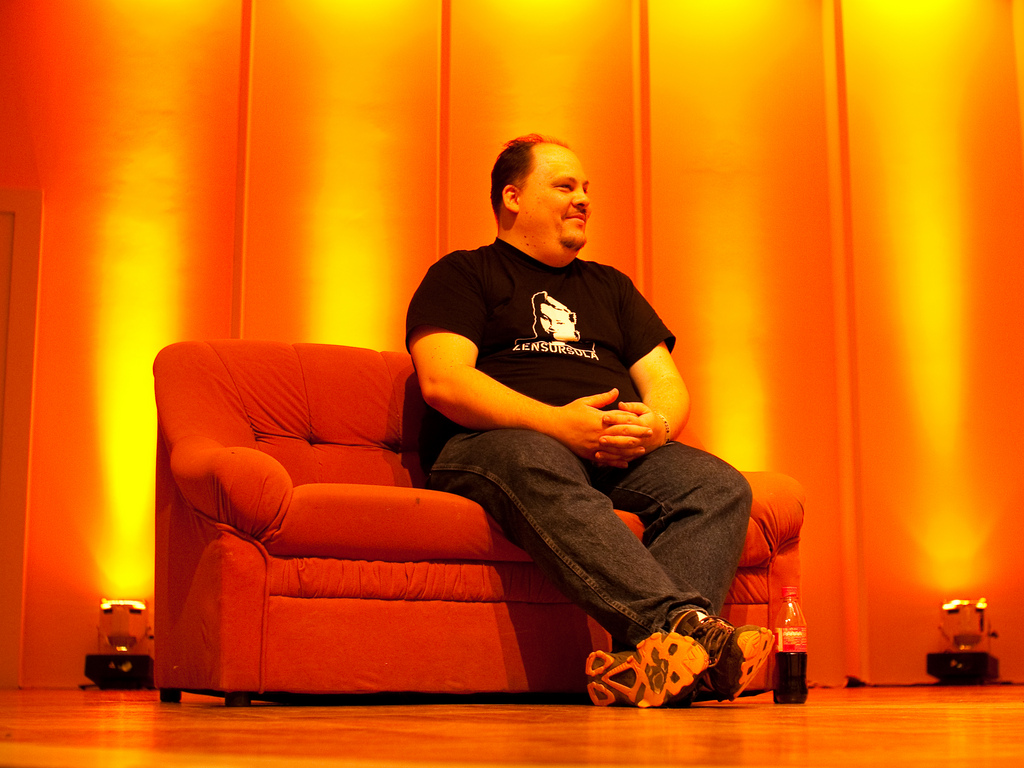
Felix von Leitner sitting on the podium during the 2009 Chaos Communication Congress.
This is how it might have happened:
Our guest author Hans Bonfigt and fefe have known each other for a long time. In former times, they crossed swords quite frequently in Usenet. And a good enmity binds you just as much as a nice friendship. Enmity and friendship probably are not too far apart, anyway, as long as you respect the other party.
By some, blog.fefe.de is called the “Boulevard Press for Nerds“. This is quite a remarkable comparison. Because there are similarities, such as a very striking use of language (more like a “restricted code”) and a one-sided tendency – even if said tendency is very much to my liking, no (few) taboos.…
To summarize it all, I would say both are mouthpieces that are extremely good at proving prejudices. . But there are also quite a few differences between the two:
The Bild-Zeitung is a business empire. With many editors and employees, no end of capital behind the scenes, a refined logistics and sales concept, in short: a huge Journaille machine. And it also has considerable political influence, because quite a few politicians probably determine what to say with already more or less an eye on the BILD- Zeitung.
Felix von Leitner is basically all working by himself. No printing press rotates for him. At most, there might be the occasional small server. His is always offering his opinions for “free”. As a general rule, the BILD costs money, except if you pinch it. You only get a free copy on very special days, such as October, 1st, when it is distributed to almost all German households. On those days, it will deliver two- or one-page free adverts of the huge German business elite, such as VW or Allianz, which make at least me run away.
But to make up for it, fefe has a “crowd of nerds” (I count myself upon them) backing him who provide him with exciting links. All that is left for him to do is a little judgement, combination and comments. And then his “newspaper” is ready for publication.
The BILD-Zeitung used to be the dominating German print medium. I cannot really make an estimate about the influence of the institution BILD on our society and politics, but I think it is still relevant today. BILD might well also have determined the result of quite a few elections in this country. There is no doubt that it influenced a number of decisions.
I assume that this might change in the future. It will be exciting to observe – BILD or blog? For all my friends, I recommend reading Fefe’s Blog. It is definitely preferable to BILD.
RMD
P.S.
I took the picture from Wikipedia. It was originally uploaded by Flickr.com and transferred to here through Flickr upload bot by Tullius (disucussion). At that time – 16:10, August, 5th, 2011 (UTC) – it was set free by Flickr under the Creative-Commons Licence „Namensnennung – Weitergabe unter gleichen Bedingungen 2.0 generisch“. „Fefe“ is licenced by melle. Lizenziert under CC BY-SA 2.0 through Wikimedia Commons –
https://commons.wikimedia.org/wiki/File:Fefe.jpg#/media/File:Fefe.jpg
Roland DürreThursday October 15th, 2015
New Concerns is What the World Needs.
When I wrote this heading, I thought of the wonderful song by Ina Deter. It fits quite well, because, after all, most of the concern heads, especially in Germany, are (still) men. So here is her song:
I dedicate this article to my friend Hans Bonfigt. His last article as a guest author brought an immense number of new IF Blog readers in its wake. This is how it happened: Hans has a “historic enemy“, Felix von Leitner. Even in the good old usenet times, they often “crossed swords”. Felix writes the much-read blog.fefe.de and set a link from there to the guest article by Hans in the IF Blog. And then the show started: more than 20,000 readers clicked on this article within a few days. And many other articles, too, benefited hugely from the effect.
Back to Hans. Sometimes he has a tendency towards brutal language. Once in a while, it will deflect you from his basically good ideas. If he does not like an enterprise, he affronts it. Some consider this defamation. That is not nice. I, too, believe that his absolutely valid ideas would perhaps be better accepted if his condemnations were not so all-inclusive.
I respect this. Because, in his harsh way, he is probably correct. Basically, most of what he writes is actually quite harmless if compared with the naked truth.
Just take a close look at the concerns that dominate the world. In Germany, you usually have enterprises with a good reputation, a precious brand, lots of prestige and history. They have a well-trained work force, lots of knowledge, good sales channels and a high degree of publicity. Through their processes and build-up, they seem to be equipped to cope with all kinds of potential mishaps. Mostly, the employees – due to well-worked-out wage agreements – earn more than persons working in the social sector or freelance. Due to an excessive job protection legislation, their jobs are also a lot more secure than those of the rest of the working population in this country.
However, if you look behind the glittering façade, you will see that the patina crumbles. More often than not, their classic business models fail and classic turnover areas are endangered. Far too often, they employ persons who are paid far too well and are no longer needed in the scenarios of the future. Inherited liability weighs heavy on them and the market changes to their disadvantage. New competition threatens them.
There are huge inner weaknesses hidden from the outward appearance. Much that glitters is not gold at all. It is truly fear-inspiring. If I then continue by analysing the behaviour-controlling values of business that controls the world, it makes me dizzy. I am talking world-wide, for all concerns in all sectors.
Because we have desolate conditions in the global economy. Strangely, we tolerate them. There is not the slightest bit left of the common-good economy idea – as for instance laid down in the Bavarian Constitution. Nobody accepts the duty given to the industrialists with the right – which I personally consider of high value – to do business.
The good reputation of an enterprise, too, has become means to an end. If you have it, it is easier to make a profit. Ethics is wrapped into CSR – Corporate Social Responsibilty and used only to camouflage reality. Because all concerns and enterprises in business follow three unwritten laws:
The three commandments of current capitalism:
First Commandment
Do not develop products for what humans and the market needs. Instead, control the market in such a way that it will buy those products that give you the highest profit! In order to achieve this, manipulate the people permanently through a collective brain-washing, also called “marketing”.
Second Commandment
Set the rules and regulations for your business dealings in such a way that they will exclusively be beneficial for you! In order to do this, use the superweapon “lobbyism”! It must be your highest priority to control politicians through your lobbyists in such a way that all legislation is to your benefit!
Third Commandment
It must be the absolute goal of all your entrepreneurial activities to maximise the profits and the shareholder value! Profit thus gained must be privatised as fast as possible, losses have to be socialized immediately!
These commandments of modern capitalism have priority over all else, be it employees, customers, suppliers or other stakeholders. World-wide and without exception. Because in Asia, China, India, Japan, Korea, South-America, the USA or wherever, the one and only important factor is: profit.
In Europe, the situation is no better. Just look at the former EG or the Comecon countries. I cannot imagine that it is different in Switzerland. Nor do the Scandinavian concerns give reason for hope: just look at the stories around, for instance, IKEA.
To sum it up, you can say that, for all concerns and many more business enterprises, gaining and maximizing profit and consolidating your position on the market always has absolute priority. This is how the concern business has come to a point where all that matters is survival. The preservation and constant strengthening of the own system have become the exclusive goals as determined by the system itself. And the end justifies the means. In theory, such systems are called “de-personalized”. And making self-preservation your exclusive goal makes you inhuman and is the first step towards a fascist system.
An enterprise should aim at: supplying the people in the country with goods that promote their well-being. This is opposed to the current direction of business. The needs of the people are no longer served. Instead, the goals are formed along the lines of business. Of course, if you do this, there is no room left for a “common—good economy” as the Bavarian Constitution demands it. For me, this borders on “criminal behaviour“.
Now I will take a close look at all sectors. I wonder if I will find one that is not criminal?
It cannot be the food industry (why do you no longer call it victuals or nutrition industry?). In this sector, even the smallest customers are manipulated towards eating unhealthy through lies. One (not only food) scandal follows on the heels of the last, fraud and blackmail are common practice. Lower quality and extortion are accepted for economic reasons, the same is true for environmental destruction, not only in the Third World countries. In this respect, I only mention particularly dire cases like the seeds situation as a side-line.
Nor is it necessary for me to write about those industries that supply humanity with raw materials. We all know what traces those robber barons have left on our planet. The same is true for their sub-division, the oil and petro industry. Allegedly, enterprises such as Gasprom even have their own para-military organisations, which is equipped like a private army with heavy weapons. Why? Well, it is clear, isn’t it? If necessary, they can use force to give weight to their interests.
But the EVU’s do not fare any better, either. Neither does the chemical or pharmaceutic industry. You read all the time that medicine is licenced after the best of tests have been executed (exceptional healing capacity, negligible side-effects) and thus is now on the market. And after many users – often children and teenagers – consumed the medicine for a long time, you suddenly hear that the positive effect was ZERO and the side-effects were considerable. But that is nothing. You continue with “business as usual”.
Trade, too, probably has no clean slate. What harsh measures do the discounters use both against their competition and their suppliers! And the customers, too, are constantly cheated. They dominate the field with a long-term, ruinous cut-throat competition. The only thing left in the end will be the ruins of many no longer needed chain stores and a destroyed infra structure.
I will not even mention the traffic enterprises and finance services, the speculation, world and gambling companies, the media enterprises, the weapons industry, the logistics sector, let alone the luxury food industry.
My own sector, the IT industry, too, is not one I trust. For instance, I can well imagine that many producers are quite happy about all those virusses and spams appearing. And about the eavesdropping and much more. I assume that only a small part of the hardware and software systems actually are still made for processing and communicating data.
No. Most of the server and storage systems are probably sold for spam and virus defence, as well as for eavesdropping and such. It would be quite easy to de-activate the spam flood in emails with a suitable protocol (even the old telefax machines had a code provider) – but nobody wants it. Probably because it would be a shame to let all this nice business go.
Here is something else I notice:
No matter how high a profit. The higher the better. Even if it looks rather amoral.
I once read that, at Reemtsma (sector: luxury food industry – tobacco) the EBIT of a good year can well be as much as half of the entire turnover. Let us assume that, in this sector, the turnover is only one twentieth of the capital. Then the capital return rate is 1,000%. Well, there were times when 4% were considered a reasonable turnover return rate (in the 1950ies at VW – those were also the times when you still could get a low one-digit interest on your conventional bank account). If you take 200 as the factor turnover/capital, you get a turnover rate of 10,000%. Well, not everybody can achieve this!
And what do I read on the Reemtsma Website as a reprimand?
Illegal cigarette trade is among the most lucrative crimes…
I wonder why!
Today, there is no upper limit to what marketing may cost. And manipulation need stop nowhere at all.
The only thing that matters is that it does what it is supposed to do. Especially in the sector of “digital marketing”, you hear of enormous progress. The most modern scientific results in neurology and psychology are utilized. Thus, the cost of marketing and sales grow all the time. In some enterprises, they are already as high as half the turnover. In other words: the customer who buys the product pays half of what he pays for measures executed in order to make him buy the product.
Is that OK?
This is even true for enterprises, for example, in the pharmacy sector. One would assume that, basically, medicine does not need advertising. After all, it is badly needed, isn’t it? But nothing could be further from the truth – here, too, the advertising costs is easily 40% of the total turnover and more. And for enterprises promoting internet “services” such as for instance booking hotel rooms, the per cent ratio of marketing might well be more than half of the total cost.
Even politics manipulate us through marketing. Not just when it comes to lobbyism. Normally, the party that has most of the money at their disposal will eventually become the reigning government. Because they can employ the better marketing companies and campaign better. In almost all cases, there is a correlation between the number of votes and the money used in the electoral campaign. But where do they get the money? Of course, from the institutions that have a) money and b) important interests. So who are we talking? Well, those enterprises that would wish to make the rules for their business the rules of our society. I see a huge threat to our democracy! In fact, thinking of the elections for the next president of the USA – who call themselves “God’s own country” – gives me pause.
This is why I cannot really do anything other than say Hans Bonfigt is somehow right when he says things rather bluntly.
RMD
(Translated by EG)
Klaus HnilicaThursday October 8th, 2015
We can do it! Or: Blessed Be Those Who Have No Idea
Carl and Gerlinde (XLV)
There were days when Carl, even during the phase of waking up when Gerlinde’s elven-like blabbering actually made his basilar membranes vibrate but his eye-lids had not yet moved upward, knew that something unpleasant was going to happen…+
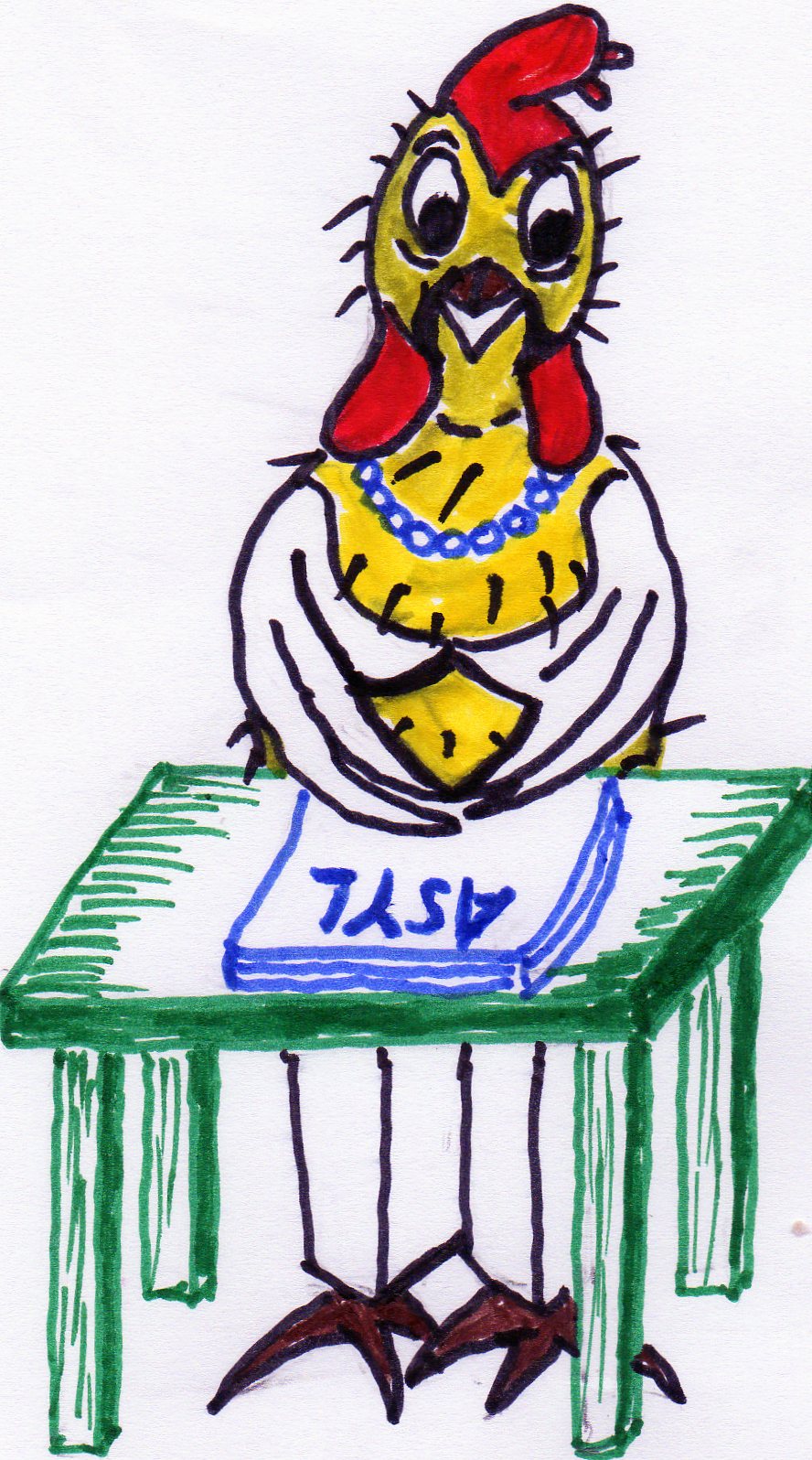 Accordingly, the facial expression he offered Gerlinde and which was mirrored one-on-one in her face – if, these days, it was possible at all to see anything of her face in between those extremely obtrusive illustrations in the ’Frankfurter Allgemeine’ – while he was eating his breakfast egg, naturally, looked a little strained.
Carl noticed how reliable his gut feeling had been when, at long last, his secretary Bettina offered him his usual cup of coffee in the office. Because her meaningfully pursed lips, wide-open eyes and several attempts at moving the cup of coffee closer towards him were certainly no good omens.
When she proceeded by telling him that Dr. Osterkorn had asked everybody to a meeting at ten thirty in the big conference room – no documents to prepare – it was absolutely clear that his sinister foreboding would, again, prove correct …
The only surprise was that, on top of Bernie alias Dr. Osterkorn and a number of new and unknown faces, not only the other three sector heads, but also both TRIGA managing directors were present.
Apparently, Dr. Schäufele, the head of trading, was in charge of the meeting, since he had placed himself with a rather crumpled face and among constant whispering with his colleague Dr. Tuchweber at the head of the huge conference table.
In accordance with the sober atmosphere, Carl unobtrusively sat down next to Miriam Braun on the only vacant seat.
Dr. Schäufele was immediately in the middle of things! After greetings by the concern heads from Düsseldorf he read in a rather pronounced way, reminding everybody of the gigantic national task that, due to the dramatic change in the German political situation, we were now facing without once looking up from his text. He also said that the concern heads were going to approach this task with a huge amount of respect and responsibility.
It went without saying that, in the face of this unparalleled challenge, the TRIGA company, too, would – this was the first time Dr. Schäufele actually looked up from his manuscript – contribute to the best of its ability!
This was especially important, Dr. Schäufele continued, since our Federal Chancellor had given a clear signal with her “We Can Do This”! In her inimitable way, without getting lost in details, she not only invited every state in Germany, every community and every town, but also every individual citizen to cordially welcome all the refugees from Syria. Everybody is called upon to make him- or herself part of this European task and go right to their limits and beyond when it comes to human and financial resources. And since the processing of asylum seekers will be a lot faster in the future, all this can be done without a considerable increase in federal funding, says the Federal Chancellor!
It is hardly a surprise, said a tight-lipped Dr. Schäufele, that, due to this exemplary attitude of our Federal Chancellor, huge parts of the press celebrate her and even some mention her in connection with the Nobel Peace Prize!
Instigated by these jolting words from the Federal Chancellor, the concern heads now appeal to all concern firms to also contribute to this great national program and think about including young, trained and untrained refugees of war in their projects! Particulars about how this has to be done, so Dr. Schäufele, will be worked out by a specially installed working group at the appropriate time for the entire concern. And then forwarded to all the individual sectors and departments; it went without saying that, naturally, all unplanned personnel will have to be integrated into the existing work processes within three years in order to make sure that both the current and medium-term sales and profit goals will not suffer and that there is not the slightest interference with the concern numbers as determined; because nobody – ladies and gentlemen – Dr. Schäufele admonished everybody with a baleful expression, which was accompanied with an intense nodding of the Technology Manager Dr. Tuchweber, can and wishes to risk a profit warning of the concern, even in these difficult weeks and months! Nobody can wish that! Absolutely nobody!
And as a prophylaxis, Dr. Tuchweber interrupted his colleague from trading Dr. Schäufele, he expects the entire leading crew of the TRIGA firm to influence their employees in such a highly motivating form that every one of them realizes how serious the situation is and thus not only works at a hundred per cent of his or her capacity but at those implicitly demanded a hundred and twenty per cent of said capacity! Because this was the only way, Dr. Tuchweber admonished the assembled listeners with a stern look, for Germany to master this gigantic task of channelling the streams of refugees in an organized way.
In the face of the high spirits unfurling all over the meeting room after this intense appeal of the management, Carl did not dare to ask the question if the concern heads themselves, too, were thinking about a contribution of their own by providing extra hitherto unplanned money for this so great national task. Instead, he just whispered the question into the ears of the person responsible for underwear sales, his neighbour Miriam Braun.
But even as Miriam Braun shrugged her shoulders several times with a helpless smile, Carl already became quite convinced that both the concern heads and the managing directors, just like the members of the Federal Government, were not to be envied for their quite well-filled money bags. Instead, the one thing they were to be envied for was the fact that they were all ’blessed with having no idea whatsoever’. This cluelessness has been created and guaranteed by a hierarchical order and command structure that removed everything not meant to be heard or seen ’in the upper regions’ through a precise and well-oiled filtering system!
Yes, even the production of such a banal thing as underwear followed this pattern.
Since, however, Carl had no intention of being subjected to this blessing, in fact he even started suffering from an unexpected case of sickness that might well threaten to befall the other persons in the room and even in the country, he spontaneously jumped up, shook his head and left the room, to the surprise of the other participants of the meeting …
KH
Roland DürreTuesday September 8th, 2015
Dear Governments: Why Don’t You Think Harder – Before Coming Up With New Legislation?
§ § § § § § § § § § § …. … …
As I see it, ever more doubtful bills are passed quicker and quicker and with less and less diligence. This is true on the Bavarian, German, and European level.
Let me illustrate it using some harmless examples – harmless because probably nobody has ever been truly or severely punished or suffered from any of those bills. And they probably never caused any serious misery.
Among other things, I am talking the Culturally Valuable Goods Law, which they want to reform and make stricter, the Tele-Media-Law with its Disrupter Accountability (which is about accountability when using WLAN) and, last not least, the very controversial Tariff-Unity-Law.
The first of these three bills has been passed on August, 10th, 1955. It was supposed to prevent the total sell-out of German sacrosanct objects of historical and artistic value. It was probably a reaction to measures taken by countries such as Egypt who wanted to make it harder for foreign countries to steel their historic objects of art.
Now they want to modernize it – and even in this phase, they started a debate that, basically, makes clear what nonsense the bill is. For me, the question comes to mind: why do we not take a closer look at these laws before modernizing them? And why do we not ask ourselves what benefit and what damage these laws caused? Basically, we all know that all laws that have no use are detrimental by their very existence. And why are we not courageous enough to just abolish a law that has no use, anyway?
But no: instead of sweeping through, they come up with new useless laws all the time. Because they feel it would be a little too courageous to just abolish laws. But why?
In the same way, the issue of “disrupter accountability” as part of the Tele-Media-Law only causes misery. On my travels, I am often fascinated to see how unproblematic access to the internet is in many countries. But woe to the person who enters Germany …
To me, it also seems that disrupter accountability is one of those topics that particularly appeals to the outcry for security and the distrust culture of our civilized world, but also to the German mentality (German “angst”?). Who of us would want strangers to be given a right to trespass through our property?
The Tariff Unity Law is another example. Another nonstarter. Let me cite from Wikipedia:
Starting with July, 10th, 2015, we have the Tariff Unity Law in Germany. It says that, if labour agreements collide in one enterprise, only the tariff agreement of the union which had most members when the last agreement was signed can be applied. The law was subjected to strong criticism both from unions and the opposition and has been made the object of several constitutional complaints.
There was no chance to see if this law is doing any good. Because, sadly, it will probably never be installed. After all, even the first case it was used on turned out a failure. I am talking the argument between the GDL (Gewerkschaft der Lokomotivführer) and the Bahn AG. Well, basically this tariff argument was why the law had been instituted.
So what happened? The only reason why the opposing parties could agree during the mediation talks (incidentally, the mediator was a county governor from “the Leftist Party”) was that they both agreed that the law was never going to be put into practice. This is how the road was paved for the agreement.
For me, this sounds a lot like:
I write a program for a customer. And the first thing he does is agree to never use it. Well, would that not be a reason to start having doubts about the performance of my program …
Incidentally, there are other bills that have never been applied in practice. One of them is the Employee Involvement Law. In the spring of 2010, the Great Coalition decided to make it very attractive tax-wise if employees get more encouragement to invest in the enterprise. It is a rather complex law – and as far as I know, it has never been applied.
Both this and the aforementioned topics are hardly ever mentioned these days. The same is true for the Road Charge Law – the discussion of which was not that long ago either.
In fact, I believe that legislation is one of the areas where the simple wisdom “less is more” should be applied. But what we do is the opposite. Both the European and the national clouds let one law after the other rain on us. And quite a few announcements will give us pause like thunder and lightning. For instance, Frau Nahles wants a new regulation for “Fake Self-Employment”. She declared that the goal is to make sure everyone in our society actually pays into the social security insurance.
Well, I am absolutely sure that nothing good can come of this. I already look forward to seeing the results.
RMD
(Translated by EG)
Roland DürreSaturday August 29th, 2015
“Why Don’t You Have A Euro-Flat-Rate?
A short time ago, a friend of mine who also spends his vacation here asked me this question. After all, he knows how much I travel in Germany and Europe. Well, the question astounded me – and I was wondering why, indeed, do I not have one? As it is, I always have to beg for WLAN passwords. Wouldn’t it be convenient if I could always have access to the internet, no matter where I am and independent from the WLAN drama in Germany and some other countries?
As always, I needed a few days to think about it. And each day, it became clearer to me why, indeed, I do not wish to have this kind of flat-rate. And that, in my opinion, this is the wrong approach. Which is also why I will continue to always look for the nearest hotspot on my travels.
First and foremost, I simply find it too complicated. After all, during my travels, I also use several devices for access to the internet. Besides my Android-Smart-Phone, there are two tablets: a big one if I carry a lot of luggage and a small one, for example for bike tours. Sometimes I travel with the MacBook Air – in order to be able to work efficiently – and sometimes with the Chromebook. Or, as now in our tent, I have both of them with me.
And I definitely do not feel like equipping all my devices to make them become mobile radio compatible. And to me, “tethering” also looks like a less than optimal solution. The rechargeable battery of the mobile telephone will be empty in no time. Some way or other, that is also too complicated. After all, all my devices have the WLAN function as a matter of course.
And when all is said and done, the world-wide transmitter towers erected by the telecom companies, too, are not really sufficient. Which means that I would not really gain very much. But deep down, my refusal of private flat-rates has philosophical reasons. Basically, I do not wish access to the internet at all times and in all places. For me, it is totally sufficient if I get the chance to access the network once in a while on my travels. For instance in the evening at the hotel or on the campground.
And there are certainly more than enough WLAN networks wherever I stay. Unfortunately, however, and for totally irrational reasons, they are often nailed shut with passwords. I find it a fair and uncomplicated procedure to share WLAN hot-spots for high-power networks.
Perhaps a good metaphor for using private flat-rates world-wide is individual and private mobility. That is also an area where they thought they could do without making the transport of materials and humans a common duty as long as everybody has his or her private means of transportation. Then we got the many small and big vehicles with the combustion motors that alone make you independent. Which is what caused the traffic mania of private mobility with all the consequences we see every day.
Consequently, I find fixed networks with open WLAN subsystems “on the last mile” better suited for my vision of a “Common Land World” than private and competing telecom companies.
There is a constantly growing awareness inside me of how many resources belong to all of us, that is: humans as an entity. And that we should not and must not use and destroy those resources as we wish and in private for unimportant things. Because soil, nature and water are too precious for our survival and the survival of the next generations.
One of the commodities I would also count among the Common Land is, for example, the absence of noise. There is no doubt that the thoughtless, accidental or also voluntary generation of noise destroys your quality of life. And that is why I only generate noise when this is absolutely necessary and avoid it wherever I can.
Free communication is a basic need of the modern world. We need it for our future. Would it not be nice if the access to all information of this world and the network connecting us all also were some kind of Common Land? A civil right for all humans. Like the air, which transports WLAN. Without any private special treatment?
RMD
(Translated by EG)
Werner LorbeerSaturday August 1st, 2015
Energy Transition is Germany’s Hobbyhorse
 Well, I admit the headline is a little polemic. I also admit that it is high time for us to “start”. In my definition, however, it involves more than just enjoying windmills and photovoltaic modules or swarm power stations.
Taking your pencil and doing the calculations with the unobtrusive FAZ article of July, 30th, will show you that the renewable energy production in Germany amounts to less, 00002 % (2 times 10 to the power of -5 per cent) of the world-wide coal-based energy consumption.
Compared to the global energy level, our energy transition is a technological children’s playground, some kind of lucrative hobbyhorse the progress of which is far too slow and that is far too expensive for broader use.
India, China, Africa, America, Australia will not forgo their rights to use coal. It depends fundamentally on implementing processes of civilization and technology in order to separate the standard of living from the carbon dioxide output. What we need globally is an economical, cost-efficient solution. Because the very bad news was written in the same FAZ issue:
 The world population continues to grow – and faster than we had anticipated.
Personal Opinion:
Once again, it will pay to think about the relation between investments and carbon-dioxide reduction. There is no doubt that there are better processes with respect to the carbon dioxide efficiency quotient than the ways favoured by us through the EEG. Just remember the filters for dust, NOx, SOx and also CO2? Quick, efficient, cheap! Or the possible green-linking of CO2 through suitable agricultural and forestry-related measures – which would at the same time be beneficial for Africa and South America.
Personally, I would rather pay an EEG extra fee that finally ends the abuse of our atmosphere as the rubbish heap of human civilization and that is internationally available as a development aid than continue to feed German wind and solar barons.
wl
(Translated by EG)
Roland DürreMonday July 6th, 2015
My “Destina”
🙂 From the South-Sea Island of Runit to Munich Rosenheimer Straße.
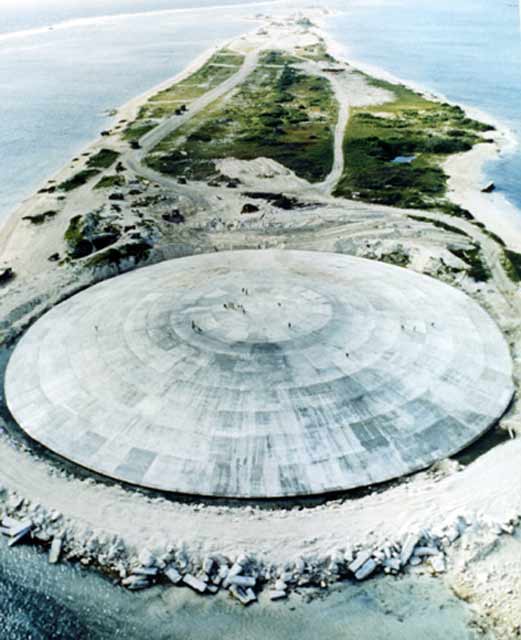
”Runit Dome 001“ by US Defense Special Weapons Agency
In the SZ weekend edition (July, 4th and 5th, 2015), I found two articles that horrified me. And I posted them as often as possible in Facebook, Google+ and Twitter.
The first article appeared in the “knowledge” sector and was titled: “Dome of Death”. It is about what the 67 nuclear bomb tests executed by the USA between 1946 and 1958 on the atolls Eniwetok and Bikini left behind.
The second artikele is titled “Extensive Human Tragedy” and tells us about a declaration by the Nobel Prize winners they published during a meeting in Lindau, demanding a fierce fight against the climate change (Klimawandel).
In the first report, the extent of the catastrophe happening in the South Sea truly horrifies me. It again brings back to my mind what a huge danger radioactive waste is. And how small-minded and futile the current attempts to find safe disposal zones in Germany are. Again, politics terminated a project that, de facto, is destined to fail.
I can well understand both the people and the counties opposing a disposal zone. After all, it seems to me that contaminating even more regions on this earth is the biggest possible mistake. Because, naturally, there can be no safety in this area.
Here is another note. The aforementioned article also again mentions that plutonium is one of the most poisonous of all radio-active materials and has a half-value period of up to 24,000 years. Well, in times when we are constantly confronted with billions, 24,000 years seem almost negligible, don’t they? Except – it has been only 2,400 years ago that the first human cultures invented writing – and that is one digit less.…
However, the second article made me almost more furious. In all fields of our lives, we trust science. When we eat food, we trust that science guarantees us healthy nutrients. When we fly, we are sure that, thanks to physics, we will not fall down. We get vaccinations and trust in science. When driving cars, we trust our airbags and even when we ride a bike we follow the laws of science.
But whenever said science provides us with matching results from different disciplines and sources, we do nothing if we do not like those results. My special fury is directed to our current government.
Regardless us of being bankrupt ourselves, they stage a “Western Community of Values” that costs hundreds of millions of Euros in Elmau. And all they can show for it in the end is a few “programmatic decisions” – all of which, even a few days after the declarations, turn out to have been nothing but lip-service.
Germany’s government actually celebrates itself for being the teacher and guardian of public virtue for all Europe and does not even hesitate to come up with slogans such as: “If the Euro dies, Europe will die”. Incidentally, this is a statement that, like many others from the same source, will not survive dialectical questioning.
For the Greeks, she has a program even the IWF finds totally counterproductive, demanding that they must reduce the retirement money they pay but that they cannot under any circumstances reduce their military budget.
And much more of the same.
Except that she is not doing her homework, for instance by introducing a general speed limit in Germany. She does not put a stop to the gigantic subsidies of company cars. Putting taxation on plane kerosene, too, is something she cannot even allow herself to think about.
And she bathes in self-praise, looking on as infra-structure and education in this country go south. How profits are privatized and losses are socialized and thus how the rich get ever richer while the number of the poor increases along with their dwindling property. To make up for it, she is number one in Europe when it comes to indoctrination and coming up with stupid dogmata.
That is when I occasionally start asking myself if my “destina” might not be to fight all this stupidity and counter-productivity. But that would mean I have to stop doing what I am currently doing, namely linking and mentoring persons and supporting start-ups. And I have not yet quite reached that stage.
RMD
(Translated by EG)
P.S.
Tonight will be the first time in many years that I will again be part of a demonstration. I will sit on my bike and ride it for a fair distribution of space on the Munich Rosenheimer Strasse: Radel-Demo Rosenheimer!
P.S.1
I took the picture “Runit Dome 001“ by US Defense Special Weapons Agency from Wikipedia:– http://sonicbomb.com/albums/album61/runit.jpg. It is licenced under “common property” through Wikimedia Commons –
Roland DürreWednesday July 1st, 2015
No More Border Controls, but More and More Camouflage Manhunts
This morning, I heard an interview with our Bavarian Minister of the Interior, Mister Herrmann, on “Bayern 2”. The background was that it has been decided to use more and more policemen for camouflage manhunts! As a justification, they pointed out how the increased dragnet policing they had had so much success with during the otherwise allegedly also ever so successful Elmau G7 summit. At least, as we all know, our politicians were extremely happy with the results of the event.
 This is how it works: in the name of a European Vision, you abolish border controls. But not altogether! Because even during the Elmau event, there were border controls – I experienced this myself at the Austrian border sitting in the DB IC bus on my return journey from Zurich. However, I did not read anywhere what policing successes these measures are supposed to have rendered. Or if the success of said measures is already included in the aforementioned numbers. But I only mention this as a sideline.
And now camouflage manhunts are going to increase. First it is going to happen near the borders, then, because it is such a huge success, they will extend them further and further. Until finally they will also happen in the cities, because that is where they probably make most sense from the policing point of view. Provided we do not already have them.
Personally, I already almost wish we were back in the good old times with just normal border controls. Some way or other, those were the days when I knew what to expect. As opposed to this, a surprise control is always at least inconvenient and a nuisance. One of the reasons for which is that the controllers always have to expect the worst.
But this is how, unfortunately, the “European Unity” works. The EURO is heightened to become a sacred cow and inhuman behaviour is justified by claiming we need to defend our “community of shared values”. Our constitution is weakened by higher (European) regulations. Our freedom is reduced on many levels, an increased social injustice is sped up and we collectively subjugate ourselves under some obscure belief in eternal growth. And there is more and more “bureaucrazy.
And as a constant and mantra-like justification, it is said that all this is absolutely necessary. Any other behaviour would threaten the European Idea, our prosperity and, above all, our jobs. Mind you, in many “weak” European countries, a dire job situation is more than readily tolerated.
I am truly worried thinking about my beloved Europe.
RMD
(Translated by EG)
Roland DürreSunday May 24th, 2015
The Mumbai MonoRail.

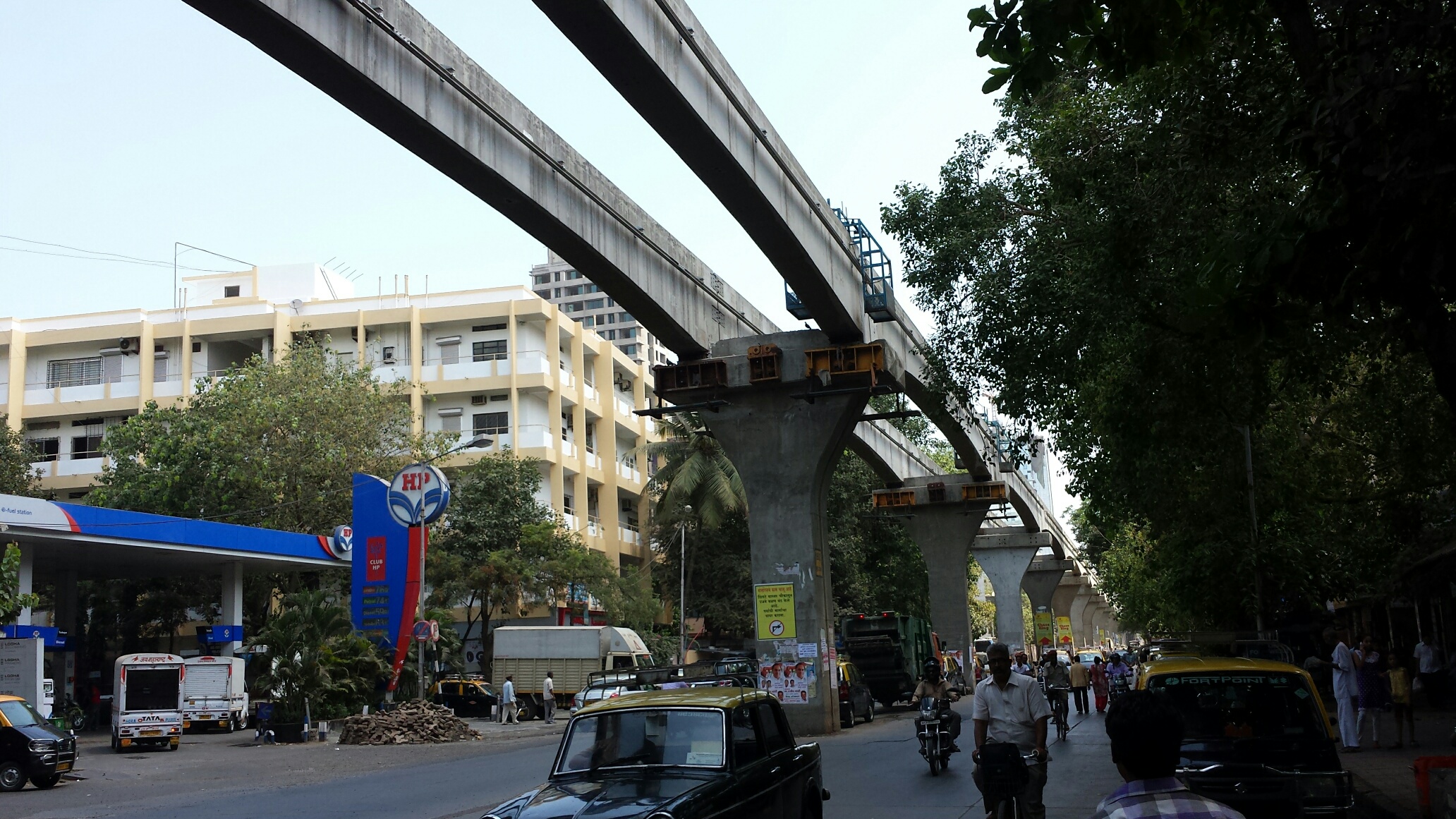
In the street facing the Dodha complex – which is the skyscraper I am currently living in – a lot of concrete is being used for building the MonoRail tracks. Over the narrow street, a two-lane concrete line is snaking its way through many very different houses. Eventually, it is supposed to prepare the way for the Mumbai monorail train through the city.
The only other project of this kind is the “Fly Over”, probably the most important higher-level street in Mumbai, part of which also detours onto the ocean, thus connecting the city districts and their skyscrapers. As I already wrote, you can categorize the skyscrapers into three classes: “already finished”, “still under construction” and “not finished, but no longer under construction”. In fact, I am sure you could find quite a few other exciting categories, as well.
Somewhere in Mumbai, the MonoRail is already active, connecting it to a not-yet finished future city. It has almost become a tourist attraction. However, one cannot really call it a tourist attraction in the same league as the magnetic levitation train to Shanghai Airport.
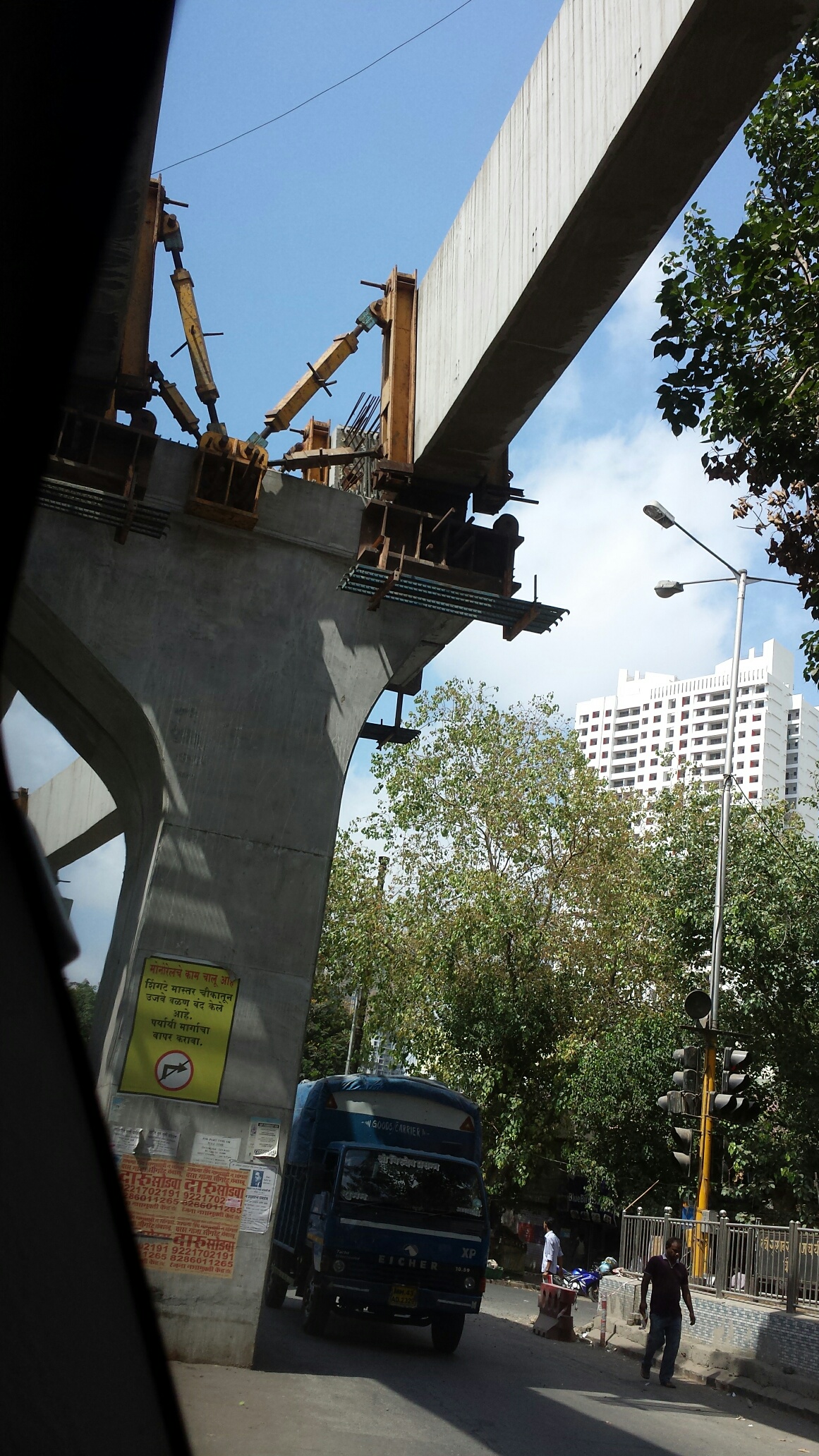
To me, the MonoRail looks like a prestige object of Mombai. In terms of public transportation, I doubt that it will be all that beneficial. But then, a MonoRail is definitely something special and therefore a good means to improve the reputation of Mumbai as a modern city. Besides, the project will also mean that some very rich will become even richer. In India, a few always means a few more. And whenever a huge project will increase private prosperity, then it is definitely justified.
A short time ago, a new government was installed. It is leaning towards right-populist. Instead of dealing with apparent problems, the first thing it did was forbid the consumption of beef, making it punishable most severely. And before the elections, they promised to install air-conditioning in all those many old Metro trains with open doors and windows. Because AC is always something people are in favour of. This intent is probably something totally impossible to put into practice.
In another district, they want to introduce an identity card for every cow. In order to guarantee that the cow has a happy life. Regardless of the fact that India is one of the world’s biggest – if not the biggest – beef exporting nation. However, it seems more like these measures are meant to oppose Muslims, who allegedly are the powers behind the Indian beef industry.
To me, it also seems the women are still treated rather strangely in India. They do not seem to be met at eye-level, there is always the insinuation that they are second-class persons. Sexuality is rather absent from public life, so it seems that the society is a rather prudish one.
And apparently, this causes friction, at least among the male population. In order to avoid escalation, you get separated compartments for women in the often over-crowded metro. Just like there are compartments that may only be used by disabled persons or cancer patients. These are easy to recognize by the symbol for cancer, which is a big circle with a huge crab in the middle and the handicapped symbol we, too, are familiar with.

We, however, being Westerners, mostly go places by car (a white Toyota six-seater) and consequently spend (too) much time on the streets of Mumbai. Somehow or other, there is no alternative. Even if we go only short distances, it takes quite long, because of the traffic jams. The ever-present AC makes it bearable.
Our driver works for a company that is a sub-company of a sub-company of a very big company. They also drive for Western companies. Formerly, these enterprises had their own cars and employed drivers. But that was expensive – although objectively it was very cheap. And then they started saving money and outsourcing.
Now, the combination driver/car is supplied as a full service by huge enterprises, using various providers. Some provide the cars, others the drivers and again others the service. The drivers get less money, the customers are less happy, but the enterprises make a mint. Basically, all services seem to be provided by huge service enterprises.

Foreign companies in India mostly produce things that probably nobody will need any more in the near future, for instance turbines for steam engines. They are for coal-fired power stations. In fact, they mostly do not produce the high-end products. After all, who wants a steam turbine from India for his nuclear power station?
As early as May, the temperature is higher than 40 degrees Celsius, even in the office buildings where the engineers work and where the quality management and similar things take place. You have propellers on the ceilings, but no air conditioning. Because electricity is expensive in India. So it is no surprise that the customers are not always satisfied with how the projects are finished.
The representatives of the state are all friendly and eager to help, which is true for most of the people I met in this country. Allegedly, however, corruption has gigantic dimensions: they say that, without small or larger contributions, nothing goes.
Some families are incredibly rich. The truly rich persons can afford everything; the high import tax on luxury articles does not make the slightest difference. In some underground car parks, you will find a collection of the newest cars with the logos we know quite well, next to some vintage cars that look like they were new. The rich live in fenced communities. In the underground car parks of these areas, you will see entire brigades of people giving their luxury state coaches a new polish after each outing. I have not often seen so much car tin polished to high-gloss and shining chrome as during my few days in India.
More and more people get poorer and poorer. They live on streets that, to my perception, seem even dirtier than they used to be. People live in circumstances that almost defy description. As soon as, two weeks from now, the monsoon will arrive, their homes will regularly be under water.
Live is considerably better in the mostly self-administered slums. But it is not at all easy to get access. Especially if you have absolutely nothing.
At the crossroads and noisy streets, beggars are aplenty. Among them are women and children, elderly persons and handicapped persons. Some women carry a toddler or small child in their wraparound garment while begging. Strangely enough, those children always seem to doze. I never saw any of them cry or sob. Someone told me the babies get medication in order to make them peaceful when the beggaring is under way.
All of Mumbai has a funny odour. You could say it smells. Leaving the plane is not the only moment when you realize that this is so. It seems like the rubbish and dirt increases every year. And Mumbai is a noisy city.
On the 29th floor of the skyscraper, the smell of the city is a little less obvious, but, regardless of the so-called “sound proof window”, this is not true for the noise. On the cars, it often says “horn me” – and that is how it sounds, too.
In between all the common noise, both in the day and at night, you will occasionally get the shrill trumpets of the railway and the loud humming of the helicopters. They drive and fly both by day and night. The noise of the trains comes from below, that of the helicopters from all sides as they fly over or between the skyscrapers. And from above, the noise of regular air traffic will add to the ruckus. All of these contribute to, again and again, robbing me of my sleep in the hot Mumbai.
Some developments I seem to remember from home. Well, not quite as strongly as here. But at home, we also have notices for building contracts concerning public transport where providing the vehicles and the drivers are separate affairs. Especially as a biker, I notice that the plastic waste along our streets constantly gets more. Just like I discover more and more prestigious projects and a tendency towards gigantism by our administration. I also know laws that make no sense and politicians who are incompetent in Germany. And the fact that society drifts apart is not something unknown, either.
It seems like we are learning from the Indian example. But then, as I see it, this sort of “progress” and “growth”, which I am not at all in favour of, seems to happen all over the world: in India and Cuba, China and the USA, Italy and Portugal… And also in Germany.
Luckily, we at home have not yet reached the dimensions I witness in Mumbai. Yet the tendency seems to be the same. The question is: will we manage to turn around? In India, I see no hope that it might still happen.
When I last visited India late in 2013, one Euro still changed into more than 80 Rupies. Currently, I get 70. I ask myself how many Rupies I would still get for my Euro late in 2016? Perhaps only 60? However, since my last visit, life in India has not become any cheaper.
This makes me thoughtful. Perhaps the Indian society is actually the pattern after which the future will form itself –in our country, too?
And yet!
So far, our days in Mumbai were very nice. To be sure, we had a privileged life. I was annoyed to witness the circumstances as I related them. Because noise, smell, sitting in the car during traffic jams and similar things are not at all the world I feel comfortable with.
Yet it was a good time with very happy days. It was nice to share and experience so much with Barbara, my son and his family. And I was lucky enough to see many “Shiny Eyes” in the faces of many simple and certainly in those of poor people on the streets. That is also something to make me happy.
It is probably both the sad and nice thing about being human that we can stand and endure so much. And absurdly enough, we find it easier to be happy when we have less. And when we have to suffer a little. As soon as we are too well off, the shiny eyes disappear in expensive pubs and bars. And near the swimming pool, more often than not, the only shining eyes you sometimes see are among the children.
Consequently, you get happy eyes more often in Mumbai than on the streets of Munich. Basically, this is incredible. But then, I got the same impression during my bike tour through the west of Cuba a few months ago.
RMD
P.S.
I learned the term “Shiny Eyes“ from Nadja. With her work, Nadja wands to contribute towards “more shiny eyes”. As I see it, this is a wonderful idea.
Roland DürreSaturday May 23rd, 2015
Mumbai and its Skyscrapers.
 We are spending this week in Mumbai and living with my son in the Mumbai Dodha housing complex. At first sight, it looks like a very well-maintained housing area with a beautiful club building and swimming pool. It has two towers with 49 structural levels. My son lives on the 29th floor with bright rooms that are considerably higher than three metres. It is a very nice flat with a wonderful view of the ocean. However, they built a new skyscraper with many flats exactly between the ocean and Dodha, which now makes it impossible for many of the Dodha flat holders to see the ocean. We just manage to look around the new skyscraper.
Late in 2013, I already lived here. During my first night in 2015, I was surprised, because I seemed to remember even more noise. So what had happened? Well, the answer is easy: not far from the building we are staying in, more skyscrapers still in the construction phase rise to the sky, among others the one I just described. During our last visit, they were just in the construction process, and I mean day and night – and that had made the noise almost unbearable.
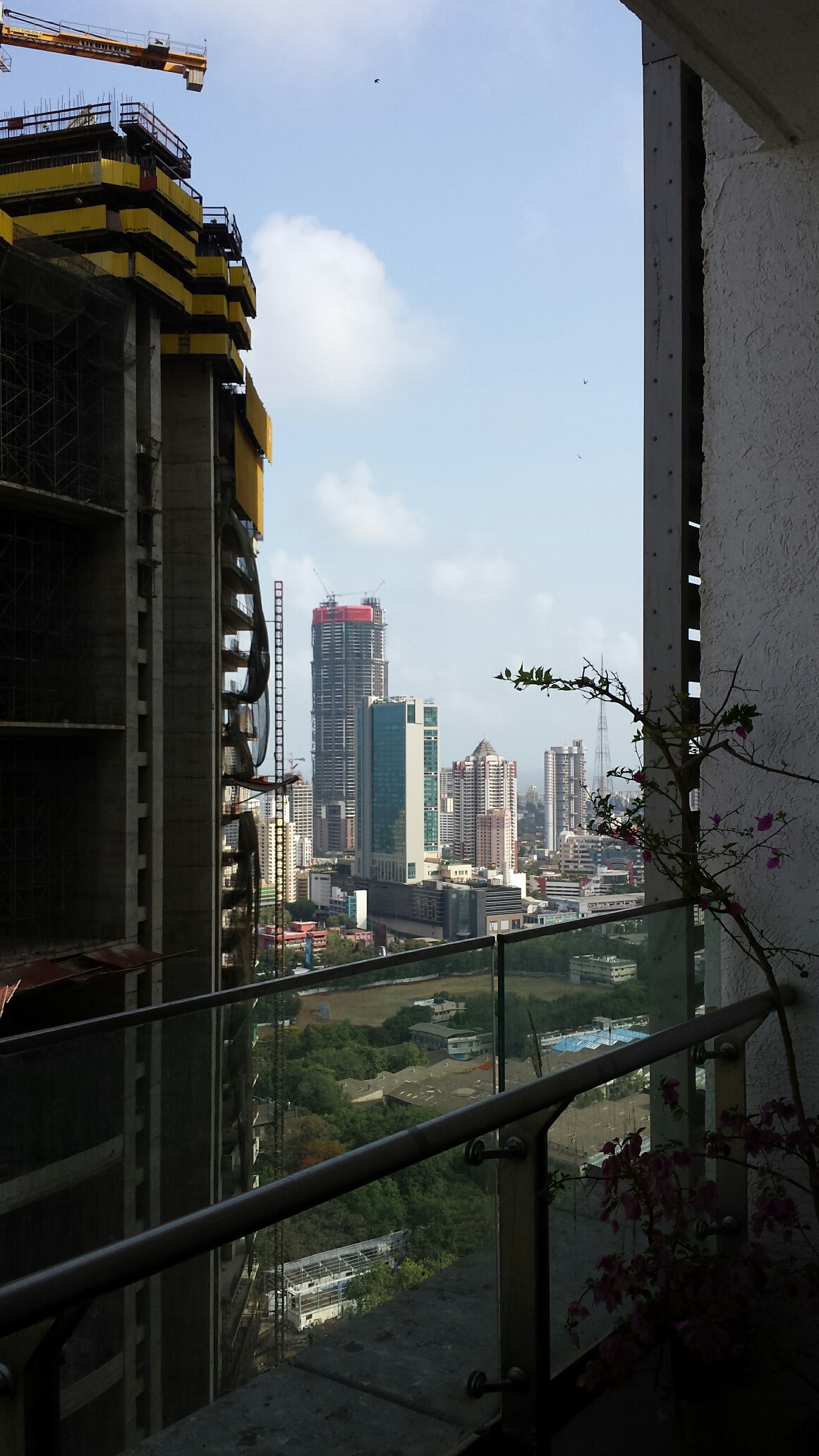 Now the construction work has been terminated one year ago. As likely as not, it will never be resumed. Because the construction company closed down. The skyscrapers facing our flat have become hideous ruins. But they are not the only closed down skyscraper construction sites in Mumbai. You can see huge building shells without any construction activity going on in many places all over the city. Many of them already look like ruins.
There is a simple explanation for this.
Either the construction companies are bankrupt. After all, in India, the concept for getting rich is simple: for instance, you start a realty project and sell the flats in advance. There is more than enough money in India. Then you build the house. Naturally, as you proceed, the costs will increase. But not only by around 70% as in Germany with huge projects. Here, too, the Indians have surpassed us.
So what do you do if you find it will cost more? You start new projects that will be planned and sold. Using the money from those projects, you finish the first building. And you use the good press you get for even more projects with which to finance the old ones. Except this is a snowball principle, isn’t it? And since they are always finite, you will soon have a few concrete skeletons sitting around. For me, they look like threatening memorials of a degenerate economic system.
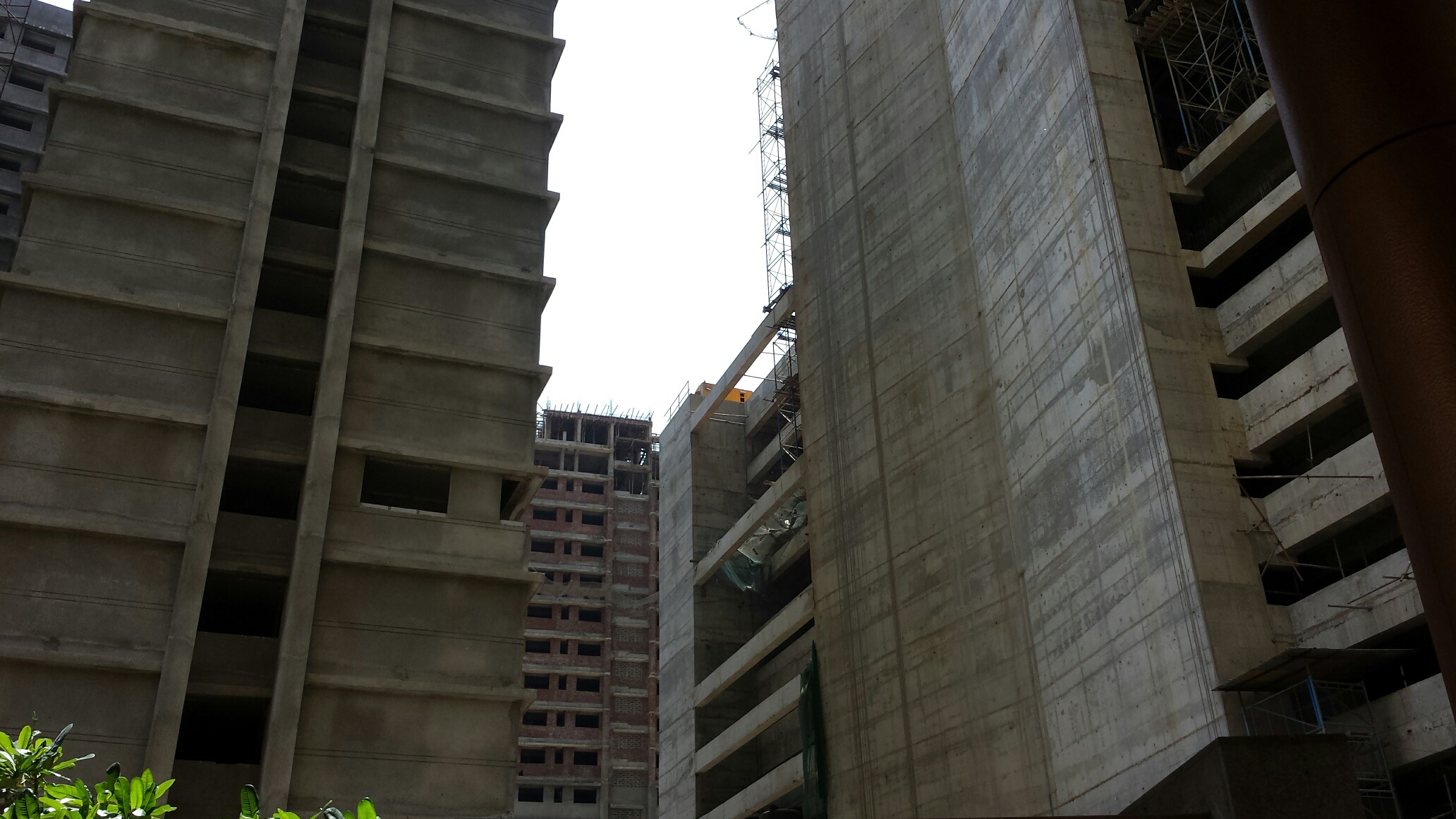 Sometimes, you also see skyscraper construction sites where work has been terminated for another reason. The builder-owner dramatically ignored the official requirements. Perhaps he was hoping to get away with first creating facts which later can be cured by bakshish. Except this method is not always a success, perhaps even because the competition offered more money. Now the authority demands deconstruction.
Except how to deconstruct a skyscraper you started with twice the base area you were supposed to? So what you do is just let the concrete skeleton with all its many floors sit there. In neither case, you need to continue, because, after all, you already did your business. The money has been earned and ended up in all the various private purses.
And we are talking a lot of money. Let me take the towers I am living in with my son as an approximation: there are six flats on each level. If you have 50 levels, that means 300 flats. Depending on the situation within the tower (before the unfinished skyscraper was built right in front of it), the flats were between 1.5 million (lower floors) and two million (upper floors) USD. That gives you a total project volume of 45 million USD: Well, that should suffice for all the parties concerned to become rich: the financiers, the salespersons, the project workers, the lawyers.…
The ones who suffer are those who bought the flats. However, they are mostly so rich that they hardly notice. Besides, they also know where and how to retrieve their money. Eventually, it will be the public. As usual – the profit has already been privatised, the loss is socialized – at some future point.
Consequently, you see them more and more often, the Mumbai ruins. But it seems that nobody is really upset about them. The poor ones living down in the streets are certainly not upset. Why should they revolt against things they cannot change, anyway?
However, in Mumbai you also keep coming across new construction sites where people work industriously. Among them are those buildings that, a few years from now, are supposed to be the highest buildings used purely as living quarters world-wide…
Please note that, when writing this, I do not wish to criticise India or Mumbai – in fact, no matter what I see here, I always have to think of back home!
RMD
(Translated by EG)
P.S.
The building I am currently living in is perhaps 15 years old. Yet some of it looks like, basically, a renovation is more than due. At least if your socialization happened as middle-European as mine did.


