
Roland DürreThursday April 21st, 2016
Letterbox Companies, Corruption and More… (Series) #2
Today: Bribery & Secret Accounts
When I was still generating application software, I always had to do requirement engineering. Well, the term had at least the advantage that the word “management” was not part of it. Today, one would probably call it “requirement management”. Now, however, I prefer the more agile approach of a system outline with “user stories” and “use cases”.
Regardless of how you name it, you will always find something like Entity-Relationship-Models (ERM). Objects, or rather classes of objects, are described along with the qualitative relationship between said objects or classes of objects.
For me, the best example of an ER model is love. You have the lover (entity E1), love (relationship L->) and the beloved (entity E2), also E1 L-> E2. Of course, it is true for both sexes.
And as soon as the relationship is symmetrical (<-L->), you get a “Happy End“.
Even the doubtless very clever Jesuits as the best thinkers of the Catholic Church used exactly this same metaphor in order to make the incomprehensible and often doubted Trinity Dogma look humane. They simply made God the Father the lover, the Holy Spirit love and Jesus the beloved one.

🙂 Was waren das noch für Zeiten, als wir diesen tristen Schein sauber gefaltet und tief versteckt als eiserne Reserve in der Tiefe unseres Geldbeutel hatten.
Bribery can also be defined as an entity relationship model. There is a briber, the bribery and the bribed person. As early as a few decades ago, we had a controversial discussion and debate during a Rupert Lay – at the time he was considered the doyen in business and society – seminar.
All managers present agreed that bribery, at least if a German civil servant is concerned, is an absolute “no-go”, because it is definitely forbidden by law. However, bribing a buyer in a society that is definitely corrupt – for example in order to preserve jobs – might well be ethically acceptable. After all, someone else might otherwise do the bribing. And besides, our tax offices accept a declaration where “special expenses” are permissible up to a certain amount of money without giving the name of the recipient.
So much on the management concept of the 1980ies. Personally, I saw – and still see – matters a little differently. One reason is that such reasoning would make any behaviour acceptable, even using other unethical means – for instance violence. Another reason is that this kind of bribery would just make the wheels of corruption turn even faster.
How does bribery look in (real) life?
As a general rule, corruption consists of a system of illegal accounts. After all, it can only work if the briber (E1) and the bribed person (E2) remain unknown. Consequently, you have to take the money out of the enterprise circle as early as possible and transfer it into the shadow realm of illegal money.
In this realm, there are no rules – or rather, individual persons make the rules. As we all know, individual persons are weak and can easily be tempted. Especially if their social background is a corrupt system like the illegal account system showing them how to do it.
Humans love themselves most. And their sense of justice will protest if a corrupt person from an alien world is to get such a huge amount of money on top of everything. Consequently, they take a considerable sum out of the bribery money for themselves – which, in my opinion, is easy to understand. Any other behaviour would be more than stupid.
I assume that (more than) half of the bribery moneys paid never reach the bribed persons. Instead, it remains with the bribers. That is what makes bribery so problematic. Because all of a sudden, the ERM becomes symmetrical. The briber wants the bribery as much as the bribed person, because they have become accomplices. The lie “you have to bribe because it is the general rule” becomes even weaker than it already was.
It goes without saying that the money that has been paid to both parties must end up somewhere – and, again, it gets clear why so many fake companies exist. This is how we get back to my first article of this small series. In my next two articles, I will describe in detail how I was to be bribed.
RMD
(Translated by EG)
P.S.
I took the picture of the 1,000 – Euro bill fromWikipedia.
Roland DürreWednesday April 20th, 2016
Entrepreneur’s Diary #116 – Social Media: Corporate Twittering
Modern enterprises want their employees to “actively participate” in the company. The participation of the employees when things are developed and their actively being part of decisions is considered a positive asset and a necessary requirement for a secure future. Terms such as “democratic enterprise” are en vogue. Some even get enthusiastic about holocracy (Holokratie), which is a term I like to intentionally misspell as “holocrazy”.
Yet I have all the respect in the world for the underlying intensions. Just as I also very much appreciate the ideas about “Common Good Economy” (“Gemeinwohlökonomie” – for instance as initiated by Christian Felber). But how is an enterprise supposed to manage the necessary change?

My Twitter Windows.
As I see it, social media play an important role when it comes to trying to establish the culture of an enterprise – both internally and externally.
For change and modifications, communication at eye-level and an internal intranet that works a little like the well-known social media systems à la Facebook are an important requirement. Today, we also call these concepts “Corporate Social Media (CSM)“. Perhaps we will soon have an “SMO” on top of the SEO (search engine officer who is responsible for the search engine optimization) – with the SM, naturally, not being short for sado-maso, but for Social Media (Social Media Officer).
I am a little sceptic about a CSM who has been appointed from the top. The employees should initiate the transformation. The same is true for the very popular term CSR (Corporate Social Responsibility). It is about how an enterprise can live up to “ethical expectations”. This is also one of the tings the basis must want and work towards.
You will immediately understand my scepticism about CSR initiated by leaders after, for instance, having read the books by Mr. Otfried Höffe. His books have become standard literature at universities in the ethics faculties. I have no idea why this is so, because, as I see it, the books contain poor material all the business students have to learn. They do not satisfy any philosophical requirements.
But then, I am an evil sceptic who even considers the valuable term BGM (company health management) ridiculous, regardless of it not even beginning with a “C”. Incidentally, I distrust abbreviations that start with a C as a matter of principle. This is not only in politics and not only when the C is for “Christian” or “Corporate”. I am also very cautious when it comes to all combinations and abbreviations that contain terms such as management, manager or officer.
But now let me write the constructive part of this article. I would like to show with the example of twitter how you can actually manage to make people inside an enterprise really enjoy the meaningful use of corporate social media addressing the world outside the firm. The motivation of the employees is joy and intrinsic, without any special incentives or such.
How to make an entire enterprise twitter and thus authentically demonstrate its strength in the network, at the same time showing its nice collection of great individualists and presenting them to the market?
As you can easily imagine, this cannot be done through centrally controlled marketing strategies that follow ancient concepts. The role of marketing is among the things that need to undergo drastic change. Virtues – and I do not mean new virtues – such as the subsidiarity principle that is based on trust and error tolerance must also be re-established.
Before I elaborate on the details, I would like to point out the difference between “collective enterprise twittering” and the “functional twittering” as it is done by the National Railway (Die Bahn@bahn) or the Telekom with their twitter accounts (“Telekom hilft” @Telekom_hilft – I tried it myself when I was in an emergency situation and it helped me a lot). It makes a lot of sense and is often a good way to get the attention of these enterprises when you have problems. And it is also often the only chance a user has of being heard when the hotline or other “normal” channels that should connect you with the enterprise fail.
For the enterprises, the use of these social media channels is quite beneficial, because it helps to release the burden of the expensive hotlines that by their constantly being busy already annoy the customers. And, as a general rule, good social media services can be offered much cheaper than the classic help desk.
But this has nothing to do with “corporate social media” as in “here, the employees twitter”.
In order to twitter collectively as an enterprise, the first thing you need is a shared twitter account that is used by many, ideally all, employees. Initially, a defined team should do the exemplary twittering for the enterprise on this account and maintain the account. In the long run, it is, of course, desirable that all the parties concerned share the maintenance work and responsibility for the account.
Perhaps such a team should also help with some advice and organizational assistance as to what sort of communication is supportive of the enterprise and what is not. But then, most employees have quite a good instinct when it comes to this issue.
Also, all office buildings should have a screen installed in rooms such as the entrée, meeting halls and kitchens. On these screens, a twitter wall (here is the example of the ActMobCmp-Twitter-Wall) with current tweets is running at all times. Because reading the tweets your friends and colleagues have written will whet your appetite and encourage you to do some twittering of your own. This is how activity and shared directing will start happening by itself.
In this article, I used “twittering” as a kind of metaphor (pars pro toto) for social media in general. With Facebook, Google+ or also a Corporate Blog, it is not much different. Thus, Corporate Twittering is a good way to start more social media activities. As soon as (almost) everybody is enthusiastic, you can also try “Corporate Blogging”.
RMD
(Translated by EG)
P.S.
For more articles of my entrepreneur’s diary, click here: Drehscheibe!
Roland DürreSunday March 20th, 2016
Invitation: IF Forum im & AktMobCmp – Augsburg
Dear Friends,
with this email, I would like to invite you to the IF Forum on April, 28th, and remind you of my project #AktMobCmp, which will take place on May, 20th and 21st in Augsburg.
Both activities are meant to show people the way to become happier and more successful, both individually and collectively.
IF Forum:
On April, 28th, starting at 18:00 hours, the InterFace AG at Unterhaching will again host the IF Forum in their office building.
The active parties will be Jolly Kunjappu and yours truly. We want to articulate our central and very special desire for a little more peace. The special occasion is Jolly Kunjappu’s new book ”Ask An Answer“, which, on that Thursday, will be the focal point of our performance. We want to use it for giving impulses and thus inspire people to find a little more “PEACE”.
Jolly is a good friend of mine, human being, philosopher and artist. During his eventful life, he left many tracks. As an inspired consultant for entrepreneurs, he fascinated top managers. Currently, his presentations provide important input and make many persons contemplative. His musical career brought him in contact with many relevant artists, among them Mick Jagger and the Rolling Stones.
On April, 28th, during the IF Forum, we will have the kick-off for our project “peace”. You are all invited to come and actively participate. For more information, click here:
https://archiv.if-blog.de/rd/jolly-roland-am-28-april-2016-im-if-forum-fuer-leben-in-frieden/
AktMobCmp
Mobility is a central and global determining factor of our lives. The development grew its own momentum in an absurd way, thus gaining power over our cities and the entire planet. We have all been forced under the same yoke and now often act contrary to our elementary needs. Our mobile habits develop lives of their own and destroy our means of life. Individual traffic based on private vehicles with a combustion motor has reached a dominant position. Public transportation gets more and more obsolete and “active mobility” (on foot, by bike or other means like skateboards or inline-skates) is only considered remaining traffic. While, especially in the latter section, e-mobility might well be a great chance, the one-on-one replacement of the combustion motor by electro motors is not a valid alternative.
The movement “active mobility in everyday life” (#AktMobCmp) wants to counteract this ever stronger development. On anti-conferences, we pool our ideas, build networks, find solutions and become active. The initial event earlier this year in Unterhaching was truly encouraging. Günter Schütz from Augsburg spontaneously decided to organize the next event on May, 20th and 21st in Augsburg. It is again two days and sponsored by Transition Town Augsburg e.V. with the friendly support of the local Agenda 21 of the City of Augsburg.
For more information, read the Flyer designed by Günter and visit the of AktMobCmp website.
(www.actmobcmp.org or www.aktmobcmp.de)
I would like to invite you to come and attend the Augsburg #AktMobCmp. But there is even more I would like to ask you: I am sure you know persons who, even today, are convinced that a lot needs to be changed about mobility or who already mostly go places “actively”.
Please inform these people! And there is even more of a plea of mine: The barcamp #AktMobCmp is an important event. On top of many participants, it also needs supporters. You are all welcome to sponsor or actively support it. If you know potential candidates, please inform them and hand them one of the flyers!
RMD
(Translated by EG)
Roland DürreFriday March 11th, 2016
“Inspect-and-Adapt“ Your Estimates!
 I always like visiting the Munich Techdivision. For me, this event, organized by my PM-Camp accomplice Sacha Storz, is very attractive. The next event is on March, 16th, 2016, between 7 and 8.30 p.m. They finish earlier than usual, because they want the visitors to have the chance to be back home in front of their TV sets for the Bayern Soccer Game. The location is the TechDivision offices at 73, Balanstr. (building 8, 3rd floor) in 81541 München.
Here is the official call for participation:
According to estimations by User Stories, project planning still plays a central role in agile software development. Imprecise estimations will, for instance, cause higher costs than planned or a longer production time than originally agreed upon.
During a TechDivision study, we investigated the User Story Estimates in four different projects. The goal was: identify problems and propose improvements. It is a rather well-known principle – after all, there is always an “inspect-and-adapt” framework in Scrum.
But: how can it be adapted to estimates? And how are the results of the study related to the #NoEstimates discussion?
I find the topic rather interesting. After all, I am a supporter of the provocative theory: “don’t estimate“– and I can find numerous reasons for this theory. In addition, I find it quite motivating that my own son Rupert will be the speaker.
About the speaker:
 Rupert Dürre is a consultant at the Swedish IT company Netlight. His interests are various areas of agile software development in requirement engineering and development practices, such as also the question how to organize teams in order to make an effective cooperation possible.
Note:
There is no admission fee for the event. Please register at the website: event.
Well, next Wednesday at 7 p.m., I will be at Balanstrasse and I look forward to seeing many friends!
RMD
(Translated by EG)
Roland DürreWednesday February 24th, 2016
Jubilee – A Hundred Videos Downloaded to Youtube!
I have now had a Youtube-Channel for a few years. As with almost all my internet activities, I call myself rolandduerre or Roland Dürre. I just noticed that I published my hundredth video on January, 13th, 2016. It makes me quite happy to celebrate this jubilee. Consequently, I will now write a short post about it.
Among other things, I publish the IF Forum presentations on my YouTube channel. But you can also find considerable parts of Rupert Lay’s works on the channel. I was there for many of his presentations, especially on the Ronneburg with Bernd Sielaff behind the video camera. There are also some of my own presentations about current topics around InterFace and IT. And more often than not, my friend Friedrich Lehn (fhlcinema) was the man behind the video camera and the mixing console.
The jubilee video is a short report on the barcamp for Active Mobility in everyday life #AktMobCmp of earlier this year:
The uncrowned champion is: Klaus-Jürgen Grün. He tops all other recordings with his presentation of “The Art of Negative Thinking”.
Personally, I consider the presentations by Rupert Lay extremely important in our times. He established his philosophical heritage in two presentations. Here is part 1, where he demands a New Enlightenment.
Very much a current topic – even though already recorded a few years back: Wilfried Bommert:
My favourite video recordings are, for example, those with Eberhard Huber or Roger Dannenhauer …
But there are many more great orators on the channel. I do not want to name them all. So why don’t you just visit and browse through my Youtube-Channel?
Incidentally, I also find this presentation of mine rather nice.
RMD
(Translated by EG)
Roland DürreSunday February 14th, 2016
Current Topic: Cheap Oil – Motor for the Economy or Obstacle on the Way to Transformation?
On Tuesday, February, 16th, 2016, Dr. Martin Held and my friend Jörg Schindler will give an exciting presentation on:
Cheap Oil – Motor for the Economy or Obstacle on the Way to Transformation?
at the orange bar.
Admission from 18:30 hours | starting at 19:00 hours | finale at 20:30 hours in the orange bar, Green City Energy, Zirkus-Krone-Straße 10, (6. OG), Munich
Admission: free.
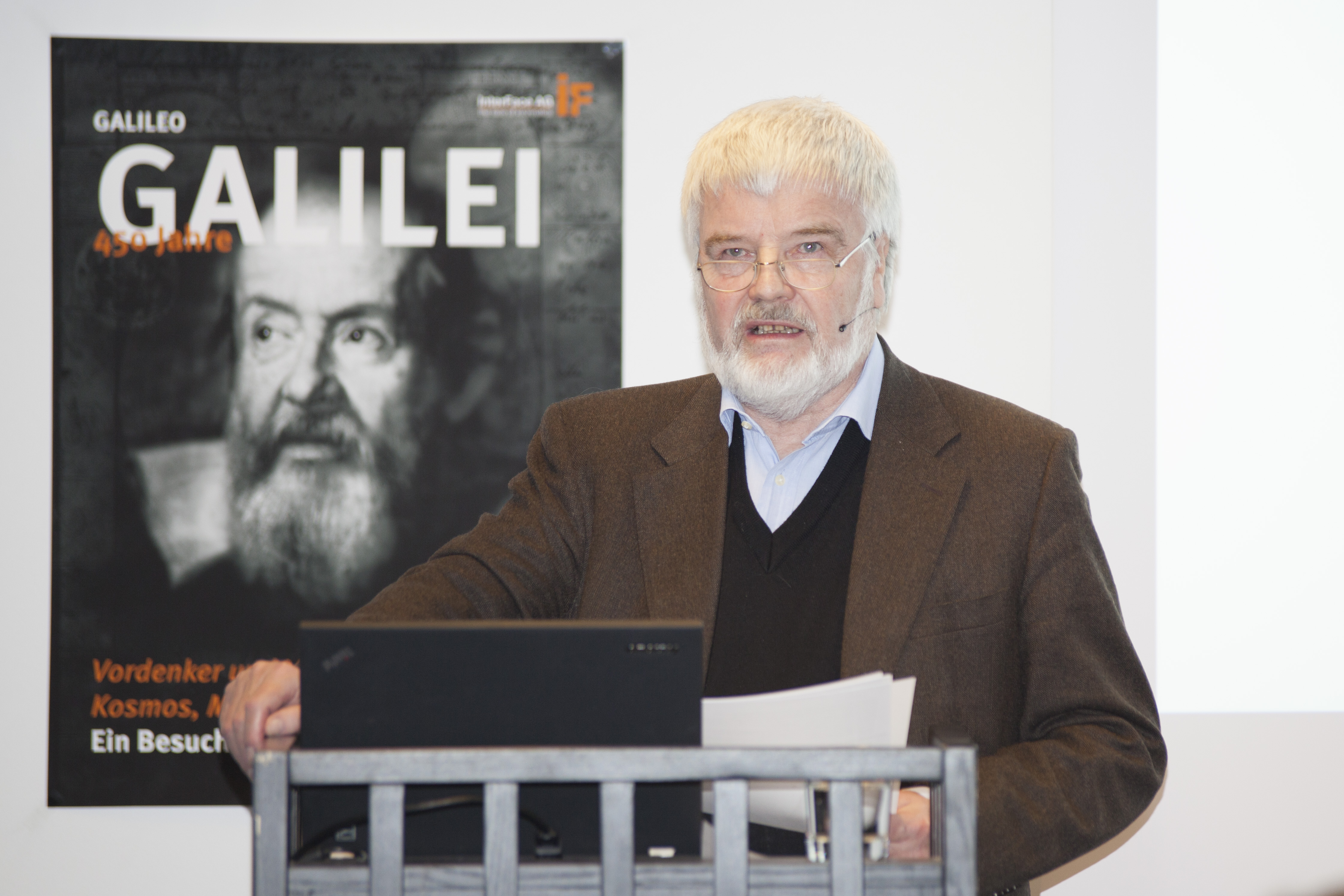
Jörg Schindler at the InterFace AG IF Forum
Are you a car driver, property owner or entrepreneur? Everybody is happy about the low oil prices and the resulting cheaper energy.
It saves money and, in the short run, has the effect of a great global economic stimulus plan. For the economy, they also expect positive impulses.
Except – the central traffic sector will remain extremely dependent on oil. This is a problem that cannot be solved by simply pulling the lever, following the motto “no more oil, electricity instead” (keeping everything else as before).
Instead of triggering the transition to post-fossil mobility, the oil production is now extended to arctic seas and ever lower oceanic altitudes at a high ecological risk. The low prices are misinterpreted and seen as fortuitous boom boosters, providing an extra motivation to again do some serious “upgrading”.
What are the reasons for the oil prices falling so drastically? What price will our society have to pay for this prolonged fossil resource consumption? Will this make a halfway tolerable transition towards a post-fossil, sustainable development (Great Transformation) even harder to achieve?
The speakers Dr. Martin Held and Jörg Schindler say that the most important factor for a successful Great Transformation is in danger: the adaptation time. What are the alternatives? Who could start working on said alternatives? What is the role of the civil society when it comes to the future transformation process?
For registration, please send an E-Mail to andreas.schuster@greencity.de or call 089/890668319.
The speakers are:
Dr. Martin Held (discussion group: Die Transformateure – Akteure der Großen Transformation, board member at ASPO Deutschland e.V. and long-time head of studies at Evangelische Akademie Tutzing, Tutzing)
and
Jörg Schindler (discussion group Die Transformateure – Akteure der Großen Transformation, board member at ASPO Deutschland e.V. and long-time managing director of Ludwig-Bölkow foundation, Neubiberg)
RMD
(Translated by EG)
P.S.
If you cannot come to the presentation but still wish to invite the speakers at another time, I will gladly connect you. Just send me an E-Mail .
Roland DürreThursday January 21st, 2016
Bernd Fiedler – K-Working
I am sitting in the ICE 1682 from München to Berlin, on my way to the PM-Camp-Orgateam meeting. Again, the WLAN does not work in the train (no IP) and I do a little “tethering”. The Deutsche Bundesbahn will not repair the WLAN before tomorrow morning at 8 a.m. (according to a @DB-Bahn tweet in reply to my complaining through twitter), although a simple “reset” would probably do the job.
But, luckily, I have the new book by Bernd Fiedler on me. Bernd is a good friend of mine. I like coming along when he goes on presentation tours, or else I meet him playing cards. He is one of those persons who never create new problems. Instead, he always talks of things and the future in positive terms. Consequently, meeting him is always a delight.
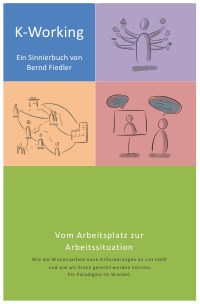 Now he wrote a small book. And thanks to DB, I have time to read it. Like its author, the book is constructive. The title is: K-Working. It describes how brain-workers might and should cooperate in a “new world”. Reading it really gives you courage and delight.
Yet it is also a book full of critical remarks, containing surprising and often very precise theses. For some persons, Bernd produces a merciless mirror to hold in front of them. And more often than not, some of the actual (bitter) situations are exactly what I, too, experienced in the past, which is why I find myself sharing the analysis in in the book.
From the outside, the book looks small and unpretentious. But somehow or other, all you need to know about brain workers and leadership can be found in it. And he says it all in a very simple and commonly comprehensible language. It is exciting and an easy read.
That is because it does not want to be a missionary advertising highly elaborated and complicated theories. Instead, it remains rational, focussing on what is really important.
Even the font is nice and large – basically, my reading is almost exclusively digitally these days and reading my old pocketbooks is often a hug effort for me. K-Working, on the other hand, can easily be read in the half-light of an early January morning and the (very much appreciated) diffuse ICE illumination.
All that is important can be found in the book. It is concise and has no endless repetitions as you often find them in US management literature. In those, you often know after the first fifty pages what will follow. And on the remaining 300 pages, you get it all again and again several times. Well, K-Working is not like that!
The book was published as a pocketbook by the epubli publishing house, the language is German. It has 140 pages and the ISBN is 9783737566599. And for 14.99 €, you can already buy the second edition (!), also at epubli.
RMD
(Translated by EG)
Roland DürreSunday December 6th, 2015
What Annoys Me #34 – Lobbyism, Marketing and their Associations.
In my last article, I tried to voice my pessimism about Best Practice, methods, processes, standards, certificates, etc.
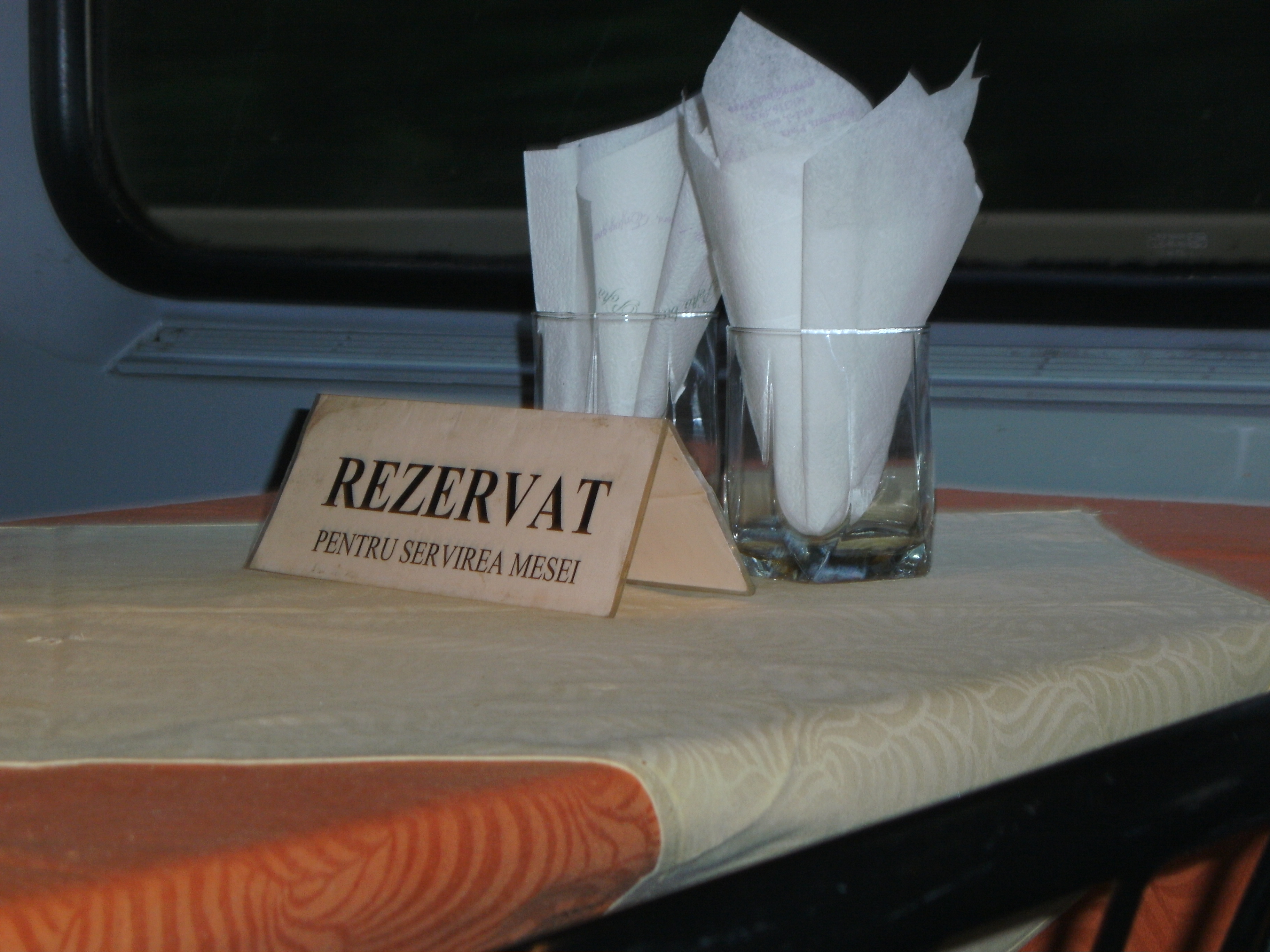 Now I am thinking of it while sitting in the InterCityExpress Train, being hungry and yet avoiding the Spaghetti Bolognese offered at the “Bordbistro”. Mind you, I basically like Spaghetti Bolognese, but not as “convenient food”. This same meal is probably advertised and served in all German ICE trains today. What is worse, I remember well how delicious the meal I took in a Romanian dining car a few years ago tasted.
Now I wonder who I should thank for all this. I am sure the industry is partly to blame. But the consumers with their “stinginess is super” attitude will certainly also be partly responsible. However, I also find it annoying that there are “free” clubs that actually promote this nonsense. It would be better if there were clubs protesting against it. And I am sure there are more serious problems in the world against which to get active.
Clubs have different goals and purposes. Especially in Germany, the number of clubs is horrendous.
There are some “good” NGOs that, in my estimation, prevail like a bastion through the ages. On a world-wide scale, I consider AI (Amnesty International) one of them. Others started well, but then, as time went by, they developed more and more into systems. Regardless, they still make a positive contribution in my opinion, even though there are often quite a few things that smell. I mean the likes of the Red Cross, Green Peace and similar organizations.
There are also some clubs that have been founded for a specific improvement, for instance Greencity or the Urbanauten. Others want to be quite differentiating when it comes to their social enthusiasm. In Germany, sports clubs have a huge tradition. Consequently, the number is endless: from alpine sports to gymnastics and shooting. These clubs were founded because of the common desire to do something new together.
Since all clubs are social systems, they also underlie the normal rules of development. They might well come to have the system maintenance as their only goal (self-goal) or become commercial enterprises (ADAC, enterprises of the entertainment industry “sports”). Regardless, I consider these clubs basically ok. And a sports club for everybody is definitely more to my liking than a fitness studio.
But there are also clubs the foundation of which was nothing other than the wish to gain advantages for its members from the outset. They were founded to break good laws and socialize losses. Their rules are determined according to the wishes of their customers.
I do not like them. I am talking lobbyists. They put enormous pressure on politicians and members of parliament in order to gain advantages for enterprises or sectors. As a general rule, these enterprises only want more profit for their customers, without taking the common good into consideration at all.
Lobbyism is one of the great challenges of democracy. As I see it, democracy can only work if we abolish lobbyism!
RMD
(Translated by EG)
P.S.
The industry of the cat-gold-salespersons and happiness-whisperers (aka marketing) with their motto “buy yourself happiness” are another threat to social market economy. Besides lobbyism, this is the second weapon of late capitalism for suppressing humans. Especially the marketing of today with its filigree methods and techniques is a hindrance to the development of an autonomous life lived in self-responsibility (called freedom) even in its early stage. I will soon write more about this.
Roland DürreThursday December 3rd, 2015
First a Norm, then a Certificate.
Or:
Why I believe that “certifying things” is often nonsense.
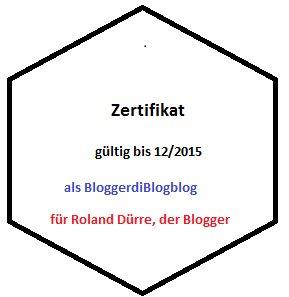
Created by Barbara Dürre, a certified certificate producer 🙂
In order to make life easier, people scale the world. They make certificates (Zertifikate) that prove how objects of this world follow or have been generated according to a certain standard.
The DIN is certainly a positive example (initially: Deutsche Industrie Norm). It was started by a club/association of industry partners. This standardization of technological items certainly brought considerable progress.
I am sure this made a lot of sense. The same is true for a common “metrics” in Europe or even world-wide for characteristics of objects (distance, weight, size, volume, etc.). or states (pressure, speed, temperature, time, etc.).
After the “standardization” comes the “certificate”. Stating a reliable and tested actual measure for an object is the simplest form of certificate. You can say:
There can only be a certificate if a standardization has been done before.
Wherever people are successful in a field, the underlying method will also be applied to other areas. Even if, perhaps, it does not make sense. For instance because everything that is alive cannot be reasonably standardized like a dead mass.
Brussels (the EU), for instance, now not only certifies plants and fruit. No, there are many areas – and I mean areas where it cannot be done – where they standardize and certify endlessly. For example, we have a cucumber norm and sustainability (including the certificates). Institutions and associations of all sorts also take part in the “standardizing”, using all imaginable areas for any purpose at all.
Mostly, they start with writing down collections of (allegedly) best practice. You will have won if you managed to introduce an obligatory ISO norm or some such. And then they start teaching the auditors and doing audits.
But do we really want to standardize humans, their interactions and their lives? During the last few decades and centuries, metrication and measurements have been applied to humans, nature and social systems.
Now enterprises have to have certifications saying that they function “correctly”, even though they consist of human beings. “Correct” is defined as something that follows the logic of an often very complicated and contradictory standard. And everything else is “wrong”. And more often than not, people totally forget what was intended or what was initially the problem.
They even wanted to extend the concept and include families. In the 1960ies, they discussed if people should be allowed to marry without a marriage licence. They also demanded a father or mother licence if you wanted to become parents.
(Incidentally, driver’s licences, too, are just certificates). To be sure, the intent was well-meant: they wanted to improve the situation of children.
At the time, I cynically thought how it would perhaps be desirable to also certify sons and daughters, since fathers and mothers were under consideration. After all, children should behave according to standards, shouldn’t they? Well, today, this concept became a little bit true: schools, for instance, generate their curricula following the standard child image – without ever considering how different children are.
I am glad that, in the end, the parent licence did not come after all. Regardless of many children, unfortunately, still living in rather sad conditions. However, the “parent licence” is an excellent example for the limits of standardization and certificates.
So roles in the family are not yet certified. Yet in other social bodies, they try to standardize away – for instance in enterprises when it comes to management. Just think of project, knowledge, quality management, etc. And I am sure that, sooner or later, the BGM (business health management), the common good economy and the CSR (Coporate Social Responsibity) will be certified. And, of course, before they certify them, they have to standardize them.
In my book, social systems with humans acting therein are something that nobody should try to standardize. Standardized social systems give me pause. Also, I do not believe that leadership and management can be standardized. But how can you certify something that cannot be standardized?
But let us stick to project management: It will not be possible to standardize PM in a rational way. So how to certify it in a rational way?
Basically, it is a pity, isn’t it? After all, they say that project managers too, (like, for instance programmers) should again learn from their masters and from practicing a lot in order to become experts – just like craftsmen.
You can get titles with money, through finishing an expensive course and by learning a lot by heart. But you will only become a master through sweat and industriousness. And it is quite possible that, in the future, only the masters will be wanted.
RMD
(Translated by EG)
P.S.
Incidentally, it is quite well worth the effort doing an internet certificate search. I was literally beaten by the multitude – also by how absurd many of them are. I will refrain from giving examples, there is no end.
Roland DürreSunday November 22nd, 2015
A Beautiful Week – DOAG with Presentation, PM Camp with Many Friends …
Now I returned home from Dornbirn and it is the weekend. It was a truly strong week. First, I spent two nights in Nuremberg with a long day on the #DOAG2015 and then, between Thursday and Saturday, I enjoyed a very intense PM-Camp in Dornbirn #PMCampDOR. Incidentally, the two hashtags will link you to the tweets for the two events. It is well worth taking a look.
Last Wednesday, on the DOAG 2015, I was again permitted to speak. I talked about:
“Creative Room – Healthy Room!“
Here are the picture by Christian I used and the short outline of my presentation.

“created by Christian Botta“
Today: More often than not, the work situation in enterprises seems to be insufferable. There are (many) employees who mentally already have given notice. The salary is considered compensation for personal suffering. But then, they have neither the courage nor the strength to say: “Love it, change it, or leave it“.
Useless meetings, feeling powerless and the burnout syndrome are the consequences. Now they want to do something about it, see also: BGM (company health management).
Consequently, we find change all around us. Conferences are replaced by anti-conferences. I prefer attending barcamps…
And I will now present the story of my presentation. I had to hand in a short version. Then the documents for the presentation. Also the transparencies. But I had none. Because I always speak without.
Christian Botta of VisualBraindump made a picture protocol of my presentation. Thanks a lot!
Today, I give my presentation. Perhaps I will call it “Complexity, Innovation and Burnout in Enterprises”. In fact, that would have been a better title than the one in the proceedings. Or perhaps “How to Keep Humans Species-Appropriate”. Because, basically, I was talking about the same principle as the “key speaker” Gunter Dueck.
I started with the impressions for the presentation from early this year. That was when Dietmar Neugebauer (President of the DOAG) asked me if I would again like to speak in November on his conference. I certainly gladly accepted. Then there were the thought-provoking impulses. One of them was OpenInnovation at InterFace AG , realized with the Nuremberg FAU, chair of Prof. Möslein. During the final event of this project, there was a presentation by Dora on “creative rooms”. After this, it became pretty clear to me how rooms (and organisations) should “look” if you want them to provide innovative inspiration – both physically and virtually.
Apparently, they have something to do with participation, respect, eye-level, culture, breaking patterns, joy and happiness.
A few weeks ago, I heard an interview with Dr. Marius Poersch. Marius is a psychologist, head doctor in a hospital with many patents who have suffered from burnout. He wants to be more than just a “repair shop”, so he also does some scientific research on what humans and organisations can do in order to minimize the burnout risks. After his presentation, I have a good idea what a “burnout-free” room should look like.
Surprisingly, but basically also logically, the result is: the rooms are exactly the same. The “room” as described by Dora for promoting innovation looks exactly like the one presented by Marius for keeping us healthy.
So what are the reasons for all this frustration we suffer from? We assume it is the complexity that gives us fear and the bureaucracy that is generated in our society as its consequence, trying to give us some dubious sense of security.
Insertion:
As an example: my own frustration as an entrepreneur (because at oracle in Nuremberg), the story of DocuMaker and the Federal Agency for Employment.
Failure due to stupid rules, the Oracle middleware product manager does not know the product, prediction about the future of Oracle by Larry Ellision … lots of frustration, immense loss for all. Thank God no Distress for us, because the success would have been Oystress.
Assumption:
A complex world with quick change gives us problems. And then there are the processes, rules, protocols, processes that are supposed to help with the complexity but all they do is make life harder for us.
Insertion:
About the Berlin PM Camp (complex versus complicated).
There were also many abstract discussions about the difference between complex and complicated. According to Niels Pflaeging, it is quite simple: as long as it is just complicated, the classic methods of project management and problem solving can help us. But this is no longer true when it gets complex.
I think it is not as easy as that. I did a session with Maik Pfingsten (Blogger, PoD-Cast) and rather enjoyed Maik’s definition of complexity (from the perspective of the system engineer)
x – axis: degree of complicatedness;
y – axis: speed of change;
The more you get of both, the more “complex” it is;
I extended this to also include the
z – axis: “human factor” degree in the project.
This means: the more complicated and dynamic and the more of a human factor you have, the more complex it is …
But:
Seneca said: Philosophy does not mean talking, it means acting.
Consequently:
What can we do? Whenever it gets more and more complicated, when matters change ever faster and when the human factor becomes more and more apparent?
There are no cooking recipes or Best Practice, neither are there any methods or technologies. All I can offer are a few ideas to think about.
As an engineer, software person and technologist.
Let me refer you to the: Agile Manifesto (2001)As an entrepreneur, manager and leader:
Hans Ulrich – Eight Theses on Change in Management (1982)Insertion:
Here are his “Eight Theses on Change in Management” in a nutshell with a few additional notes:
- Accept not knowing and not being able to predict the future as a normal state of affairs!
Well, you simply cannot predict the future … - Broader horizons for your thinking!
Oppose “You cannot do this” or “This is how we always did it”. Do not suppress the freedom of ideas. Share knowledge. - Move in the category “both”, instead of “either-or”!
Black-and-white is out, colourful is in. - Think multi-dimensionally! Your balancing of values must be ethically responsible. Basically, humans can only deal with three ideas at one time.
- Use self-organization and self- control as your basic formative model for your enterprise!
Responsibility, subsidiarity - Consider management as a function that gives and promotes meaning!
New management image. - Focus on what is really important!
Work economy. - Make use of group dynamics!
Cultures, symbols, rites, rituals …
As a human being:
John Izzo – five things you should consider before you die!
I strongly recommend the Review of the book.
Or the experiences made by Bonnie Ware:
Here are the five things he found out people wanted:
- “I wish I had had the courage to live my own life“
- “I wish I had not worked so much”
- “I wish I had had the courage to show my emotions“
- “I wish I had remained in contact with my friends“
- “I wish I had permitted myself more happiness“
Those are the five insights Bonnie Ware collected when he accompanied dying persons. As I see it, there is a lot to be learned for life from these statements …
Yet none of all these things will help you if you are not prepared to actually live. Something is still missing.
Insertion:
One of my mentees works for Osram: They are already in a permanent crisis, anyway. Additionally, their move from near the 1860 stadium to Garching looked a little stupid to me. My mentee lives in Unterhaching. His daily way to work is now four times as long as it used to be. He feels how his mood gets worse and worse. .
He arrives at work in a bad mood and returns home in a bad mood. Dialogue: How is your boss? – He is in a good mood! – What is he doing differently from you? – He rides his bike every morning from Trudering to Garching! – So why don’t you, too ride your bike! – Cannot! – Cannot is not defined!
He then bought an e-bike and went to work riding it every day. And ever since then, he arrives at the office in a good mood, and the same is true for when he arrives at home. And he feels so much better …
In simple terms:
Our body needs exercise and fresh air. And time with nature. And you can have it so easily – with active mobility in everyday life. See also AktMobCmp.
Seneca, too, taught us:
Follow the laws of nature.
(Seneca was a teacher who wanted to make his students successful and happy. Unfortunately, this has never been the first goal of my teachers).
How is anybody supposed to come to terms with his own life if he cannot even come to terms with his own mobility? And driving a car is definitely not something that makes you free, nor will it bring you fulfilment in life … (Even if that is what a seemingly overpowering industry tells us in a gigantic brainwashing process).
So: what we need is nice and regular exercise!
But not the kind of exercise I experienced after the Eldorado cinema in the Sonnenstrasse. I had tears in my eyes when I exited after having watched the great “Die Kinder der Mme Ann“. And just imagine, right across the street, there is a fitness studio on the first floor. It has huge windows … And you can see in the light of the windows how the persons do their “work-out”. According to the motto Work Hard, Play Hard, WORK OUT …
For me, this is a horror vision. Planning fitness like an entire life. So why not change your life! You will see it can be done. Because, as Seneca said:
The reason why we do not start doing something is not that it is hard. Instead: Things are hard because we do not do them.
RMD
(Translated by EG)
P.S.:
During my presentation, I made two more insertions: about terrorism and about the asylum seeker situation. And I gave a short summary of what caused both. But most importantly, I described why I am not at all happy with how we react to both problems. However, I will write two separate articles about how I feel about these issues in the near future.


