
Roland DürreSunday November 2nd, 2014
Wasn’t the Last Millennium Totally Crazy?
In the last century, before the turn of the millennium, everything was different.
In those days, managers still believed in the predictability of the future. What is more: they were convinced that growth is something that can continue endlessly.
People living at the time had the impression that everything can be done and that, thanks to technology and progress, all problems can be solved. After all, humans as the crown of creation felt they were omnipotent – far above the animals. And they believed everything can be controlled.
The motto was: faster, higher, bigger, further and more comfortable.
Engineers and technocrats were in charge. A life without cars was unthinkable. Individual traffic with heavy vehicles and a combustion motor, also for individual persons, was a self-evident human right for everyone – just like the short vacation in the “DomRep” or in Thailand. A society was considered “developed” if the poor, too, could afford to buy a car!
Weekend trips to London or Madrid, just like short vacations to New York or Abu Dhabi helped the people to overcome their boredom in a mundane fashion. Consumption was the method you chose in order to give yourself importance and buy happiness. Regardless, stinginess was considered cool and money was the new religion. Using this concept, it was quite easy to destroy the world.
Professors at university taught us that good managers will never have to react. Instead, they will always act. Because the good ones will see into the future. Just like, in 1968, the chain-smoking and therefore constantly coughing driving instructor, who, due to his looks, was nicknamed “Old Death” had taught me that a good (German) driver will always foresee what will happen in the next second.
The universities also taught us that a manager always has to be free of emotions and personal feelings. Decision making science recommended that, first and foremost, we always collect enough information. Afterwards, you had to evaluate and analyse them absolutely objectively. Only after this step, you would then have to decide in a very rational and logical way, without all emotion. And while doing so, you have to ignore intuition and heuristics as deceptive factors.
This was also the reason they gave why a “normal woman” had no business in management. Because women – with very few exceptions – are just too much driven by their emotions. Obviously, women in “high” management positions were the exception from the rule. And those who were actually looked like men.
Textbooks also said that an organization is good if and only if the highest manager is able to control the entire system as he desires by “adjusting just a few screws”.
Consequently, the companies oriented themselves at military ideals when forming their organizational structures. Hierarchy was the standard, only very few ultra-modern enterprises were bold enough to try a matrix cooperation and even fewer were courageous enough to try “cooperative leadership”. Terms such as self and network organization were out of the question, just like transparency and agility were feared. Everything was dominated by “simple-mindedness instead of diversity”, rather than the “wisdom of the masses”.
Taylorism, moralizing processes and globalization were held to be the success recipe for the economy and to guarantee prosperity for the entire world. All the big enterprises aimed at world market leadership at all times. At the same time, the exploitation of humans and all kinds of resources grew geometrically.
On the other hand, the mass was considered a primitive mob. Citizens were said to be stupid and taken for fools. Marketing manipulated the masses, lobbyism removed their interests. Those who voted in a democracy were considered election-booth fodder. Their wish for peace was overruled with invented and hugely propagated anxieties.
Those who reigned, along with the governments knew a lot better what is good for everybody. They even drew up laws which ignored existing judicial practice and constitutional rights. This is how the citizens were spied on and made fun of in masses. More often than not, this happened in order to satisfy interests and demands of foreign power or powerful concerns.
In extreme cases, even courts of justice were declared no longer responsible. In their place, obscure arbitral courts were instituted. Citizens who had violated tax legislation were severely punished. At the same time, the exact same countries created “tax oases” for concerns.
And worst of all was: the governments believed they could shape order in the world with wars and create peace with weapons.
Well, I am happy that those times are now over.
RMD
(June, 20th, 2030)
Roland Dürre
CANZONE 11
I often tell you about Arcis-Vocalisten concerts. Evelyn Gemkow (EG), who is responsible for our blog translations into English, is a member of the choir.
However, there is another “singer” among the IF author team: Axel Maisch. He has been friends with me for a long time and works at InterFace. A short time ago, he joined the vocal ensemble CANZONE 11. They were founded by Tanja Wawra in 2011 and are now 16 female and male singers from and around Munich.
 In their new concert program, CANZONE 11 chose the meeting of the sexes as their focal topic! It is all about
“her & him”
After all, the inexplicable and often so tragic meeting between man and woman has inspired the poets of all centuries to write the most wonderful words, to paint the most charming pictures and to come up with the wildest metaphors.
Consequently, it is more than understandable that composers, who draw images with music and interpret words with sound, could not resist taking up the idea. They filled it with sound and never stop interpreting it anew.
The core element of “her & him” are the love songs by Johannes Brahms, in addition to works by S.E. Johanson, G. Holst, J. Mäntyjärvi and Nils Lindberg.
The concerts will be on November, 22th, (in the Augsburg Zeughaus) and November, 234rd, (in the concert hall of the “städtischen Sing- und Musikschule”).
For more information, click here for the Canzone 11 website Canzone 11 or enter Facebook (https://www.facebook.com/Canzone11).
RMD
(Translated by EG)
Roland DürreThursday October 16th, 2014
The Arcis-Vocalisten will sing Mozart – the “Requiem”.
A short time ago, I watched the Arcis-Vocalisten perform. It was in the Loisach-Halle in Wolfratshausen.
Along with numerous soloists (among them “Stofferl” of the Well-Brothers), the wonderful orchestra “Ensemble Nymphenburg” and the great Irschenhausener Brass Band, they staged an enchanting performance of Johann Strauß’s “The Bat” under Thomas Gropper. I was truly thrilled – not just because Evelyn (EG) was one of the choir singers.
 Yet the “Arcis-Vocalisten” will not sit down and rest. Because only a rolling stone gathers no moss.
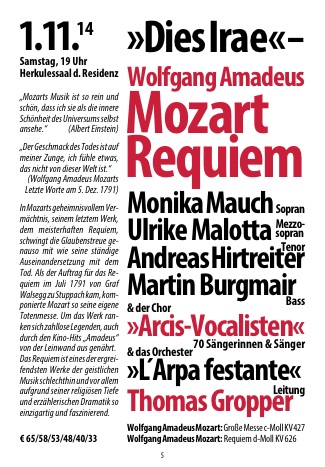
Consequently, the Arcis-Vocalisten will sing Mozart’s Requiem on November, 1st at 7 p.m. in the Herkules-Saal of the Munich Residence. They will be accompanied by the L´Arpa festante Orchestra and the soloists are Monika Mauch (Soprano), Ulrike Malotta (Mezzosoprano), Andreas Hirtreiter (Tenor) and Martin Burgmair (Basso). Again, the conductor will be Thomas Gropper.
»Mozart’s music is so pure and beautiful that I consider it the inner beauty of the universe.« (Albert Einstein)
In Mozart’s mysterious legacy, his last work and masterpiece “Requiem”, both his firm belief in God and his constant attempt at coming to terms with death are always present. Consequently, when Graf Walsegg of Stuppach commissioned the Requiem in July 1791, Mozart wrote his own requiem.
Numerous legends surround the work. You will also find them in the “Amadeus” film. The Requiem is one of the most stirring works of religious music ever written and generally considered unique and fascinating mostly because of its religious depth and narrative drama.
»I smell the taste of death on my tongue. I feel something that is not of this world.« (Wolfgang Amadeus Mozarts – his last words on Dec, 5th, 1791)
RMD
(Translated by EG)
Roland DürreSaturday August 16th, 2014
The Arcis-Vocalisten Will Sing: “The Bat”
 It is the unchallenged “Queen of the Operettas”, having swept away and fascinated the world-wide audience for 140 years with its inescapable esprit, passionate scenic speed and subtle humour: “The Bat” by Johann Strauß. During a frenzy of inspiration, the Vienna Waltz King managed to write down the entire music to the work in no more than 42 days. The piece was first played in 1874 and is the crown of the musical era of the operetta.
Gabriel von Eisenstein, a gentleman not known for his abstinence when it comes to all kinds of desires, has to go to jail for eight days – he has been a public nuisance and insulted a public servant. When his old friend Falke urges him to postpone his prison time in favour of a great party sponsored by Prince Orlofsky, who is famous for his hospitality, Eisenstein is not hard to persuade… Eisenstein is totally ignorant of the fact that his friend Falke – with a clever orchestration – seeks revenge for an exposure he suffered from the hands of Eisenstein several years back. We witness an ambiguous and delightfully comical game around amorous complications, social roles and clichés that quickly gains momentum…
The Wolfratshausen production is going to be an enthusiastic version of the work by Strauß – in a totally Bavarian setting: instead of the “spa near a big city”, where Strauß saw the scenes of the operetta played, we will have the Isar valley, instead of ball gowns and tuxedo, we will see Dirndl Dresses and Leather Pants… and the fascinatingly humoristic figure of the prison guard Frosch will be played by none less than Christoph “Stofferl” Well – who is a good old acquaintance not only for all fans of the famous “Biermösl Blosn”.
And our Evelyn (EG) is among the choristers!
RMD
(Translated by EG)
Roland DürreSaturday August 9th, 2014
I, too, am a “Meeskite”.
Last week, I took a three-day time-out (Auszeit). With my bike and my significant other, I went to Würzburg by train. We spent some time looking at the residential town and then went on to the Torturmtheater Sommerhausen by bike. They played “Emma”, which fascinated us. On the next day, we rode around 90 kilometres from Sommerhausen on the river Main to Feuchtwangen (in the district of Ansbach).
After what turned out to be quite a few metres of altitude, we ended up directly at the Feuchtwangen market place and checked into the “Lamm”. Having found our rooms and enjoyed our beer, we heard that the Kreuzgangfestspiele were currently played at the local open-air stage. And that tonight the musical “Cabaret” can be seen.
As we see it, a musical such as Cabaret on an open-air stage is definitely a nice finish to a sunny day on our bikes. Tickets for good seats are also still available. Consequently, we buy them and go to see the musical at night.
And it was a beautiful evening.
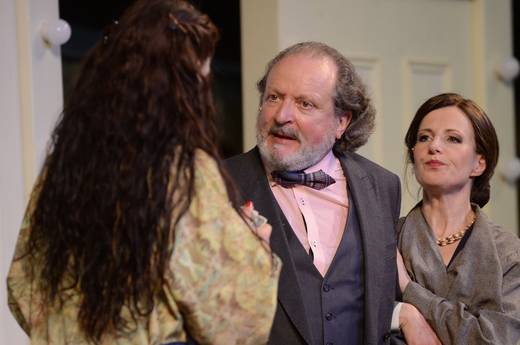
Sina Schulz (Fräulein Kost), Peter Kaghanovitch (Herr Schulz), Gabriele Fischer (Fräulein Schneider)
Well, Caberet is one of those musicals that go under your skin. The songs are beautiful earworms, the story actually is on a high level and the performance was good. Consequently, we enjoyed a wonderful theatre evening under the starry sky.
And then “Herr Schulz” sang his song about the Meeskite! And this was when I felt more than a little touched at the core of my being.
In Google, I find the meaning of “meeskite”: “ugly and not good or something”.
The song moved me so much that I looked up the lyrics. I found them on songlyrics.com.
Why was I so enthusiastic?
Well, it is because I myself felt I was a “meeskite” for many years. In my estimation, this phase lasted until I was around thirty. And even after that, I sometimes was a “meeskite”. Many of my friends also felt they were a “meeskite”. Even today, I often come across young persons who have the “meeskite” syndrome.
And I am sure that none of them has even the slightest reason to feel like they were a “meeskite”. On the contrary: these are all wonderful persons. Still, they feel “small and ugly”.
To me, the reason seems simple: people from their (our) surroundings, such as parents, school and other systemic and non-systemic influences and instances made both them and us look small. Or else, they managed to make them and us feel small.
And I fail to understand why this is so and why it should always be so. I think there were definitely systems where, in ancient times, it was different. Perhaps among the savages, who were still allowed to live in their natural environments? But does our cultural world really force us to feel “small”?
Should not the “cultural world” we ourselves created do the exact opposite: help us to liberate ourselves! And make us love ourselves?
Would it not be a beautiful utopia if humans stopped making each other look small and if we then no longer needed to feel we are “meeskites”? Wouldn’t this be a nice start of the “project freedom”?
Well, this is all I wish to say.
On stage, before his recital, Mr. Schultz says you only have to know the Yiddish word “Meeskite” in order to understand the song. And again, I get the suspicion that the “meeskite” will thrive particularly well in strongly religious and moralizing societies.
And if that turns out to be the truth, then the “meeskite syndrome” is yet another consequence of the “medicine” religion. “Religious Freedom” is and will always be an obligation derived from a tolerant concept of humans and society, but it must not be more than that. The super-elevation of religion I often witness in permanently grotesque forms of governmental obeisance right up to the point where an entire population subjugates itself under religious groups sounds absolutely inconceivable to me.
Incidentally, my mentor Rupert Lay taught the exception for intolerance: the only instance where intolerance is acceptable and even demanded is where intolerance comes into the picture. In other words: intolerance cannot and must not be tolerated!
Easily said, not so easily done – but certainly a good principle.
Miscellaneous
Meeskite
HERR SCHULTZ:
[spoken]
Now the only word you have to know to understand this
little song is the Yiddish word “meeskite”.
Meeskite means: ugly, funny looking…
Meeskite means:
[singing]
Meeskite, meeskite
Once upon a time there was a
Meeskite, meeskite
Looking in the mirror
He would say
What an awful shock,
I’ve got a face
That could stop a clock.
Meeskite, meeskite
Such a pity on him
He is a
Meeskite, meeskite
God up in his Heaven left him out on a shaky limb
He put a meeskite on him!
[spoken]
Listen, he grew up. Even meeskites grow up.
[singing]
And soon in the Heder (means Hebrew School)
He sat beside this little girl
And when he asked her, her name
She replied: “I’m Pearl!”
He ran to the Zeiddah (that’s grandfather)
And said in the scratchy voice of his
You told me I was the homeliest
Well, gramps, you’re wrong, Pearl is!
Meeskite, meeskite
No one ever saw a bigger
Meeskite, meeskite
Ev’rywhere a flaw
And maybe that is the reason why
I’m going to love her, until I die!
Meeskite, meeskite
Oh, it is a pleasure, she’s a
Meeskite, meeskite
She’s the one I’ll treasure
For I thought there could never be
A bigger meeskite, than me!
[spoken]
Listen to what happened:
[singing]
And so they were married
And in a year she turned and smiled:
“I’m afraid, I am going to have a child”.
Nine months she carried
Worrying how’s that child would look
And all the cousins, well, worried too,
But what a turn fate took:
Gorgeous, gorgeous
They produced a baby that was
Gorgeous, gorgeous
Crowding ’round the cradle
All relatives awed and wooed
He ought to pose for a baby-food.
Gorgeous, gorgeous
Would I tell a lie?
He’s simply
Gorgeous, gorgeous
Who’d have ever thought
That we will see such a flawless gem,
Out of two meeskites like them?
[spoken]
Wait! Wait! This story has a moral. All my stories have morals:
[singing]
Moral, moral
Yes indeed the story has a
Moral, moral
“Thou you not a beauty
It is nevertheless quite true
There may be beautiful things in you”.
Meeskite, meeskite
Listen to a fable of the
Meeskite, meeskite
Anyone responsible for loveliness large or small
Is not a meeskite at all!
Das Bild ist von der Website “Kreuzgangspiele – Stadt Feuchtwangen”
RMD
(Translated by EG)
P.S.
For those who did not want to follow the Link: here are the lyrics.
Roland DürreTuesday April 22nd, 2014
Carl Heinrich Graun – Der Tod Jesu
Evelyn Gemkow (EG), who helps us with the IF blog by making it possible for readers all over the world to understand our articles, has a very special hobby: she sings with the “Arcis Vocalisten”, a choir of outstanding quality. And now, they are again preparing for a very special concert, along with producing a CD:
CD production and concert of the “Arcis Vocalisten” – “Der Tod Jesu” by Carl Heinrich Graun
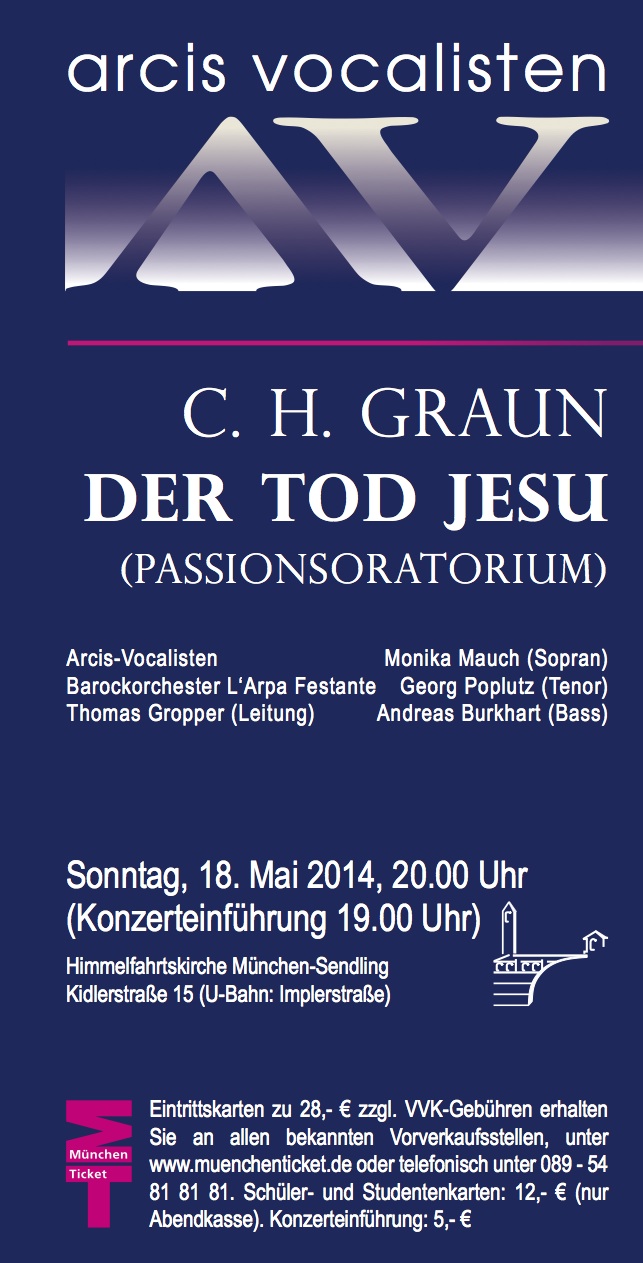 CD production and concert of the “Arcis Vocalisten” – “Der Tod Jesu” by Carl Heinrich Graun
For quite a few years, the Arcis-Vocalisten have now been cooperating with the “L’arpa festante” ensemble when performing pieces of the baroque and classic eras – to the huge benefit of the Munich concert audience.
With Carl Heinrich Graun’s “Der Tod Jesu“, the two ensembles, supported by the Bayerische Volksstiftung, now attend to a piece which – for good reasons – has been performed practically on a yearly basis on Good Friday in Berlin for almost three-quarters of a century. This is the third CD production realized by the baroque orchestra L’arpa festante and the Arcis Vocalisten in cooperation with the Bavarian Radio Station:
After Johann Sebastian Bach’s cantatas ”Aus der Tiefen“ (BWV 131) and ”Himmelskönig, sei willkommen“ (BWV 182), which were recorded in 2011, as well as the cantatas recorded in 2012 ”Weinen, Klagen, Sorgen, Zagen“ (BWV 12) and ”Herz und Mund und Tat und Leben“ (BWV 147), the two ensembles are now working on a joint project with a composer who, today, is only rarely heard: ”Der Tod Jesu“ by Carl Heinrich Graun (* May, 7th, 1704, † August, 8th, 1759). And the joint project again promises to turn into a huge musical success.
During the now numerous instances of cooperation between the Arcis-Vocalisten and L’arpa festante, it turned out that these two ensembles each found their ideal match. They are in perfect harmony when it comes to working on and performing old music. On the one hand, we have the Arcis-Vocalisten, about whom the “Süddeutsche Zeitung” wrote that they have a “huge repertory of finely tuned ways of expression”, along with “a constantly precise diction and narrative and musical homogeneity”.
On the other hand, there is the baroque orchestra L’arpa festante – one of the most traditional German ensembles specializing in old music. They stand out through the huge musical experience and virtuosity of every individual instrumentalist, as well as through their fabulous richness of colour and expression.
The two ensembles complement each other in an ideal way, and each new cooperation is a huge experience for all parties concerned, both on the musical and social level. So now the Arcis-Vocalisten and L’Arpa Festante turn towards Carl Heinrich Graun’s ”Tod Jesu“ – which is an impressive work, even if you only look at it from the perspective of its performance history. First performed on March, 26th, 1755 in the Berlin Cathedral, Graun’s Passion Cantata regularly was the constitutive factor of the musical Good-Friday program in the Prussian Capital for more than seventy years. This is even more remarkable because, in those days, remembering the works of composers from the early times was rather the exception from the rule. The audience generally was more fascinated by musical novelties.
This long-lasting popularity will immediately become understandable for the music lover of today as he enjoys listening to the work. While the libretto on which it is based is clearly a concession to the tastes of the time (which today sometimes might look over-affected), Graun’s composition still moves the senses of the contemporary listener very directly. The range of musical technique and musical expression used by Graun is huge – from the seemingly rather archaic double-fugue strictly in the old style for choir through arias in the gallant style as it started flourishing during Graun’s time, down to the opera-like, over-enthusiastic, exulting tenor aria.
At the same time, the work, as far as the underlying theological and narrative concept are concerned, is opposed to – or better: it complements – the Passions by Bach in a fascinating way. Naturally, the latter are the non-plus-ultra for the music lover of today when it comes to passion music.
On the one hand, Bach’s Passions mirror the events of the passion as a “historical” event, at the same time making the salvation history – the completion and execution of the divine plan with Christ as its centre and pivotal point – the focus of everything. Graun’s approach is totally different: Jesus is more a human among humans, a virtuous hero and benefactor in the middle of everyone, rather than the actor of an eschatological plan. Individual emotions of the divine human being Jesus are reflected and brought to the attention of the audience.
The actual events of the passion as a historical happening, however, are only mentioned as side-lines and indirectly. Music lovers need not wait for the CD to be produced by the Arcis Vocalisten and L’arpa festante, because the two ensembles will also give a performance of their joint Graun Project on
Sunday, May, 18th, 2014, at 8 p.m. in the Sendling Himmelfahrtskirche
under Professor Thomas Gropper.
As early as 7 p.m. Thomas Gropper will give an introduction to the concert, which is free for members of the Bayerische Volksstiftung.
The Death of Jesus – a passion oratorio of many facets with an impressive performance history, performed by the Arcis-Vocalisten and the Baroque Orchestra ”L’arpa festante“ in the Sendling Himmelfahrtskirche.
Tickets for 28.- Euros plus advance-booking fee are available at all the usual advance-booking outlets, under www.muenchenticket.de or by telephone: 089- 54 81 81 81. Students: 12.- Euros (concert evening only). Introduction to concert: 5.- Euros
RMD
Roland DürreSunday March 23rd, 2014
Torturmtheater Sommerhausen & InterFace AG
And again: they are practicing at InterFace – in our kreatIF …
The Torturmtheater Sommerhausen will open the 2014 season with a new, exciting piece from Canada! Again, the rehearsals take place at our Unterhaching building.
For “Fast Perfekt” (An Almost Perfect Thing) by Nicole Moeller, the actors Katharina Friedl, Alexander Diepold and Sven Schöcker have already been our guests for several weeks. Under director Oliver Zimmer, they are now preparing for the premiere on April, 3rd, at 20.00 hours in Sommerhausen.

Here is what the play is about:
A girl disappears. Just like this. Without any trace. Years later, she re-appears out of nowhere – by now she is a young, beautiful woman.
The police, but above all the media and press hurl themselves at Chloe. A huge field of speculations is wide open, because she is not prepared to tell anybody who had abducted her.
 She wants to tell her own story – not the story of her tormentor. For her, this is essential for survival. In order to do so, Chloe asks a young journalist who, even at the time of her disappearance, had reported about it. She trusts him. He is permitted to write her story as an exclusive. But she dictates the conditions.
Three persons are inescapably trapped within a story, and yet each one of them has his or her own perspective, his or her own version of the truth, his or her own story. It is important for each of them to remain in control, but who does actually control whom?
 Some parallels between Chloe’s life in the isolation of violence and the so-called freedom in their new world of media give you pause. In both fields, it is all about dependency, power and love. Even the two men seem to be terrifyingly exchangeable within these patterns.
With an unerring feeling for power play, the young Canadian writer Nicole Moeller created the play An Almost Perfect Thing. It is both impressive and disquieting, not just focussing on the sensationalism of the case, but laying open a view of deep abysses.
With this play, Nicole Moeller won the renowned Edmonton Sterling Award for the most outstanding piece of 2011.
I cannot be there for the premiere on April, 3rd – but I will go and see the drama on Saturday at the Sommerhausen Torturmtheater.
An Almost Perfect Thing will be played regularly on Tuesdays and Fridays between April, 3rd and May, 24th at 4.30 p.m. and 7 p.m. For ticket reservation from 4 p.m., please call 09333-268 or send an email to: E-Mail.
RMD
(Translated by EG)
Roland DürreMonday March 17th, 2014
Brahms in the Herkulessaal – Evelyn is Among the Choristers!
Again, the Arcis-Vocalisten are going to sing!
And our Evelyn, who always translates the IF Blog articles into English for all of you, is part of it! On March, 29th and 31st, the choir she sings in will give you an opportunity to listen to what they have been rehearsing since the beginning of this year:
Johannes Brahms (1833-1897) – Ein Deutsches Requiem – Nänie

Saturday, March, 29th, 2014, 5 p.m. in the Klosterkirche Schäftlarn
Monday, March, 31st, 2014, 8 p.m, in the Herkulessaal der Residenz München
Arcis-Vocalisten &
Neue Philharmonie München
Thomas Gropper, Conductor
Hanna Herfurtner, Soprano
Andreas Burkhardt, Basso
The piece is one of the most moving and powerful of sacred music ever written: Johannes Brahms’ ”Deutsches Requiem” (op. 45). Instead of using the classic Latin requiem texts, including the elements of threat and impeding punishment, the composer selected Bible passages from the Old and New Testaments where solace and hope predominate and made those the basic concept to spin his music around.
Using this material, Brahms created a powerful work full of dignity, seriousness and musical poetry, which will both upset and soothe the audience. Its breath-taking and forcefully designed arc of suspense and hope that constantly reaches beyond the limits of human existence is always at the centre of the music.
Along with the ”Deutsches Requiem”, you will also hear ”Nänie” (op. 82) by Brahms. It is a mourning and lamentation named after the same poem by Friedrich Schiller. Just like the ”Deutsches Requiem”, this work, too, substitutes confidence and consolation for despair and resignation in a musically brilliant way..
The Arcis-Vocalisten will present these two works to the accompaniment of the Neuen Philharmonie München, which is an ensemble that, after its foundation in 2005, grew to be one of the most noticeable young orchestras in the Munich region. It fully deserves its excellent reputation.
For tickets with free choice of seats in the entire church, please contact München-Ticket or the Arcis-Vocalisten (mailto:newsletter@arcis-vocalisten.de, no extra charge for early booking) for Saturday, March, 29th, at 5 p.m. at the Klosterkirche Schäftlarn for 25 Euros.
The same booking arrangements hold true for Monday, March, 31st, at 8 p.m. in the Herkulessaal of the Munich Residence where the following categories are available.
1st category 35 Euros
2nd category 30 Euros
3rd category 25 Euros
4th category 20 Euros
The Arcis-Vocalisten, and in particular Evelyn, would be delighted if some of the IF Blog readers are among the audience.
RMD
(Translated by EG)
Roland DürreWednesday January 15th, 2014
What I Like #1 – DuckDuckGo!
I like DuckDuckGo!
You do not know DuckDuckGo?
No problem. As always, you will find all you need to know about DuckDuckGo in Wikipedia. And you can just go ahead and try it if you click here.
What happens is you will immediately see the no longer quite so new search engine. It is not some intellectual nonsense like Wolfram|Alpha. You will find the look a little retro. And functionally, it is probably where google was ten years ago. But it is already surprisingly nice to work with. And if we all support DuckDuckGo, they will soon improve.
The time when the “Snowdon disclosures” (which, incidentally, were not disclosures at all, because our hackers had known it all for several years) reached the public awareness were the time when it was definitely clear that DuckDuckGo is now presentable. Because DuckDuckGo does not collect user data.
Consequently, there cannot be a “user bubble” either It is something I do not want and I will gladly forego the alleged comfort of “tracking” and collecting my input.
I want a search engine to render the same result for every user at all places and at all times. Because a user should be wise enough to know that, if, for instance, he is using the search engine for finding a restaurant called Bella Italia in Ottobrunn, he would have to enter Ottobrunn on top of “Bella Italia”.
So why don’t you go ahead and quickly try DuckDuckGo? – Even if it does not protect you against NSA.
RMD
(Translated by EG)
Roland DürreMonday January 13th, 2014
“Love it, change it or leave it”
What a nice sentence! Consequently, I put it at the end of my next to last Post. As a recommendation how you could deal with annoying developments in your enterprise.
I rather like the sentence. The same is true for this recommendation:
“Cook it, boil it, peel it or forget it!” or, slightly changed “Cook it, peal it or leave it!”,
which is a recommendation you should strictly adhere to when visiting tropical countries when it comes to eating and if you want to stay healthy
“Love it, change it or leave it”,
however, sounds a little too menacing for my taste. Consequently, I would like to take the sting out of it a little bit. In this context, “love” does not mean the heated and ardent love of a fan for his club which will easily switch from total exultation to great despair. No: what it means in this context is the “mature, well-pondered preference” of a social system you can identify with even after having discovered its advantages and disadvantages.
“Change” does not call for the radical element of a revolution. Instead, it means the process of change or improvement which can also happen in small steps and be very valuable.
Only “leave” is digital. If you clearly feel it cannot go on in this way, then you should come to a decision and, if necessary, even say farewell.
RMD
(Translated by EG)


