
Roland DürreMonday October 15th, 2012
Video: Dr. Stefan Hagen at the IF Forum “Project Coaching”
You can now watch the opening presentation of our technological IF Forum by Dr. Stefan Hagen from Lustenau on Youtube. It is a true pleasure to watch.
The Third Technological IF Forum was about “Project Coaching“, the motto was “best of PM-Camp“.
Again, many thanks to Stefan for his presentation. He was responsible to a huge extent for making our IF Forum a success. Stefan is also the author of the most frequently read German language blog on Project Management – pm-blog.com.
RMD
(Translated by EG)
Roland DürreSunday July 22nd, 2012
A Highway Code for the Internet?
» Every technological improvement, if it is supposed to improve human happiness, will also be an improvement in wisdom. « (Bertrand Russell)
A short time ago, I heard the following statement at an Informatics&Sustainability (Informatik&Nachhaltigkeit) event:
As more and more automobiles appeared in the public domain early in the last century, a highway code became necessary.
And then someone asked:
Do we want/need something like it for the internet?
At first sight, it sounds quite reasonable, doesn’t it? At least I would spontaneously answer: yes. Communication, too, must be regulated sensibly. On various levels, as, for example, the ISO-7 layer model outlines quite nicely. In former times, the national postal services had introduced and successfully realized communication models in the CCITT. That was in the good old times when we still had letters, postcards, parcels, telephone an telex. And it worked quite well, didn’t it?
🙂 To be sure, even at the time, there were such negative things as spams. But it was rather tedious to send someone a spam – you had to walk up to their letter box. Or else you had to buy a “bulk mail service”. It did cover a hundred per cent of the postal code area, but at least it was rather expensive!
Only when radio and TV technology made it possible to transport spams directly into the households without much of an effort, the dam was broken. And CCITT could not do anything about it. After all, this was about economic interests. And traditionally, economic interests have always justified everything.
Consequently, the call for some sort of “highway code“ on the internet seems to make sense to me.
But then comes the “but”:
The development of individual mobility, including a highway code, should, first and foremost, be a warning for us. Because, as I see it, it is an extremely good example for how, regardless of – or due to (?) – the extreme regulation mania displayed by the legislative body, technological progress (in this case individual mobility) was improved, but at the same time the common good was severely injured. Mind you, it all happened even though we have a compulsory driving licence, a complex system of punishments and penalties, including a system of minus-points and similar things.
And the damage that was done was not really noticed at all, because we “got used to it” in typical human fashion. Although said damage is massive and concerns many dimensions of our lives:
- Just think of the massive soil sealing cars brought in their wake. How many square metres of ground were filled with concrete for streets and parking places? In modern semi-detached housing areas, we often find more ground covered by garages and car parking than for greenery. All in all, the landscape was destroyed.
- Individual mobility, especially as we live it today, gave us extreme resource exploitation, gigantically wasteful habits and a massive amount of rubbish. It is the best example for a non-sustainable life-style.
- Noise disturbance has reached unimaginable dimensions. There is hardly any place left where it is really quiet. Even in the “upscale housing areas”, there is still noise from motorways.
- This development of public traffic cost us time. Many people spend several hours every day behind the wheels or their cars. Although they have a good job, they spend a lot of their time doing something otherwise only done by people in an extremely low income group. And they say they enjoy it and are prepared to give “their last shirt” for the car and even indebt themselves for the car.
- But the worst of it is that this development costs us an immense bloodlet. In Germany alone, there were years with more than 20,000 fatal traffic accidents. Today, we still have more than 5,000 fatal traffic accidents – and the numbers increase again.
World-wide, we have between 1 and 1.2 million estimated deaths caused by individual traffic each year (source). That is more than the victims of illness, wars and hunger. If you add up the last 60 years, you easily get a number higher than 50 million. That is about as many victims as WW-II cost. I will not even think about the really astronomical number you get when you count the people injured in traffic accidents.
Now the question is if a wise legislative body could have done better a hundred years ago and then during all those years?
I do not know. I do not even know if, in retrospect, we can say what should have been done differently all those years ago.
But I have a few ideas:
For example, I am sure it was a mistake to permit and even support the industry when it promoted the introduction and, above all, the sale of automobiles through sports. Motor sports and also the race courses, such as the Nürburgring were goal-oriented cooperative projects initiated by state and industry in order to promote the acceptance of the then still little-loved new technological product “car”. Thus, we were (almost genetically) pointed towards driving cars as an athletic activity where it is important to be faster than others.
Perhaps we should not have let it happen that the users of the competing means of transportation bike were publicly degraded as early as the first years of the economic miracle. I myself witnessed how my father, against his wishes, changed from using his bike to using his car for the less than two kilometers he had to go between our flat at Rosenaustr. 18 in Augsburg to the General Railway Office Building at Prinzregentenstr. near Augsburg Central Station. Simply because both the neighbors and his own wife thought it no longer appropriate to go by bike in his position.
In those days, going by bike was synonymous for “being poor”. To make matters worse, there was an overflow of cheap bikes from the stores. They all sparkled rather nicely, but unfortunately were not very reliable. And who wanted to be poor and additionally have to get annoyed all the time? But could or should we have resisted against the judgment “if you ride a bike, you belong to the poor” and the avalanche of cheap products at the time?
Perhaps we should have promoted the general welfare in individualized traffic by installing reasonable car-sharing regulations? Or maybe we could have made stricter laws and restrictions?
But how to limit the number of fatal traffic accidents? No law was sufficient (and that is still true today) to put a stop to all the ruthlessness and readiness to assume risk. It probably comes automatically as soon as you sit behind the wheel of an automobile.
Perhaps introducing an archaic mechanism, such as an obligatory blood-feud against “traffic killers“ might have diminished the number of deaths? But, of course, this kind of idea is polemics. I do not mean is seriously. And, naturally, “the end can never justify the means“.
Or maybe humans are just not fit to cope with the (imagined) omnipotence they have behind the wheel of their machines. We are talking humans for whom the (imagined) freedom and independence others cunningly made them believe they really want and for which they are actually prepared to jeopardize both their own and – which is worse – other person’s physical health. Neither do these humans care if they have to pay taxes, compulsory insurance and penalties. For their car, these humans made many sacrifices and sometimes even indebted themselves. And now they want to enjoy the intoxication and even accepts the potential death and injury of third parties.
In fact, to me it seems that this genetics of omnipotence is so deeply rooted that even cyclists sometimes act it out as soon as they mount their bikes. Nowadays – as I witness every day – even the female biker does it!
I am not sure if we would have been a success if we had tried to give the development of individualized traffic with all its terrible consequences other rules and laws a hundred years ago.
We might have avoided some of the damage if we had collectively developed a different attitude! Regulations, however, will certainly not make a difference.
Our present position is what it is. The damage has been done and the coming generations will either put things right or not. Evolution will put things right or not. It will go its way. What will come will be the right thing. No matter what. Even if it seems more like it works without purpose and in a chaotic way.
So what is my consequence with respect to the internet? Can we learn anything from the history of individualized mobility for internet data and knowledge networks?
As I see it, regulations will not help. Maybe developing an “ethical” awareness would be a better way. But how?
RMD
(Translated by EG)
Roland DürreSaturday July 21st, 2012
Remaining on Course and Project Management – A Compass for Eventful Times
During weekends, I enjoy reading the blogs my friends write. For example, Dr. Stefan Hagen (Stefan) informs you about the Nürnberg PM Forum 2012 by GPM in his PM-Blog. He also wants to attend it, because he thinks it is time for him to remember what a traditional conference feels like.
I already look forward to hearing what Stefan is going to tell me about the GPM PM Forum, both from reading it in his blog and meeting him in person. And I can already predict to some extent what he will probably tell me.
Personally, I no longer like traditional conferences. Still, once in a while, I attend them. Depending on the actual event, I usually end up more or less disappointed (or rather, my prejudices turn out to be correct). Once in a while, you will see some brilliant speakers. You also meet people you would like to see again, but that is usually about it.
What I find remarkable about the PM forum is its title:
“Remaining on Course with Project Management – A Compass for Eventful Times”
Now that already causes the first disagreement in me:
I am actually fed up with hearing catch-words such as “Eventful Times” or “Crisis”. Today, we are all better off than ever before. If this is what you call crisis, then crisis must be a beautiful thing. In fact, it is a pretty nice life-style – if you ask me, I would say let us remain there!
As opposed to common sentiment, I think we live in a time of luxury. Unfortunately, however, this luxury made us collectively (and probably also individually) obese and inactive. We live beyond our means – and on borrowed money to boot.
The only movement I can discover is society trembling with fear of losing prosperity and our desperately clinging to what we own. Is that what you call “eventful times” or “crisis”?
And then here comes the association preaching:
“Remaining on Course with Project Management – A Compass for Eventful Times”
To me, this sentence sounds strange, both linguistically and with respect to its content. Maybe people should think a little harder before creating and publishing these kinds of slogans.
So what exactly is the meaning of “remaining on course”?
Doesn’t a reasonable and courageous “remaining on course“ necessitate a lot more than project management? First and foremost, you would have to know where you want to go, wouldn’t you? You want to know which business model you aim at. We are talking culture and values, responsibility, knowledge, courage, pleasure, respect, tolerance, civil courage…
I could just as well come up with the motto:
“Remaining on Course with Requirement“.
Or, even better: Let us install an association for course finding that certifies course finding. The motto might be: finding your course through dominance-free and upright discourse. (Adorno, Habermas).
Of course, this is not entirely meant seriously. But give me a break: “Remaining on course with project management“ might sound nice, but all it is is a complex and confusing shell of words. First and foremost, you have to find the path you want to tread on. Or at least you have to find your direction. And this is certainly a very difficult project. You cannot sell project management as the trivial solution for the problem.
Suggesting that “project management is the compass in eventful times“ sounds adventurous to me. Or at least very simple (or a technocratic concept?). Why don’t you go on to say:
“With PM, we will solve all our problems!”?
But so what. As I see it, the slogan is more like advertising a milky bar. And that is probably all it is – simple advertising nonsense as we will find it all over the place. Except I do not know if, maybe, the association is harming itself by this method, rather than promoting its interest. Even if, being the powerful system “association”, you already think (and perhaps that is what you have to think) you own the certified truth cut up into standards.
I would find it truly outrageous if, for example, the PM Camp, for which I feel partly responsible, would advertise itself with such a primitive slogan. Among my own friends, I would fight such a slogan.
If you want something that brings a smile to your face, here is the original introduction from the PM Forum program brochure 2012 Programmheft PM Forum 2012 (pdf):
Internationally spoken, the weather is still inclement and the general outlook will remain stormy. To be sure, in Germany, the economic outlook is positive enough, but here, too, the entrepreneurs will have to be prepared to fight rough seas. During this stormy up and down of the economy, we now need to remain on course. It is a good thing that the enterprises invested in project management, thereby improving their position among the competitors. Through project management, you can achieve convincing results, both in time and in budget. For German enterprises, professional project management becomes more and more the success guarantee. It turns into being the compass and provides orientation, it levels out minor disruptions and keeps the enterprise flexible and agile, even in volatile times.
Words, words, words! Why don’t you go and get me a philosopher? And, please, do not ever let an owner of a medium-sized enterprise read this. Are there any buzzwords you have not read in this paragraph? Who would ever write this kind of thing? Or, even better, who will ever believe this kind of thing? What nonsense! But at least, now we know how an enterprise can be saved from collapsing. Isn’t that some achievement?
Mind you, the event costs 1,150.00 Euros for non-members at GPM. Members pay 200 Euros less. Some of the things you get in return are that you can, for example, hear our eternal German-French journalist and author Prof. Dr. Peter Scholl-Latour talk about “International problem areas and the challenge they pose for German policy“, or the self-promoting extreme mountaineering expert Hans Kammerlander about “Hanging on the satin thread. From Southern Tyrolia to Jasemba (7,350 m): 40 years on course!”.
I know both speakers and wish you all a good time!
RMD
(Translated by EG)
Roland DürreThursday March 29th, 2012
Kindle For All!
Unterhaching, March, 30th, 2012
Press Release
Kindle@InterFace
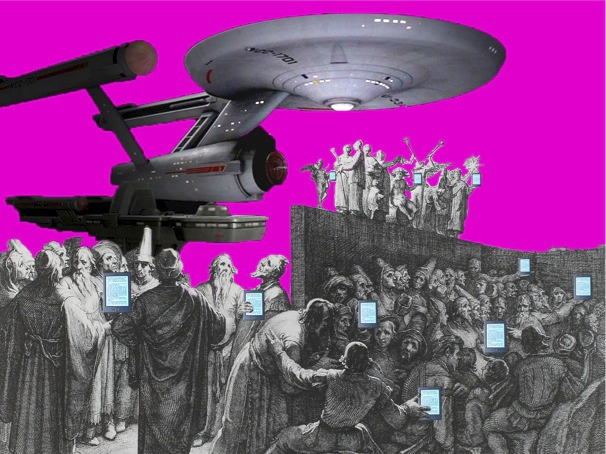 During the first ”Blue Friday“ – that is the periodical meeting of all colleagues at Unterhaching – of 2012, the InterFace AG presented all its employees, working students and interns with a new Amazon Kindle 4.
The Kindle technology caused the development of a fascinating system for knowledge distribution with various software tools both within and outside Amazon. Free software is available. Using it, you can convert texts of many formats into the Kindle format and distribute them on Kindle devices.
There is even an alternative operating system for the Kindle. You can use it in addition or instead of the one you already have. This technology literally “smells” like it has to be used in knowledge-based enterprises co-working, collaboration or co-creation. Consequently, we have to support our production processes with the new procedures and tools in the entire enterprise, thus testing where we (and others) can improve.
This is true both for generating knowledge and supporting communication and quality within the enterprise. That – and also me wanting to thank everybody for their active support during the successful year 2011 – was the reason why every InterFace employee, along with all working students, was given a new Kindle 4 for private use last Friday.
InterFace AG chairman Roland Dürre says: ”We assume that this technology – even though it is no longer all that innovative – will play an important role in the future. The paradigms for applying and using IT will continue to change and increase dramatically. By supplying all our employees with a Kindle, we want to introduce all ”InterFace-ers“ to this technology as quickly as possible, thus improving the chances for our enterprise to remain creative, vital and technologically leading.“
Contact: Roland Dürre – Mail: roland@duerre.de Tel: 0171/4850115
P.S.
Feel free to use the picture for publication
(Translated by EG)
Gastautor(en) Monday January 16th, 2012
Hurrah! I Can Read the IF Blog on my Kindle!
Here is a short instruction (not just for the IF blog)
Being an enthusiastic user of my new Kindle, I find it great that I can now read Süddeutsche, Zeit, Spiegel and much more, as well as browse through the IF blog, while sitting in the S-Bahn train.
🙂 The “installation” is a little tiresome, but afterwards…
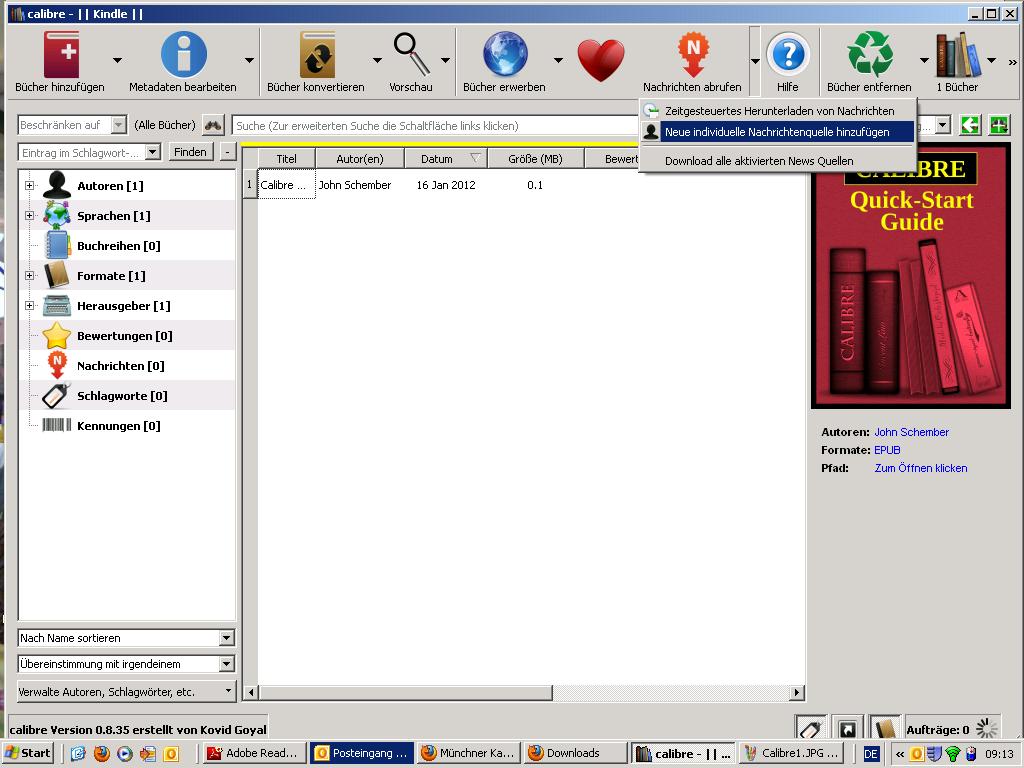
First, I installed the program Calibre on my computer. It is a free Open Source e-book management application. Using it makes it possible to convert books and files into the “Amazon format”. But you can also call up RSS feeds and then transfer them to the Kindle.
For installation, you have the option “call up news”.
You can choose between:
- Time-controlled download of messages:
what you get is countless pre-arranged RSS feeds, among others currently 68 newspapers, some of them free. - Add new individual news source:
that is what I need in order to be able to read the IF blog on my Kindle in the future.
Roland DürreWednesday January 4th, 2012
Questioning What Seems To Be Self-Evident? – Very Dangerous – Cars!
What amazes me more and more often are general concepts that we all accept as something that goes without saying. I am talking ideas I was socialized with – and I used to believe them myself.
Mind you, this is regardless of the fact that, if you consider them reasonably, they get more and more doubtful. And you quickly realize that you definitely should question those concepts. Yet more often than not, you will not dare to contradict, because you do not wish to look stupid.
Here are two examples:
- Growth will solve the problems of our economy;
- Global trade will give us global wealth;
I am sure you will easily find more of those “totally-self-evident-concepts that are actually lies”.
Last autumn, I attended a philosophical workshop. It was about “lies made up to look like the truth”. Well, those “totally-self-evident concepts that are actually lies” could not have fitted more perfectly. Consequently, I described them in my presentation ( Vortrag) and also mentioned the problems I have with them.
The discussion about the following “totally-self-evident-concept that is actually a lie” was particularly exciting:
- Cars are something we cannot do without.
It came as quite a surprise to me how my anti-thesis
“It is quite possible to live without a car, in fact, you live better!”
mehr »
Roland DürreSaturday December 17th, 2011
Advent Calendar – December, 17th
Another 7 nights to go!
Well, it gets tough! Christmas comes nearer and nearer – and still there are a few presents you have not yet bought. After yesterday’s article in my advent calendar, there is no SLYRS left in Neuhaus and the queues in front of the jewellers’ shops are long.
So what can you do?
Roland DürreMonday December 5th, 2011
Video of the IF Forum “Nano Technology –The Future of IT”
Here it is, the video of the fantastic presentation by Walter Riess at the IF Forum of November, 18th, 2011 in our Unterhaching office building.
“Nano Technology – The Future of IT”
Dear Walter – once more many, many thanks!
RMD
(Translated by EG)
Roland DürreThursday November 24th, 2011
A Golden C64 For A Good Cause
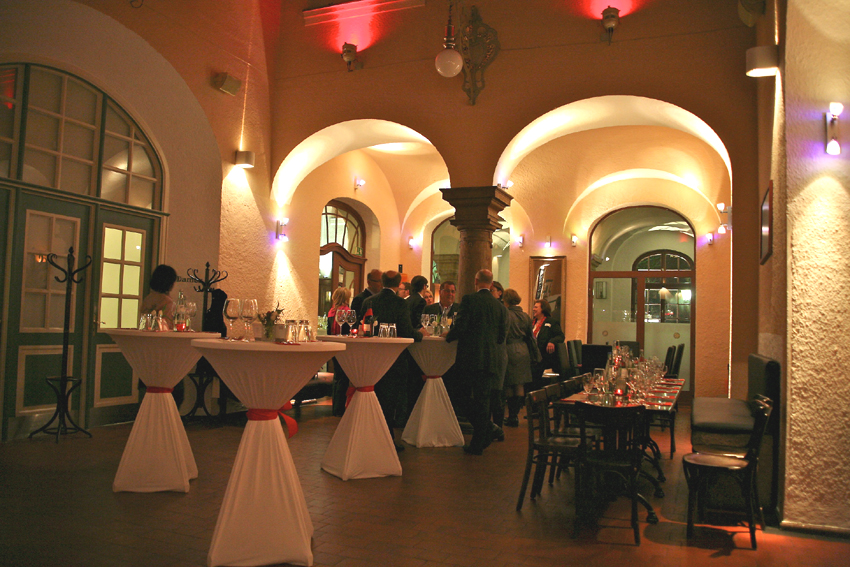
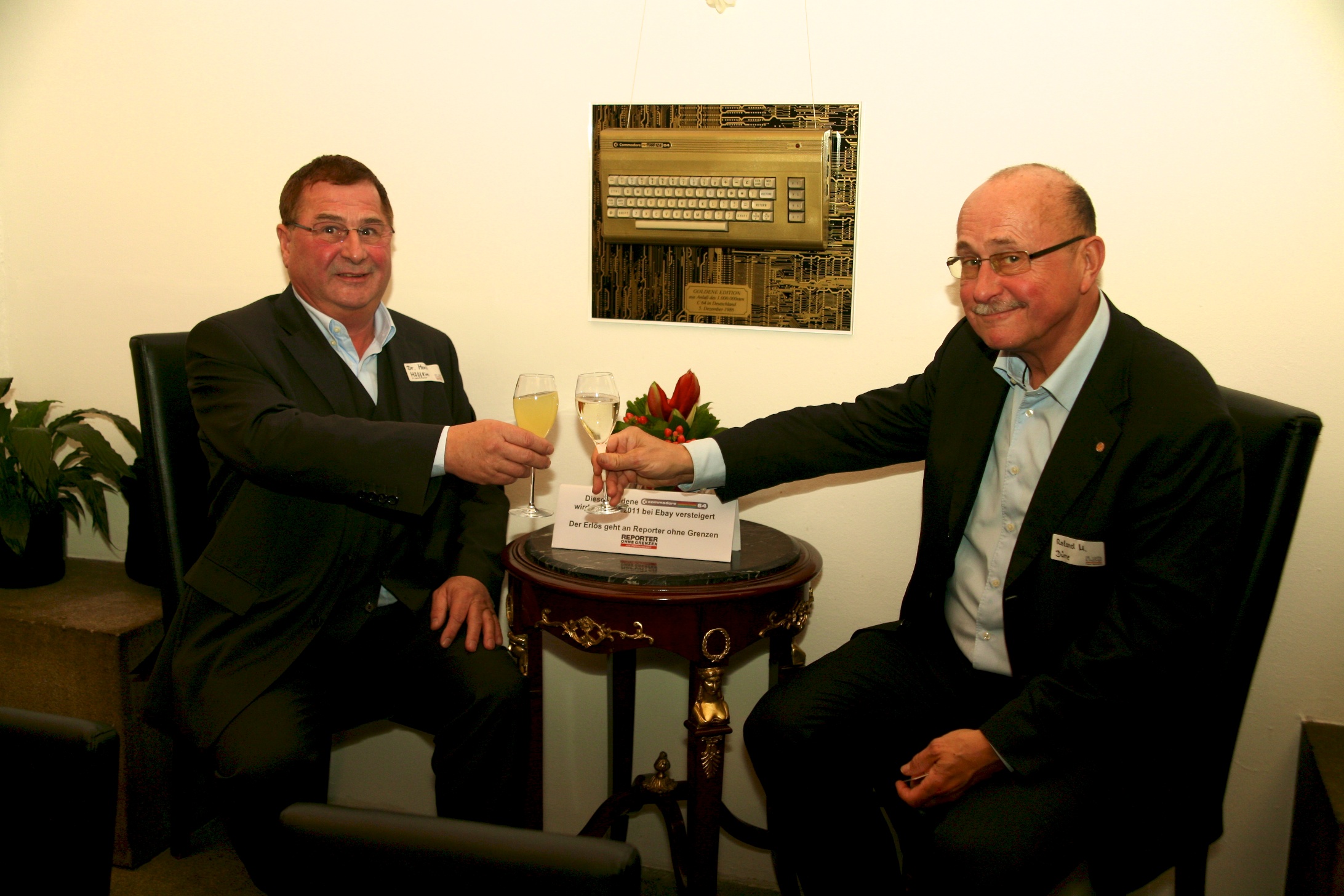 It was a nice party at the Café of the Müller’sches Volksbad in Munich, Rosenheimerstr. 1.
Our friends and partners Dr. Annegret Haffa and Dr. Horst Höfflin celebrated the 25th anniversary of their agency Dr. Haffa & Partner GmbH!
The public swimming pool cafe was a suitable location for the beautiful festivity. We cheered each other without restraints and wished 25 more successful years on us all!
Horst is a passionate entrepreneur. Due to his ancestry, he adds special knowledge in choicy wines to his technological competence in communications.
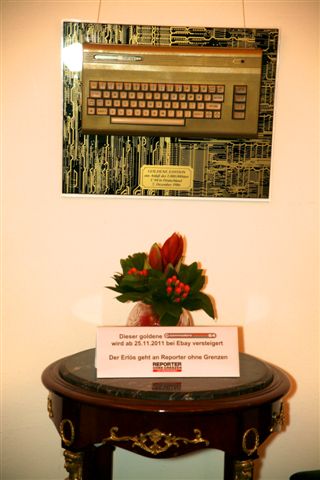 In addition, he collects beautiful, old objects. His oldtimer motorbikes, in particular, are a feast for the eyes.
He is taking this jubilee as a reason to part with a precious and much-loved piece of his collection. To be sure, it has no combustion motor, but still, it has accompanied him for a long, long time.
It is a Commodore 64. This type of computer was an important means of production in his agency 25 years ago.
Now we are talking a very special specimen of the ‘Golden Edition’. It was released in 1986 to accompany the production of C64 number one million. The ‘Golden Edition’ was limited to 200.
The one owned by Horst has the serial number 1000126.
The action will start on Friday, November, 25, 2011 (tomorrow!) at 17:02:52 hours and will end ten days later, on December, 5th, at 17:02:52 hours. I will publish the link to the auction page as soon as it starts
And here comes the best about it:
The money the auction will bring will be donated to “Reporters sans frontiéres”!
So why don’t you participate?
RMD
(Translated by EG)
The bid of the winner was 3.676,77!
P.S.
On the picture, you see the festive atmosphere of the beautiful party! The room is still empty, but as the night progressed, it really filled up!
Photograph: Ingo Weber
Roland DürreWednesday November 16th, 2011
The Future and Waste
In the German alphabet, the words Future (Zukunft) and Waste (Verschwendung) are at the end. I wonder if that is the reason why nobody really seems to be willing to deal with those topics?
Personally, I am convinced that the future is important. And that the planet earth – which currently is our only future – is massively in danger. And that things might happen pretty fast. And that we therefore must start immediately and stop the destruction of our planet. We have to limit the climate catastrohpe, along with other damage that has nothing to do with the climate, and try to repair what harm has already been done. It is a question of reason and morality.
We have to reduce energy production through burning fossile raw materials to ZERO. I am sure we will need modern technology to achieve this. Without it, there is absolutely no chance. That is why I am in favour of wind energy, desertec and the like.
But I am just as certain that this alone will not be enough. Perhaps we have to stop the gigantic waste of resources that happens on a daily basis at all levels. Above all, it means that we will have to forego a lot. If we do nothing, we will be forced to forego very much. The process might be less painfull if we are prepared to change what is habitually going on in our society. Regardless of the fact that it is already 5 past 12, instead of 5 to 12!
Our social interactions, the way we keep house and enjoy ourselves, our basic assumptions and values: everything must be subjected to radical reform. A change in our lives that sounds unbelievable will be necessary. Yet this change can lead us towards a future that is quite lovable. To be sure, everything will be quite different from what we are used to now. There will be many seemingly grave constraints, but they need not necessarily be bad. In fact, they might even make us a little happier and more content.
Consequently, I will now start a new series – similar to “What Annoys Me“. In an unforced way, I will give examples of waste that is totally senseless and that is really painful for me to witness.
RMD
(Translated by EG)


