
Roland DürreSunday March 24th, 2013
“I like” & Facebook or “WiTuN”
I like Facebook, Google+, Twitter and many more …
I constantly hear sentences like…
“… all those Facebook and twitter affairs are evil … personally, I absolutely boycott social media … virtual friendships are rubbish, because you have to see each other face-to-face, anyway… and worst of all is, after all, this stupid: I like!”
… from persons who are otherwise basically to be taken quite seriously. I mean people who climb into their cars and drive off at high speed or go back to watching TV – which means they actually use technology that used to be quite modern and relevant.
I prefer to keep quiet on hearing their comments. After all, I know that any and all of my attempts at explaining things (social media) to them is totally useless. There is nothing you can ever do about dogmatic know-all manners, especially if those know-alls do not even know what they are talking about and consequently cannot understand it. This is actually true in general.
In the last ifcamp (barcamp at InterFace) on our BlueFriday (of March, 22nd, 2013), I introduced one “knowledge management” session. It was about how we can set knowledge free and then share it. In order to then evaluate it together and identify what is relevant. With the goal of finding the right and probably better decisions for the future from the “crowd”.
In the course of our discussion, the Facebook phrase “I like” also came up. And we concluded that this is probably a first and extremely simple tool for social feedback. You can use it if you want to show people that you like something. Or that you appreciate them. Or that you simply are sympathetic. …
During the session, we came to the mutual conclusion that there is a need for a refined and neutral “feedback technology” for applications intent on using the crowd and the good social web. For these systems, this would be an absolute necessity. Without this technology, these kinds of projects cannot succeed.
We spontaneously found ways to improve on “I like”. Here are some examples.
- Give a limited number of “I like”-s to each participant;
- Assign a certain amount of them each month;
- The participants get dynamically more “feedback units” as the social relevance increases, perhaps similar to klout;
- Or maybe there could be something like a “Page-Rank” for members of a social system;
- It might also be a good idea to introduce “feedback units” with different weightiness…
In a nutshell: I believe the “feedback technology” is a very important and central component of all kinds of crowd and social web applications. But this is not at all a trivial topic; it is well worth dealing with in great detail. I am sure there is also a considerable number of scientific works with good ideas which one might be well advised to take a closer look at.
Here is an example from another field that surprised me:
I like writing in stenography. So I had this idea that the technology of “writing quickly and ergonomically (instead of tense) by hand” – which has been developed and perfected over hundreds of years – could be used for text processing on tablets or with gesture-controlled systems. And then there was a friend of mine who works among the Academia who found it a wonderful bachelor theses topic, so it was very thoroughly analysed.
So – let us get under way;
Let Us Share Knowledge – and Use It!
(LUSKUI)
RMD
(Translated by EG)
Note:
This article does not suggest that I find everything Facebook or Twitter does agreeable. If, for instance, I will notice certain tendencies towards tampering with “social metrics” at Facebook, you will have seen the last of me there sooner than you might have imagined.
But such a turn of events at FB will not change my opinion that social networks and shared knowledge applications mean social progress. In fact, it would be one more reason to rekindle the old philosophical and ethical discussion: how can we get to a stage where the production of articles and services will be done decently? After all is said and done, this will again end up in a discussion about privatization or the social responsibility of those who own all the production goods.
Roland DürreWednesday February 6th, 2013
Entrepreneur’s Diary #87 – It Is Quite Simple …
… and yet so hard!
Today, all you get is a short article: here are just a few citations of remarkable tweets by Nils Pflaeging:
Niels Pflaeging @BetaLeadership
If you want to kill connectedness: create functional division, departmentalize and allow hierarchy to invade the work #stoos
Niels Pflaeging @BetaLeadership
All that planning doesnt earn you any money. Improving the work and fighting waste does. #stoos
Niels Pflaeging @BetaLeadership
Functional division, divisionalization and matrix structures ALWAYS result in a loss of accountability. Period. #stoos
That is exactly how I feel and could have come straight from my heart. Consequently, there is nothing left for me to say.
RMD
(Translated by EG)
P.S.
For more articles in my entrepreneur’s diary, click here: Drehscheibe!
Roland DürreFriday January 25th, 2013
The Direct Path to Nerdism
This is about quality control for IT projects. You have to obtain certificates. Here is an original question you get preparatory for an exam.
“Quality management of a product consists of quality assurance, quality planning and quality control. You are responsible for quality assurance in an IT-based project. Name three central tools you need for quality assurance…”
If you can answer this and most other questions of the same sort correctly, you are a certified quality manager.
So what is left for me to say? It is better if I shut up. But your comments would be very much appreciated.
RMD
(Translated by EG)
P.S.
I discovered the topic in a Google+ discussion.
Roland DürreSaturday December 15th, 2012
Looking Back On the Dornbirn PM-CAMP 2012
Yesterday, I received an email from Stefan:
The video recordings of the PM Camp are finished. How do you feel about them? Any changes recommended?
“PM Camp 12 rocks”
The first thing I did was watch the video recordings – and I was fascinated! No changes recommended!
For me, the Dornbirn PM-CAMP 2012 (#pmcamp12) was doubtless one of this year’s highlights. So here is another link to Stefan’s report on the PM Camp 2012 (as a contribution in his PM-Blog.com).
RMD
(Translated by EG)
Roland DürreTuesday November 20th, 2012
Data Security and Industrial Espionage …
When discussing data protection and security, you often hear the term “industrial espionage”. Federal agencies or our oh-so-important business associations keep warning us:
Over the last few years, industrial espionage increased dramatically!
And, of course, the focus of said espionage is on German enterprises and their know-how.
The same sentences can also be read in a survey done by “CORPORATE TRUST – Business Risk & Crisis Management GmbH”.
You can access it through the following link . It is rather worth reading, especially with respect to how you can make people fearful?
You will find the warning that “cyber war has become reality a long time ago” and that it “has arrived in the middle of our society”. Neither can the “computer worm Stuxnet“ be ignored. After all, it was “probably developed especially in order to sabotage the control mechanism Simatic S7 – which controlled the frequency converter of the motors in Iranian nuclear programs.”
(Note the word “probably”).
To be sure, the exact goals of the customers were unknown, but the complexity of the attack shows that we went from an era of script kiddies and crackers towards a new dimension of danger – etc.
 Mind you, these are all original sentences taken from the study. The very choice of words in its martial character already makes me sceptical.
Regardless of this, I take the subject of data theft a lot more seriously than, for example, the fear of personal data being abused. I also believe that “stolen” data will help you to reach your goal faster than having to develop “something new”.
I have a vivid memory of a project we did a little less than 30 years ago. We were asked to develop something totally new. Except that we did not have the slightest idea how the “new” could be done. In those days, studying the sources the competition used was quite helpful. And to this day, I do not know if we made use of said sources legally or, maybe, in a certain shady area.
Still, I do not think industrial espionage is quite as menacing as it is projected – and not only in the internet. One of the reasons I give for this is that these fear-inspiring studies originate with firms which want to sell special counter-espionage services and products. And, of course, federal agencies and business associations are quite ready to chase the pig through the village. After all, there is nothing else they are busy with. What a nice idea to employ James Bond! Isn’t it a beautiful shiver you feel whenever you hear how evil the world is and how you yourself are absolutely powerless?
But let us remember what it used to be like!
 When I worked for Siemens, we were absolutely prohibited to take any secret documents with us when we left the building complex. And almost everything was secret. Consequently, there was a random generator at the portal. Occasionally, it lit up. When it did so, you had to open your briefcase and show what was inside. It went without saying that taking pictures on the factory premises was not allowed.
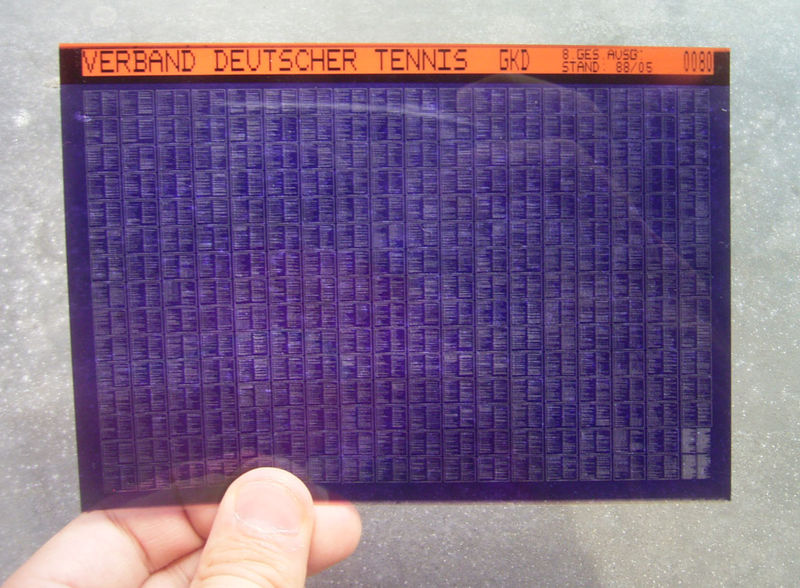
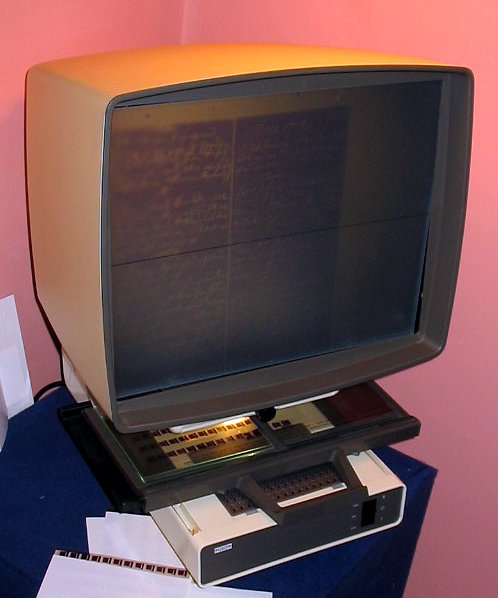
Those were also the times when we used those blue “Micro-Fiche-Films”, along with the reading devices that went with them. Micro-Fiche, or rather microform is the first technology I know which you could use for storing many data on little material. For us, it was usually sources of complete operating systems that were stored on a small square of film so we could carry it around with us in our briefcases.
Of course, it was not realistic that the secret papers were never leaving the factory premises. For one thing, our firm was quite distributed. Some data were needed when you went to see a customer. And once in a while, you also wanted to do some work at home. Consequently, we had permission papers. If you had this paper, you were permitted to take any secret paper you needed. The higher echelons – I do not remember up from which AB or GB level you qualified – were also permitted to take secret documents without the permission paper. I also do not remember if AB truly was short for “departmentally authorized“ and GB for “generally authorized“.
But then what a strange (and totally stupid) kind of firewall was that? It was certainly no more secure than the modern firewalls offered by IT?
Incidentally, the first two colleagues from the former GDR we employed directly after the re-unification confirmed this opinion. They came directly from Robotron Dresden. And they told us that, naturally, at Robotron, they always had the latest plans of the Siemens chip developers on their desks the moment they were made. Except they were not able to put them to any use. The necessary raw material (purest Silicium) could not be obtained in the GDR. Neither did they have the necessary tools to even produce the prototypes.
To be sure, I do not know if our ex-GDR engineers were just after spinning us a good yarn, but I can easily imagine that this is actually how it happened. Basically, I believe data will always end up where they should not be. But mostly it makes not the slightest difference, even if, perhaps, you get quite annoyed, and justly so.
But I also believe the methods changed. And the new methods are a lot more efficient, even though they have nothing at all to do with IT. Let us take a look a China, where, allegedly, the enterprises want to spy on Western firms. Do they really need to do that? Or are there, perhaps, far easier methods?
Here is what you can read in “invest in Bavaria” at “China in Bayern”
Currently, more than 130 Chinese enterprises, for instance Huawei Technologies, Pearl River Piano, ZTE, Yingli Solar, ET Solar and a little under 11,000 Chinese citizens reside in Bavaria. About a third of them live around Munich. Approximately 3,000 Chinese students at Bavarian universities further attest to how attractive the Bavarian universities are.
I also know that there are Chinese branches in the “regions with weak infra-structure“ in Bavaria that have such lovely scenery. Those Chinese branches specialize on R&D (research and development). Actually, these enterprises are quite heavily subsidized by the Bavarian authorities – and accordingly, their moving here is celebrated quite bombastically. Because, as a general rule, F&E is a clean sector. It does not damage the environment and attracts intelligent engineers.
And what is the first thing a Chinese F&E enterprise will do? No question! They lure away the German engineers formerly employed by their German competition. And the best ones at that! Those with exactly the kind of know-how most urgently needed in China. And the German engineers are happy to come. They are quite attracted to live cheaply in a nice place, do some F&E in a modern laboratory and mostly even be paid better than before. This is how the Chinese can choose from the best persons with the right knowledge. Now isn’t that a lot more efficient than having to crack networks and servers?
Neither can I find any fault with it. After all, we live in a globalized world and I rather like the Chinese with their friendliness and tasty cuisine… And I seem to remember “knowledge is the only raw material that grows as you share it“!
After all these ideas, I read the aforementioned “study” with totally different eyes. “Installing fear“, is, after all, a very successful marketing strategy…
RMD
(Translated by EG)
P.S.
I took the pictures from the central media archive Wikimedia Commons. They were taken by Nichtich and Tomasz Sienicki [user: tsca, mail: tomasz.sienicki at gmail.com]
Roland DürreSunday August 26th, 2012
Change
During the vacation I spend in the wild South of Greece (Peloponnes, Mani), I sometimes read a few of the internet “information pages”: ARD, SZ, Spiegel and such.
And I notice that remarkably often the news sound helpless. Take, for instance, mobility. Here is what I read:
Even the vehicle that won the VCD price for being equipped with the most economical combustion motor still produces far too much carbon dioxide. Electronic cars are nowhere near coming onto the market. Fuel prices skyrocket…
And then there comes the fear:
What will happen to the backbone of the German industry – automobile industry?
To be sure, the fear seems justified. But here, too, there are solutions. And we definitely should concentrate more on the solutions. Also in the “news“. Wouldn’t it be nice if the media were to spread less helplessness and fear, and instead work at a concept for the future?
Our future will be characterized by change. Because the change we need will happen. In fact, it is already under way. This change will and must happen with our collective and individual awareness. We have to change our mental concepts. And that is what we will do, simply because we will have to do it. The process will be a part of the evolution, supported by our world-wide network through the internet.
And here it begins. Even as I write this, more and more people try to coordinate work and life better. Many use public transportation or their bikes more often than they used to. And they will probably soon use the electro scooter. We will have to and will manage to make our mobility, along with our entire lives, a little more “decroissant”.
In many areas, the hierarchic structures dissolve, being replaced by networks. Entrepreneurial initiatives substitute systemic realizations. Strict interconnection is replaced by lose interconnection, central control makes way for self-control. This will be particularly necessary in complex social systems, and that is where it will happen. Maybe this could also indicate how we might solve our “current problems”, such as EU and EURO.
More and more people start changing their habits. They refuse to be made part of the marketing mechanism. They reduce their consumption. They no longer want status symbols. They are more nutrition-conscious. They get joy in their lives from what is really important to them. They prefer being something to seeming something. They get more critical and autonomous and will no longer accept being told what to think by religions and associations.
If we want change, we need no federal programs. They would be no help, because what must happen has to come from deep inside ourselves. It might be a good idea to do without subsidies and regulations, because they will certainly not help us. The development of our awareness and our values must happen in a fair discourse, free from suppression. And it has already started.
Parallel with this, all we have to do is act. Decentralization is the motto. We all together, as well as every individual person, must do what is right and refrain from doing what is wrong. It is quite simple, isn’t it?
RMD
(Translated by EG)
Roland DürreSunday July 22nd, 2012
A Highway Code for the Internet?
» Every technological improvement, if it is supposed to improve human happiness, will also be an improvement in wisdom. « (Bertrand Russell)
A short time ago, I heard the following statement at an Informatics&Sustainability (Informatik&Nachhaltigkeit) event:
As more and more automobiles appeared in the public domain early in the last century, a highway code became necessary.
And then someone asked:
Do we want/need something like it for the internet?
At first sight, it sounds quite reasonable, doesn’t it? At least I would spontaneously answer: yes. Communication, too, must be regulated sensibly. On various levels, as, for example, the ISO-7 layer model outlines quite nicely. In former times, the national postal services had introduced and successfully realized communication models in the CCITT. That was in the good old times when we still had letters, postcards, parcels, telephone an telex. And it worked quite well, didn’t it?
🙂 To be sure, even at the time, there were such negative things as spams. But it was rather tedious to send someone a spam – you had to walk up to their letter box. Or else you had to buy a “bulk mail service”. It did cover a hundred per cent of the postal code area, but at least it was rather expensive!
Only when radio and TV technology made it possible to transport spams directly into the households without much of an effort, the dam was broken. And CCITT could not do anything about it. After all, this was about economic interests. And traditionally, economic interests have always justified everything.
Consequently, the call for some sort of “highway code“ on the internet seems to make sense to me.
But then comes the “but”:
The development of individual mobility, including a highway code, should, first and foremost, be a warning for us. Because, as I see it, it is an extremely good example for how, regardless of – or due to (?) – the extreme regulation mania displayed by the legislative body, technological progress (in this case individual mobility) was improved, but at the same time the common good was severely injured. Mind you, it all happened even though we have a compulsory driving licence, a complex system of punishments and penalties, including a system of minus-points and similar things.
And the damage that was done was not really noticed at all, because we “got used to it” in typical human fashion. Although said damage is massive and concerns many dimensions of our lives:
- Just think of the massive soil sealing cars brought in their wake. How many square metres of ground were filled with concrete for streets and parking places? In modern semi-detached housing areas, we often find more ground covered by garages and car parking than for greenery. All in all, the landscape was destroyed.
- Individual mobility, especially as we live it today, gave us extreme resource exploitation, gigantically wasteful habits and a massive amount of rubbish. It is the best example for a non-sustainable life-style.
- Noise disturbance has reached unimaginable dimensions. There is hardly any place left where it is really quiet. Even in the “upscale housing areas”, there is still noise from motorways.
- This development of public traffic cost us time. Many people spend several hours every day behind the wheels or their cars. Although they have a good job, they spend a lot of their time doing something otherwise only done by people in an extremely low income group. And they say they enjoy it and are prepared to give “their last shirt” for the car and even indebt themselves for the car.
- But the worst of it is that this development costs us an immense bloodlet. In Germany alone, there were years with more than 20,000 fatal traffic accidents. Today, we still have more than 5,000 fatal traffic accidents – and the numbers increase again.
World-wide, we have between 1 and 1.2 million estimated deaths caused by individual traffic each year (source). That is more than the victims of illness, wars and hunger. If you add up the last 60 years, you easily get a number higher than 50 million. That is about as many victims as WW-II cost. I will not even think about the really astronomical number you get when you count the people injured in traffic accidents.
Now the question is if a wise legislative body could have done better a hundred years ago and then during all those years?
I do not know. I do not even know if, in retrospect, we can say what should have been done differently all those years ago.
But I have a few ideas:
For example, I am sure it was a mistake to permit and even support the industry when it promoted the introduction and, above all, the sale of automobiles through sports. Motor sports and also the race courses, such as the Nürburgring were goal-oriented cooperative projects initiated by state and industry in order to promote the acceptance of the then still little-loved new technological product “car”. Thus, we were (almost genetically) pointed towards driving cars as an athletic activity where it is important to be faster than others.
Perhaps we should not have let it happen that the users of the competing means of transportation bike were publicly degraded as early as the first years of the economic miracle. I myself witnessed how my father, against his wishes, changed from using his bike to using his car for the less than two kilometers he had to go between our flat at Rosenaustr. 18 in Augsburg to the General Railway Office Building at Prinzregentenstr. near Augsburg Central Station. Simply because both the neighbors and his own wife thought it no longer appropriate to go by bike in his position.
In those days, going by bike was synonymous for “being poor”. To make matters worse, there was an overflow of cheap bikes from the stores. They all sparkled rather nicely, but unfortunately were not very reliable. And who wanted to be poor and additionally have to get annoyed all the time? But could or should we have resisted against the judgment “if you ride a bike, you belong to the poor” and the avalanche of cheap products at the time?
Perhaps we should have promoted the general welfare in individualized traffic by installing reasonable car-sharing regulations? Or maybe we could have made stricter laws and restrictions?
But how to limit the number of fatal traffic accidents? No law was sufficient (and that is still true today) to put a stop to all the ruthlessness and readiness to assume risk. It probably comes automatically as soon as you sit behind the wheel of an automobile.
Perhaps introducing an archaic mechanism, such as an obligatory blood-feud against “traffic killers“ might have diminished the number of deaths? But, of course, this kind of idea is polemics. I do not mean is seriously. And, naturally, “the end can never justify the means“.
Or maybe humans are just not fit to cope with the (imagined) omnipotence they have behind the wheel of their machines. We are talking humans for whom the (imagined) freedom and independence others cunningly made them believe they really want and for which they are actually prepared to jeopardize both their own and – which is worse – other person’s physical health. Neither do these humans care if they have to pay taxes, compulsory insurance and penalties. For their car, these humans made many sacrifices and sometimes even indebted themselves. And now they want to enjoy the intoxication and even accepts the potential death and injury of third parties.
In fact, to me it seems that this genetics of omnipotence is so deeply rooted that even cyclists sometimes act it out as soon as they mount their bikes. Nowadays – as I witness every day – even the female biker does it!
I am not sure if we would have been a success if we had tried to give the development of individualized traffic with all its terrible consequences other rules and laws a hundred years ago.
We might have avoided some of the damage if we had collectively developed a different attitude! Regulations, however, will certainly not make a difference.
Our present position is what it is. The damage has been done and the coming generations will either put things right or not. Evolution will put things right or not. It will go its way. What will come will be the right thing. No matter what. Even if it seems more like it works without purpose and in a chaotic way.
So what is my consequence with respect to the internet? Can we learn anything from the history of individualized mobility for internet data and knowledge networks?
As I see it, regulations will not help. Maybe developing an “ethical” awareness would be a better way. But how?
RMD
(Translated by EG)
Roland DürreSaturday July 21st, 2012
Remaining on Course and Project Management – A Compass for Eventful Times
During weekends, I enjoy reading the blogs my friends write. For example, Dr. Stefan Hagen (Stefan) informs you about the Nürnberg PM Forum 2012 by GPM in his PM-Blog. He also wants to attend it, because he thinks it is time for him to remember what a traditional conference feels like.
I already look forward to hearing what Stefan is going to tell me about the GPM PM Forum, both from reading it in his blog and meeting him in person. And I can already predict to some extent what he will probably tell me.
Personally, I no longer like traditional conferences. Still, once in a while, I attend them. Depending on the actual event, I usually end up more or less disappointed (or rather, my prejudices turn out to be correct). Once in a while, you will see some brilliant speakers. You also meet people you would like to see again, but that is usually about it.
What I find remarkable about the PM forum is its title:
“Remaining on Course with Project Management – A Compass for Eventful Times”
Now that already causes the first disagreement in me:
I am actually fed up with hearing catch-words such as “Eventful Times” or “Crisis”. Today, we are all better off than ever before. If this is what you call crisis, then crisis must be a beautiful thing. In fact, it is a pretty nice life-style – if you ask me, I would say let us remain there!
As opposed to common sentiment, I think we live in a time of luxury. Unfortunately, however, this luxury made us collectively (and probably also individually) obese and inactive. We live beyond our means – and on borrowed money to boot.
The only movement I can discover is society trembling with fear of losing prosperity and our desperately clinging to what we own. Is that what you call “eventful times” or “crisis”?
And then here comes the association preaching:
“Remaining on Course with Project Management – A Compass for Eventful Times”
To me, this sentence sounds strange, both linguistically and with respect to its content. Maybe people should think a little harder before creating and publishing these kinds of slogans.
So what exactly is the meaning of “remaining on course”?
Doesn’t a reasonable and courageous “remaining on course“ necessitate a lot more than project management? First and foremost, you would have to know where you want to go, wouldn’t you? You want to know which business model you aim at. We are talking culture and values, responsibility, knowledge, courage, pleasure, respect, tolerance, civil courage…
I could just as well come up with the motto:
“Remaining on Course with Requirement“.
Or, even better: Let us install an association for course finding that certifies course finding. The motto might be: finding your course through dominance-free and upright discourse. (Adorno, Habermas).
Of course, this is not entirely meant seriously. But give me a break: “Remaining on course with project management“ might sound nice, but all it is is a complex and confusing shell of words. First and foremost, you have to find the path you want to tread on. Or at least you have to find your direction. And this is certainly a very difficult project. You cannot sell project management as the trivial solution for the problem.
Suggesting that “project management is the compass in eventful times“ sounds adventurous to me. Or at least very simple (or a technocratic concept?). Why don’t you go on to say:
“With PM, we will solve all our problems!”?
But so what. As I see it, the slogan is more like advertising a milky bar. And that is probably all it is – simple advertising nonsense as we will find it all over the place. Except I do not know if, maybe, the association is harming itself by this method, rather than promoting its interest. Even if, being the powerful system “association”, you already think (and perhaps that is what you have to think) you own the certified truth cut up into standards.
I would find it truly outrageous if, for example, the PM Camp, for which I feel partly responsible, would advertise itself with such a primitive slogan. Among my own friends, I would fight such a slogan.
If you want something that brings a smile to your face, here is the original introduction from the PM Forum program brochure 2012 Programmheft PM Forum 2012 (pdf):
Internationally spoken, the weather is still inclement and the general outlook will remain stormy. To be sure, in Germany, the economic outlook is positive enough, but here, too, the entrepreneurs will have to be prepared to fight rough seas. During this stormy up and down of the economy, we now need to remain on course. It is a good thing that the enterprises invested in project management, thereby improving their position among the competitors. Through project management, you can achieve convincing results, both in time and in budget. For German enterprises, professional project management becomes more and more the success guarantee. It turns into being the compass and provides orientation, it levels out minor disruptions and keeps the enterprise flexible and agile, even in volatile times.
Words, words, words! Why don’t you go and get me a philosopher? And, please, do not ever let an owner of a medium-sized enterprise read this. Are there any buzzwords you have not read in this paragraph? Who would ever write this kind of thing? Or, even better, who will ever believe this kind of thing? What nonsense! But at least, now we know how an enterprise can be saved from collapsing. Isn’t that some achievement?
Mind you, the event costs 1,150.00 Euros for non-members at GPM. Members pay 200 Euros less. Some of the things you get in return are that you can, for example, hear our eternal German-French journalist and author Prof. Dr. Peter Scholl-Latour talk about “International problem areas and the challenge they pose for German policy“, or the self-promoting extreme mountaineering expert Hans Kammerlander about “Hanging on the satin thread. From Southern Tyrolia to Jasemba (7,350 m): 40 years on course!”.
I know both speakers and wish you all a good time!
RMD
(Translated by EG)
Roland DürreMonday June 18th, 2012
EURO + GREECE + BILLIONS + FUTURE
On Sunday evening, I watched “The News”. Incidentally, this is a stupid euphemism! How would you watch news?
I found it remarkable that they were talking about a “Fateful Hour for Europe”. Just because they had tiny general elections in a tiny European country. Incidentally, the same country will get a really serious beating next Friday in the soccer game. Because they misbehaved big time.
🙂 Or maybe they will cause a sensation. Well, when we are talking soccer, nothing is impossible.
But they call it a “Fateful Hour” – and for all of Europe, at that! Another one of those euphemisms. Are we looking at the next “European War”, or what?
So what is this all about?
For me, the Munich decision about the Third Runway is more important. Perhaps this is really the beginning of an about-face – away from the concrete-chromium-jet-set society? I am not yet courageous enough to be hopeful.
But let us get back to all those billions. In German, one billion means 1,000 times 1,000 million. Unlike the British convention!
Then I heard in the news how fortunate it is for us Germans, too, that Greece will now remain in the EURO zone (?). Otherwise, we Germans would have had to pay additional costs to the tune of more than 100 billion Euros.
Now that, too, is bullshit. But even if it were so: what is an extra 100 billion in this game? In this game, the public corporations of the FRG are already indebted by more than 2,000 billion Euros. Not too long ago, it was a little less than 2,000 billion. In view of this, 100 billion are less than 5 %. This is ridiculous.
And currently the national debt is increasing faster than ever before, regardless of the “debt brake” (another one of those linguistic stupidities) and “an overwhelming tax flow”. Neither the “obligation to economize“, nor the “fiscal package“ (again twice linguistic stupidity) can change anything about that fact. The system is no longer linked to a person. It just runs as it runs.
Besides, it is quite irrelevant whether we reach the 3,000 billion for our national debt sooner or later. Basically, it is quite simple:
This kind of national debt, no matter if we are talking Germany, Greece, Europe or the USA, can only be overcome by one means: inflation (or even better: collapse of the currency).
Let us discuss the friendlier version: inflation (I consider collapse rather unlikely, which is why I am not discussing it).
If we want to achieve a nominal reduction from 2 billion in real debt to 1 billion in a certain time interval (let us say, for instance, five years), then the value of the money must be reduced to half its worth. If we want a reduction from nominally three to one billion, then the money value must be reduced by the factor three. In terms of inflation, there is not that much difference, is there?
Firstly, it is not such a bad idea if the very rich, for a change, have to let go of some of their wealth. The determining factor whether or not someone is going to lose or actually even profit is his or her mixture of investments. And this is one area where the rich cannot be sure about the best strategy. Gold and real estates will not necessarily be the best choice. Which is why mostly the losers are in the majority. In the past, quite a few millionaires ended up paupers.
Unfortunately, the truly poor people who have nothing but their retirement money are the real losers. For instance “Grandma with her savings account” or the “Hartz 4″ recipient. And many more. But it will happen anyway. All we can hope for is that the pain will be eased a little.
Maybe the solution is actually some sort of “un-conditional basic income” – along with supplementary occupations in the typical low-income sector. There is enough work in our society – even for the so-called “social fringe groups“ and “persons with few qualifications“ (another one of those unfortunate phrases).
When we are talking inflation, we often forget that many basic necessities, such as food, are still relatively cheap in Germany, regardless of all the inflation we have. With many products, inflation was softened in the past through an “increase in productivity“ and a “readiness to forego top quality”.
The latter of the two aspects is something I cannot understand. But it can be explained by a (slow) adaption to the lower living standards based on the consumer being massively influenced towards poorer but more attractively labeled products – which, in actual fact reveal a tendency towards an abnormal living quality – through marketing.
The former of the two aspects, increased productivity, might well be a dying swan. After all, “increased productivity“ is only partly due to “real creativity“ and “innovative solutions“. In fact, it is mostly more the result of us treating nature and resources extremely lavishly. Along with a systematic exploitation of humans, both here and in other regions of the world. Using humans and nature in a “non-sustainable“ way might be another one of those euphemisms.
Well, the wealthy people, in particular, are now changing their consumer habits. More and more often, quality beats quantity. It gets more attractive to have “less” instead of “more”.
We face many problems – and they get more and more obvious. However, the only way to solve them will be through creativity, innovation and a different mental concept. “Everything is functioning quite well” and “this is what we always did” will get us nowhere!
So here we go – start NOW
RMD
(Translated by EG)


