
Roland DürreWednesday July 1st, 2015
Bruno Gantenberg of Zurich PM Camp at InterFace AG!
A little late, but so much the more motivated, we at Interface AG open the year 2015 under the Ada Lovelace symbol, starting our much loved lecture series “IF-Forum” with a high profile speaker and a topic as controversial as it is exciting.
I would like to personally invite all my friends, in particular those from the PM Camp environment, to come and watch this presentation. You will not regret it. At the Zurich PM Camp, the speaker – Bruno Gantenberg – moved his audience in the truest sense of the word. As far as I am concerned, I already very much look forward to speaking the introductory words for the presentation.
Here is the original text taken from the InterFace AG corporate blog.
 On July, 23rd, Bruno Gantenbein, who is a senior counsellor and project leader at CSP AG, will speak about “learning, too, is evolution”. The Swiss unschooling pioneer will allow us a glimpse into the practice of this new way of learning, at the same time building a philosophical bridge towards project management. Taking his own family and the circumstances of same as an example, Bruno Gantenbein will describe the unschooling approach. He will also introduce the “Spirit-Hand-Heart-Head” Model, he himself developed, which the Gantenbein family has now been practicing successfully for ten years. Applying the results won in this context to project management shows a relevant technological connection with IT and the InterFace AG.
What is Unschooling?
Unschooling is a way of learning controlled by children in their normal everyday environment. It includes the cooperation of their parents or other nearest persons of contact without trying to imitate traditional schools or their curricula. Consequently, there is no planned teaching or certain times of the day when special school-like activities are obligatory. Topics are discussed whenever the child is interested. The parents – or other persons living in close proximity to the child – are less teachers than supporters or comrades-in-learning.
In his provocative book: “Drive, What Really Motivates You”, the best-selling author Daniel H. Pink writes about intrinsic motivation, giving the interesting advice: “Let un-schoolers teach you one lesson!”
Well, Mr. Gantenbein, that is exactly what we are going to do with great pleasure.
The presentation will be on Thursday, July, 23rd, 2015 at 18:30 hours in the InterFace AG offices at Unterhaching (Leipzigerstrasse 16). We welcome our guests from 18:00 h.
As always, you can easily register for this IF Forum via E-Mail. We already look forward to exciting discussions and an inspirational exchange of opinions!
RMD
(Translated by EG)
Roland DürreSaturday June 27th, 2015
Where Our Children Went to School – Experiences in Rich Bavaria (II).
An SZ – region Munich – article of June, 24th, 2015 by Stefan Galler shows yet again what state our schools are in these days. And it also shows our mental concept when talking the lives of small persons given into our care.
Why? Here is the background information!
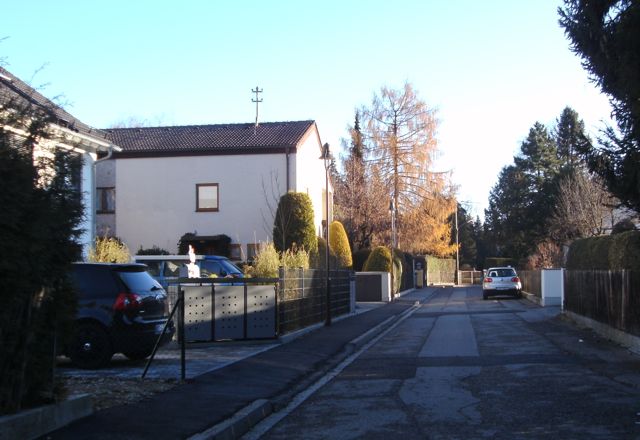
Riemerling – seemingly a harmonic idyll – but that is only how it seems – beware: school!
Even last year, space became a rare commodity in the Riemerling Primary School (which now also has an all-day sector). For instance, lunch was outsourced to the school building in Hohenbrunn on the Siegertsbrunner Straße.
Riemerling is situated directly in Ottobrunn, but it is part of the Höhenbrunn municipality, which is situated a little less than three kilometres out of Riemerling.
The two schools belong together. They use a bus for transporting the children from Riemerling to Hohenbrunn to have lunch (called: lunch-time supervision). The bus takes around 20 minutes for the drive, because it does some detours. The S-Bahn trains do the same distance in three minutes and you can easily ride your bike there in less than 15 minutes.
What sort of country is this, where young persons – who actually should still be permitted to be children and toy around – are forced to spend their entire days in schools and then transported by busses that take twenty minutes for one way to go and have lunch – with the quality of the meal being something I can only guess at?
Do we have a right to treat the time of our children with so little responsibility?
The parents’ council of Riemerling primary school now started an online petition. Under www.change.org, you can find the online petition for a referendum. The objective is: “We want a lunch-time supervision for our children that deserves the name, and we also want it back in Riemerling!”
I would gladly agree. Except – when I went to primary school, we all were out of school by midday and could recuperate from the maltreatment we had suffered in the morning in freedom and with fresh air. Consequently, I would recommend to parents: shun all-day schools. And if you believe they are absolutely necessary, then maybe you should take a closer look at your own lives. Perhaps something went wrong with it?!
RMD
(Translated by EG)
P.S.
Six of my seven children went to Riemerling Primary School. Initially, it was still a halfway humane school with a director who understood children and saw himself as a “mild father”. With a new director – a lady who sees herself as a manager – matters deteriorated. Now the motto became: “Nice exterior, evil interior”. Finally – for me nine years ago – the school has turned into a total catastrophe.
Roland DürreThursday June 25th, 2015
Where Our Children Went to School – Experiences in Rich Bavaria.
On this picture, you can see the school building where my daughter Maresa graduated from high-school after having spent the last two years of her eight-year stunt there. Like all our children, she went to the Ottobrunn Grammar School.
Consequently, between 1990 and 2015, we always had children in our family who attended this grammar school. In one year, we even had one child in every uneven grade (5th, 7th, 9th, 11th, 13th). That means we are a rather experienced “customer” of the educational institution “grammar school”. The same is true for the “primary school” – and I think I have earned the right to actually discuss schools in this country.
We selected Ottobrunn Grammar School because the way from our home in the Waldparkstraße Ottobrunn was only a little less than one kilometre. We had moved there in 1990, early enough for the start of the new school year. Since we did not wish to impose a long daily journey to school on our children, the distance and the way to school were our primary criteria.
The subjects taught in Ottobrunn were also to our liking: they offered languages still spoken today and mathematics. They even had a memorial stone in the schoolyard reminding people of the importance of “Love and Peace”. I rather liked that and found it adequate, because the school building did not really look that old, either.
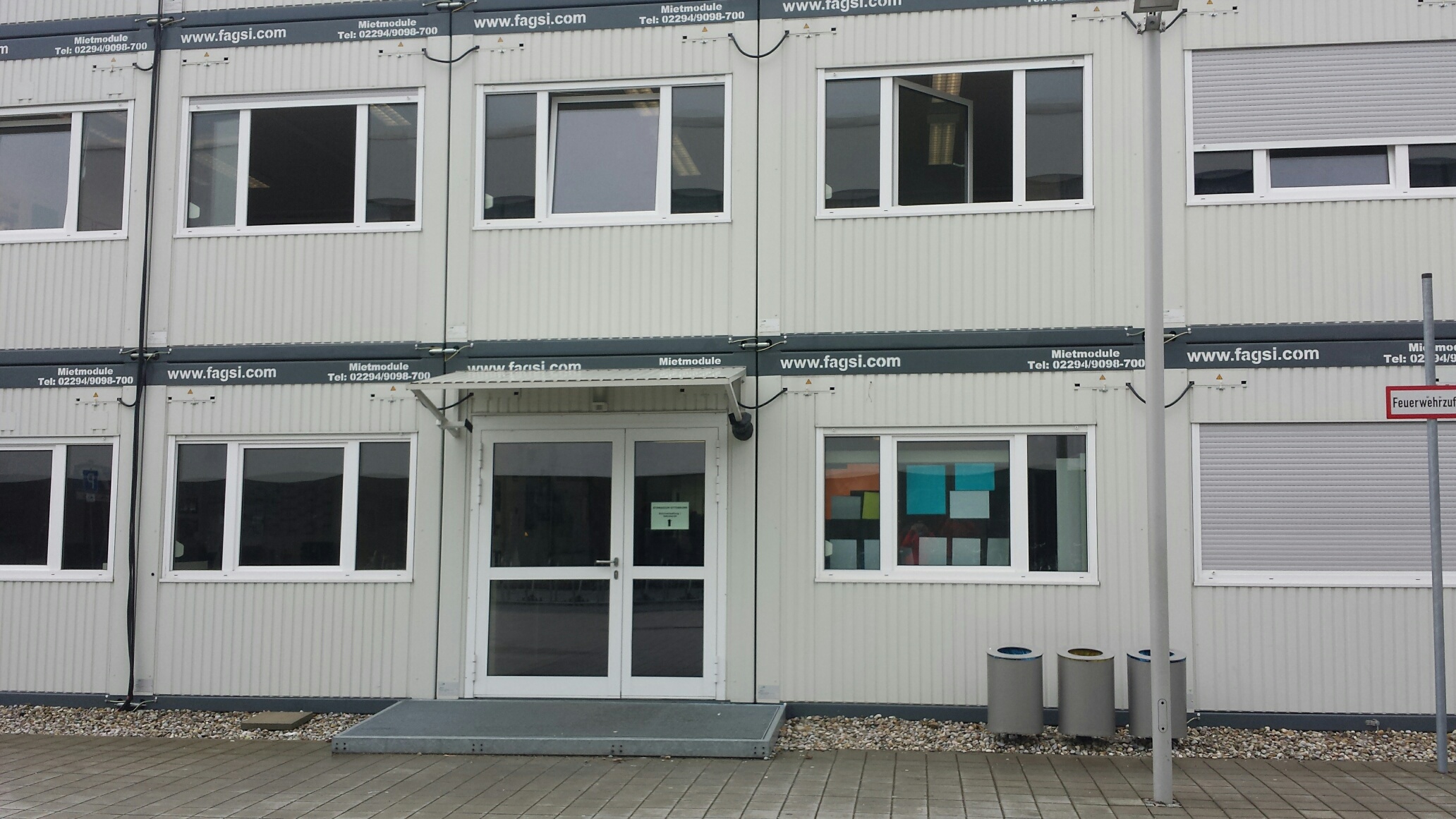
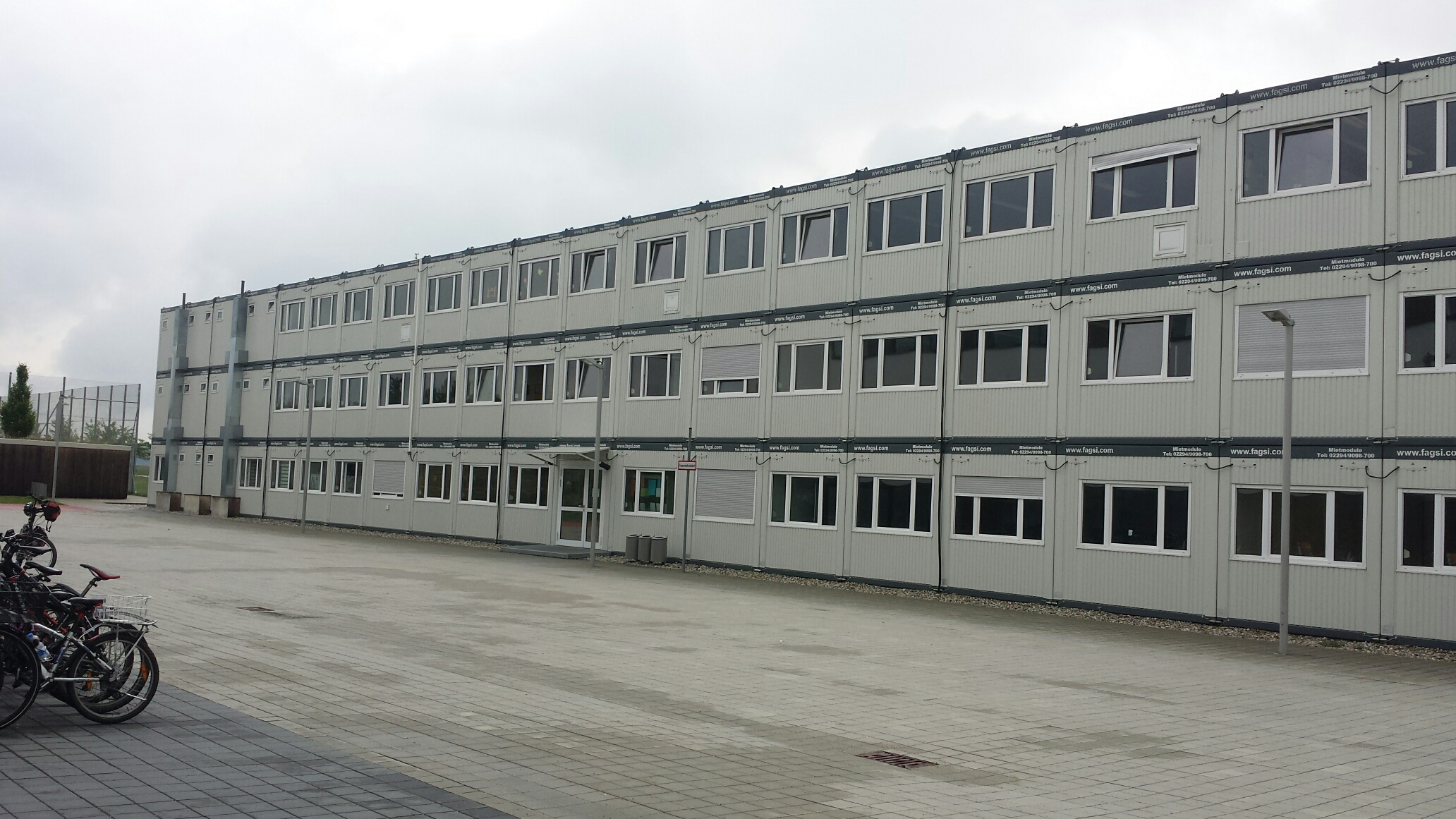
Entrance to the container school building in Höhenkirchen-Siegertsbrunn.
Today, I would like to discuss the building, which slid deeper and deeper into a state of disrepair. Even worse: they found out that there was contamination by asbestos or other poisonous substances. Consequently, they had to tear down the Ottobrunn school building and build a new one.
What a nice coincidence that they already had a container school in Höhenkirchen-Siegertsbrunn! Originally, it had probably been built as an interim solution for their grammar school. I assumed that it would no longer be needed when the Höhenkirchen-Siegertsbrunn grammar school was finished.
Wrong! Because the Neubiberg (that is a neighbour of Ottobrunn) school had suffered the same destiny as the Ottobrunn school building. Consequently, the children in Neubiberg were the first to be transferred and they had to travel to Höhenkirchen-Siegertsbrunn for quite some time.
As soon as the new Neubiberg Grammar School building was finished, the Neubiberg children were allowed to come back and the Ottobrunn children had to travel. Now they had to move to the interim solution and travel to Höhenkirchen-Siegertsbrunn on all school days. Where they were taught in the container school building.
The Ottobrunn Grammar School building was mostly demolished, because they plan to build a new one at the same location. They said that renovation/restoration work is not economically sensible.
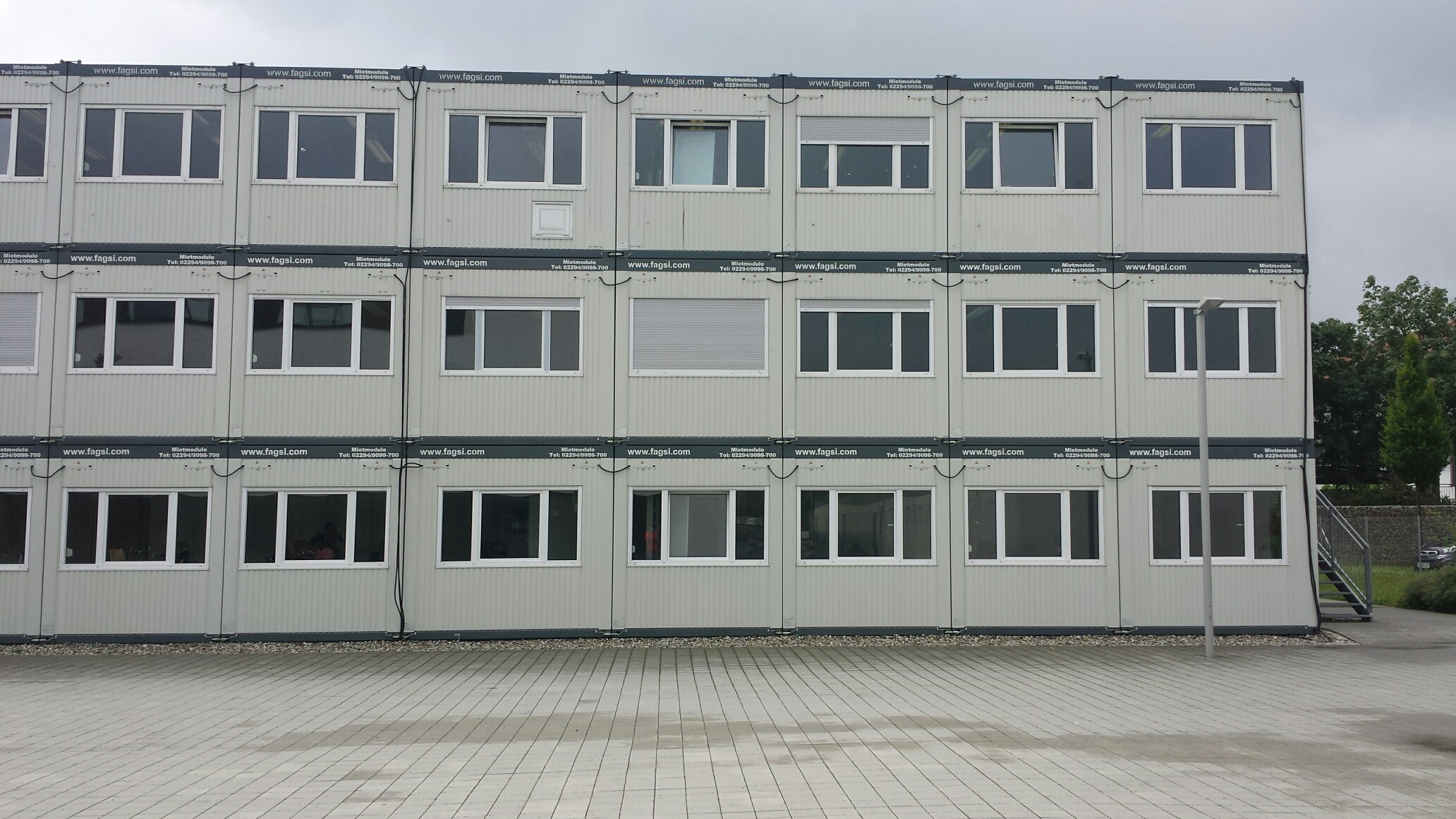 For my daughter, this meant that her daily way to school increased from one kilometre to about eight kilometres (or an S-Bahn train travel).
Basically, I find this rather outrageous, because, after all, we had chosen Ottobrunn for the closeness of the school. And then they move Ottobrunn – at least as far as schools are concerned –ten kilometres to the south.
Yet this is not all of it, either! What tops it all is that the children from Ottobrunn were a lot happier with their container interim solution than the children in the pretty and newly finished building in Höhenkirchen-Siegertsbrunn at the opposite side of the street. They will probably still be happier when they move back to their new grammar school buildings in Neubiberg and Ottobrunn.
The reason is that you cannot or must not open the windows in the new building. Because, naturally, this building has been designed according to the latest building-isolation regulations – and the least expensive offer probably again got the contract. However, a good climate in “modern” buildings is an expensive thing. You can easily start getting a headache or worse after two hours spent in the building. Mind you, we are talking this phenomenon in our upcoming age of all-day schools. For me, this would have been a reason to go crazy when I was a child. …
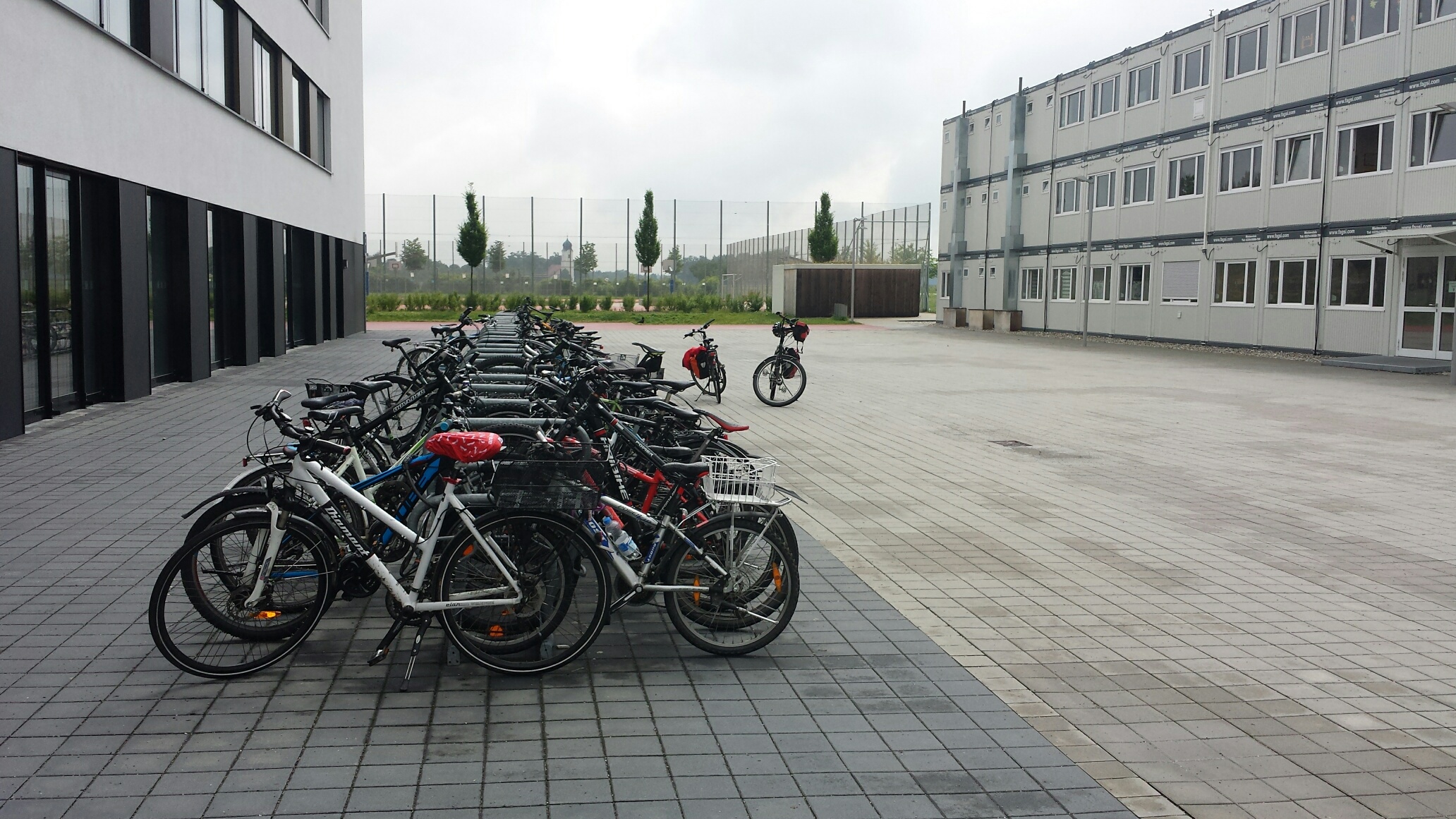
To the right, you see the containers, to the left, you see the new grammar school..
Doing my inspection – or rather my “feeling around” – I did not have a very good feeling.
Currently, they are busy doing construction work in Ottobrunn, too. Around the mid-term of next year, the children now being taught in Höhenkirchen-Siegertsbrunn will return to breathing Ottobrunn air. But they say that in the new building in Ottobrunn, you cannot open the windows, either. And I am sure in Ottobrunn, too, the least expensive bidder was given the contract. Why can’t they at least again build houses with windows you can (and may) actually open?
Also, I am quite curious to see how long the new buildings in Höhenkirchen-Siegertsbrunn, Neubiberg and Ottobrunn will last. I think this is another area where the half-life gets ever shorter.
RMD
(Translated by EG)
P.S.
Allegedly, they have a rule in Switzerland:
As soon as the bidding process is finished, the least expensive bid is automatically removed.
Roland DürreMonday April 27th, 2015
Project & Product – #PMCampSTR
 The Stuttgart PM-Camp (Hashtag #PMCampSTR) will take place from May, 7th through May, 9th, 2015 at the Stuttgart “Hochschule der Medien” – and I already look forward to being part of it. I bought both the admission and train ticket and made my reservation for the room at the Commundo.
The team in charge of organising the event chose “Project and Product” as their title. This is how the Stuttgart Organizational Team wants to open its PM-Camp for interested persons outside the classical field of project management, for example for IKT (information and communication technologies), as well. Using the term “product”, for instance, they aim at engineers who build high-end products.
What is a project?
Let me cite Wikipedia:
A project is a goal-oriented, one-time proposition consisting of a number of coordinated and controlled activities. It has both a clearly defined beginning and an end and will be realized taking into consideration all necessary restrictions with respect to time, resources (such as money/cost, production and work conditions, employees) and quality in order to attain a goal .[1]
This definition, which in my opinion is a rather simplified view, of “project” means:
- Every project has a beginning (project start).
- Every project has an end (deadline for completion).
- The desired results have been defined as project goals.
- All resources to be used are pre-defined.
- The project goal must be attained on time.
- The planned resources must not be exceeded.
- There is a plan: the project plan.
- The milestones defined in the planning are to be adhered to.
As I see it, projects only deserve the name if they cause a considerable change or if they create something really innovative or new. And that tells you at first glance that something is obviously wrong with the above definition.
Regardless of excellent planning, we witness massive deviations from the goal with the resources often being enormously exceeded, even with simple engineering projects. The reason is probably that even tasks that sound simple have a surprising complexity.
Innovative Change!
The situation gets worse if we are talking projects that are supposed to creatively influence all kinds of social systems and the evolution that happens anyway. If you look at the way a project is described, you will realize that the motto “close your eyes and do is hands-on” is something you are basically forced to apply. In the process, you will not be able to integrate new and better findings into the developing project path at all times.
Even in retrospect, it will be hard to judge the causal connections between measures and their effect (usefulness?). So how is anybody supposed to do so in advance? Basically, innovative change is not something you can just plan linearly. Instead, you have to find a soft and agile way to reconcile change and permanent developments.
Consequently, projects are a contradiction to innovation. Innovation is creative destruction. Which is something that will additionally make the enemies of change interested, especially if they are parties concerned with the intended change. That will make it even harder.
Projects as a part of change?
Hence, I find a definition of project more appealing if it considers a project as one of many integrated parts of a continuing process of change and improvement. Controlled change is supposed to generate useful results. Basically, I consider all well-thought-through activities designed to change or influence developments projects. To me, it does not matter if the project is actually “tangible” or if it renders abstract “virtual” results.
What is a product?
The planning, development, and production of a product, as well as its marketing, sales, support and service are the result of many small and bigger projects. They are all multi-dimensionally linked and thus connected to form a multi-dimensional “mega project”. You will want to remember phrases such as network, dynamics, learning, trial and error, innovation… But then, this is not only true for the tangible product, but also for services.
Box product or service?
So a product might be a tangible object – meaning something you can “touch” – which has been developed by an organisation with engineering competence and in huge quantities. It is also “sold” to either many customers or produced individually and “on demand” in small numbers. As a general rule, such products need to be complemented by a support service if they are supposed to be a market success and generate a “sustainable business”.
However, a product may also be a service rendered at the customer’s place or for the customer by persons who acquired special qualifications and “best practice” with their organisation. Those qualifications are usually the result of decades of personal and collective learning.
Creating a “tangible” product might actually necessitate more projects than creating a “virtual” product.
The difference it makes for an entrepreneur.
Sometimes there is a huge difference for the entrepreneur between designing a “true” product enterprise and an enterprise the product of which is offering a special service.
For instance, whenever selling a “true” product, the entrepreneur should keep in mind that feedback from the customers and from the market usually takes a lot longer than if he offers a service. More often than not, you will invest long-term into a “true” product that still has to prove its value on the market. In that sense, such a product is easier to scale in case of success than a service. But then, it also involves a higher risk.
If you sell a service, you will have your feedback rather quickly, which also means that you can learn from mistakes and perhaps change your strategy.
Well, that is about all I can think of when it comes to product and project. Except that projects, basically, are the small modules of our lives. All conscious decisions for behaviour that makes a relevant difference – for yourself or for the market – are in some way projects.
RMD
(Translated by EG)
Roland DürreWednesday April 22nd, 2015
Entrepreneur’s Diary #107 – Twenty Hours of Continuing Education During your Leisure Time?
 In 2013,we at InterFace AG had a beautiful “Technological IF Forum”. It was about “Software Craftsmanship”. We had great guests and competent speakers. The discussions were about questions such as: So how do you become a champion? How to get the necessary experience? How can you get motivated towards perfection? How to best achieve optimality and quality in a team?
One comment in this workshop, in particular, remains unforgotten: at the time, Bernhard Findeiss related (perhaps he also meant it a little provocatively) that a good “craftsman” who wants to become a real champion in his field will have to invest up to 20 hours for his continuing education. And that usually this will not be possible during working hours. Instead, a significant part of your leisure time will have to be sacrificed for it.
Initially, I was surprised to hear the number. I had to think of how many people strictly divide their time between leisure and work. And I remembered quite a few discussions I had with my colleagues. For instance about how much of the time you spend on your continuing education program can be considered official work time. Consequently, I did a lot of thinking on the topic during the last two years. On the one hand, you certainly need twenty hours each week for practicing and learning if you strive towards championship.
I totally agree. On the other hand, you still need plenty of time in order to work towards success. And then, you also want enough time for your family and private affairs. And I think it can be done. Many of my friends – experts, managers and entrepreneurs, both male and female – live and love their jobs. They are true “champions” and basically spend all their time tackling topics they consider important. And still they are good spouses and mothers/fathers.
I am now a “retiree”. And still, I learn and practice twenty hours each week. Except, I doubt if I am a champion. But I will continue practicing …
RMD
(Translated by EG)
P.S.
For video recordings of the IF Forum, click here: “Craftsmanship“.
P.S.1
For all articles of my entrepreneurial diary, click here: Drehscheibe!
Roland DürreSunday April 12th, 2015
School, Education, Future.
On the Facebook page “Alphabet – der Film“, Bernice Zieba advertised the book “Children Do Not Need a School”. She also pointed out that and where you can order the book. The book is about “Homeschooling und Unschooling”. I have not (yet) read the book – consequently, I cannot evaluate it. However, I know the film Alphabet quite well and I strongly recommend watching it.
On Facebook, this entry caused an intense discussion among those in favour and those against compulsory school attendance. The discussion excited me quite a lot, especially because my own experiences with school, both as a student and father of several pupils were anything but positive. Consequently, movements such as “Sudbury – Free at Last” (Sudbury – endlich frei) sound rather attractive to me, at least as a beautiful utopia.
Hence, I could not suppress my desire to write my own comment on the situation of education and school. My comment contained the following ideas:
 Schools all over the world teach, instead of instructing. They do not motivate students to ask questions and think. Instead, they only teach knowledge without knowing. Consequently, the usual rule is that we get knowledge bulimia.
Attempts of the pupils to be autonomous are considered troublesome, the same is true for critical positions. Enlightenment is not encouraged in schools and has become an anti-word. Because it seems to be the major and exclusive pedagogic goal of the educational systems to shape persons in such a way that they will function as frictionless as possible in the final system. It seems that the teachers actually are told to take all creativity from the students and to make them adaptable. This is how we produce system-conform consumers who fit perfectly and without protest into the non-humane performance society.
There is one thing the modern schools and educational systems of this world are extremely good at: indoctrination! Only the degree of indoctrination still varies between schools and cultures.
But indoctrination is the enemy of life in freedom and dignity. This is not how a reasonable change can be accomplished. In fact, we will not even find the “social consensus” which is a requirement for a constructive, humane and enlightened development of our society if we continue in this way.
Here is an example: an honest discourse might be helpful – yet this cannot be realized if we never learned to use the necessary tools!
It seems clear that making sure the next generation has a good education is a central task of all societies (also of ours). This should probably have the highest priority. Yet in actual fact we witness a total failure of our educational system. The deficits found in our schools increase all the time. For many social groups, the situation gets worse and worse.
Regardless of all this, I personally tend to scepticism towards concepts like “Homeschooling und Unschooling”. And I would only find them reasonable in very special cases as a last resort or “ultima ratio”.
Well, so far my comment. But let me say one more thing: I am glad that there are still teachers out there who fight against this – probably world-wide – development by refusing to bend their knees to the pressure of systemic forces. Some of them are known to me personally – and I appreciate them. But unfortunately, I get the impression that they are more and more lone fighters, getting fewer and fewer.
RMD
(Translated by EG)
P.S.
Incidentally, I do not really understand why we always have to use those hideous US phrases, such as “Homeschooling or Unschooling”?
Roland DürreThursday November 6th, 2014
Political Education – FES and HSS
Political Education – FES and HSS
Political Education (Politische Bildung ) is still something sponsored by the current Federal Government yet forgotten often and by many. And perhaps it is also anachronistic. After all, the real process of forming your opinion no longer happens in the parties and their “foundations”, but in barcamps “on the streets”.
I know two foundations with close connections to a party: the parteinahe Stiftungen, das ist die Hanns-Seidel-Stiftung (HSS – CSU) and the Friedrich-Ebert-Stiftung(FES – SPD). Both of them invite me at regular intervals and once in a while, if the topic looks interesting to me, I actually attend.
Incidentally, the difference between the meetings organized by the two groups is that the HSS is better organized and the meals, too, are very delicious. At the FES, you mostly get no meals and the organization is not quite as perfect. Perhaps that is one of the reasons why the CSU has such a huge majority in Bavaria while hardly anybody votes in favour of the SPD.
On Tuesday, November, 4th, I accepted an invitation by the FES (SPD). They showed the film “WORK HARD, PLAY HARD.”. It is a documentary by Carmen Losmann about our modern work life I have wished to see for a long time. Moreover, they had promised that the producer Carmen was to be present herself.
I wanted to meet her in person in order to tell her about the project “Augenhöhe”.
In a nutshell: WORK HARD, PLAY HARD is a great film. Considering that it is a documentary, it is extremely exciting. And the Arena (Hans-Sachs-Straße 7, 80469 München) Cinema in the wonderful Glockenbach-District was absolutely the best setting. And Carmen Losmann, the producer, was also there, as promised.
Afterwards, there was a discussion that had both strengths and weaknesses. For me, it is always hard to have a confident discussion after an exciting event. Regardless, it was a nice evening. Especially because Carmen was able to give us her evaluation of the status of our economy in a very charming and striking manner.
However, we had to leave rather quickly, because, after all, the cinema had to switch to its normal business. Due to the flow of incoming cinema-goers, it was not possible to have a discussion with persons who had struck me as those with the reasonable arguments during the discussion. In fact, that is something I would have found truly useful.
Well, but this is only meant as a feedback for the organizers. Perhaps, next time, they want to make a reservation for a few tables somewhere in the neighbouring pubs and thus motivate the audience to continue with their discussions?
However, the event was also remarkable in that the “old world” truly was lit up again. On arrival, you had to sign your name on a list. As opposed to some data-security protagonists, I have no problem with this. As I see it, I should actually be prepared to stand by it and accept that all the world might know about me attending an event of the FES – which is close to the SPD and unions. The same is true when I accept an invitation by the competition (HSS).
When he welcomed us before the film started, the presenter said the signature was necessary because the FES, as we all know, is an “opinion-forming” organization and as such federally subsidized. Consequently, in order to continue being eligible for subsidies, they have to document that “now politically educated persons” (my wording) attended. Incidentally, said presenter was a freelance “dialectics trainer” who often works for the FES and some unions. Well, we all have to make a living, don’t we?
In my opinion, these subsidies of “political education” should either be terminated, or else they should give the money to those who work towards developing social context. And I know quite a few well-attended barcamps and similar events for citizens where many people meet, regardless of the fact that they do not show such great films and serve such delicious meals as the HSS.
These days, much is done to remember the times of “we are the people”. It is quite possible that the reigning parties and their appendages in the Federal Republic of Germany will soon also hear the call: “we are the people”.
First and foremost, however, I am happy to have made new acquaintances and found new insights during this evening. In my next posts, I will include the occasional idea from this beautiful evening.
RMD
(Translated by EG)
Roland DürreFriday September 5th, 2014
Another Barcamp – EnjoyWorkCamp!
I like Barcamps. In particular, of course, I like the PM Camp. After all, I was part of those who first initiated it. However, there are others, too – for example the OpenUpCamp. At one time, I also attended one of those. Now I found a very special Barcamp – and I will also attend it. It is the EnjoyWorkCamp.
Franziska Köppe is the founder of the EnjoyWorkCamp. This year, it will be held between November, 14th and 15th in Stuttgart. Here is what Franziska writes about it:
Where you find joy, enthusiasm and conviction, you will almost automatically get success. We all long to do something meaningful. As entrepreneurs, we strive at being economically successful, socially responsible and honourable. We want to preserve both our environment and nature. In our daily work, there are always small and big changes which sometimes have immense consequences for us and our surroundings. It is all not quite as easy as it looks. After all, there are many questions:
- How high is our own value and how can we build value-oriented offers on it?
- What will self-responsibility of our employees gain us and how to manage good team work?
- Isn’t every company and every employment a rat race?
- How to design an environment where people enjoy working?
- What tools, architecture, infra-structure, mobility, processes, culture… would be suitable?
- How can I promote common well-being in my personal surroundings?
- How to create space for myself (time and money) in order to be able to actively shape the future?
How often did we attend a conference in order to get answers to just those questions, and then the answers were found during the coffee break discussions?
So far Franziska. I will go there because I assume that the EnjoyWorkCamp – just like the PM Camp – will offer a chance to exchange of experience at eye-level. I look forward to discussing solutions around social, economic and ecologic aspects of future-oriented business models with entrepreneurs and leaders of small, medium-sized and also big enterprises.
For me, it is important that the program will be shaped by the participants themselves – which means that I can also take care of my own needs. And, in particular, I look forward to again meeting some very good friends who have already registered. Together, we want to start getting active and support each other.
Here is more information: Unkonferenz and News und Presse.
The vision of EnjoyWorkCamp is:
Common welfare, the quality of life and how to enjoy your work!
Well, this is another reason for me to attend.
RMD
(Translated by EG)
Roland DürreMonday August 18th, 2014
Start-up (2) – Our Own Foundation (1983)
Since early in the 1980ies, I had been eager to become self-employed. One of the reasons was that (as many founders I know today, too), I wanted to have a word and some responsibility in an enterprise and thus enjoy my work more. Another reason (and, surprisingly enough, not many of the founders I know today share this sentiment) was that I actually wanted to earn more money.
Consequently, I looked for the “ideal partner” (rather than the “ideal business idea”, because, even then, I thought there is no such thing). But it was not easy to even find the “ideal partner”. Luckily, though, I found Wolf Geldmacher after a little more than one year. He brought great entrepreneurial strength and was just as “down to earth” as I was.
With Wolf as my partner, it did not take long to establish the “InterFace Connection Gesellschaft für Datenfernverarbeitung und Entwicklung von Software mbH“, which was the predecessor of InterFace AG. Our fields of interest were IT and Unix. We wanted to build a successful product with the “new” Unix. We assumed that services are hard to scale. Even before 1983 (the founding was in 1984), we feared that Body-Leasing might not be a business with a long life-span. Besides, even in those early days, it seemed to us that the Body Leasing Business is situated somewhere in the legal grey zone. This was one of the reasons why we wanted to actually create a real product.
Said product was the office-compatible Unix writing system HIT. In retrospect, the entire affair was a totally crazy enterprise. Surprisingly, though, it worked. I fact, to this day I cannot entirely understand how this happened.
It only took as a few years to become the most successful Unix text system in Europe by far. It felt like a dream!
Looking back, I can identify persons and important requirements or events without which it would never have worked. Basically, we were moving at the right time and had lots of luck, because everything just fell into place.
The Duo „Wolf & Roland“
Even in the early 1980ies, we believed in “agile, lean and open“. We were in favour of self-organization and self-determination, We communicated our ideas and our expectations and then our teams were allowed to work as they saw fit. It was all done with a huge sense of belonging together.
For software development, we invented and practiced a private method you would, today, call SCRUM. Wolf was the “SCRUM-Master“ (and more than that, too). He was responsible for the technology and the people. He led the colleagues towards delivering quality and made it clear to them that they had to live quality – primarily for their own sake. And I was something like the “product owner”, the leader on the business side.
Anton Böck
In 1960, my parents sent me to the business-centred Higher Middle School “Jakob Fugger” in Augsburg. Later, it was re-named Grammar School, before 1960, it had been called business school. Stenography and typing had been compulsory until 1960, later they were taught on a voluntary basis. My father forced me to learn both, because he considered both competences as indispensable when it came to the real fight in professional life.
Anton Böck was my teacher. I was doing quite excellent in stenography. Whenever I was forced to do some learning at home, I spent hours drawing stenographic symbols. For me, this was just like calligraphy, simply beautiful. I hated the typewriter. Herr Böck was a strict teacher and he rather liked me because of my stenography. Consequently, he forced me to practice on the typewriter. As a result, I dreamed what characteristics a “nice” and “lovely” typewriter should have as early as by the age of 16.
Well, it might sound ridiculous, but I am quite sure that, without this early experience with generating text, the InterFace Connection would not have become a product enterprise.
Hans Strack-Zimmermann
Hans was my mentor and the man who made UNIX big, both in Europe and at Siemens (where it was called Sinix). I was convinced that all he said was correct and he believed in our team. Well, this facilitated matters a lot.
However, our success proves that we were correct.
Dr. Peter Schnupp
Peter was an IT pioneer of the second generation (for me, the generation Zuse was the first generation and I was part of the third). As an entrepreneur (he founded Softlab), IT expert, column author in the “Computer-Woche” and also due to other activities, we was well-known and had an excellent reputation as an expert.
Peter managed to convince the strategic decider in a big public office organization that the future will be based on IT and UNIX – and that there is a great local product.
Without this stroke of luck, the project CLOU/HIT would never have become a success.
My Projects
Even as a young software developer at Siemens AG in the mid-seventies, I had a great job. In the course of developing Transdata, I designed the “Connection Handling” and also worked on the development of “APS“ (appliers’ programming language). Connection handling has a central function in “long-distance data transfer”, as it was then called. Through APS, you could outsource processing time to local “data station computers” (operating system PDN) – which was the first time the central principle of main frames was broken.
With this “superior knowledge”, it was easy for me to get a good reputation with huge projects, which meant that, as a logical conclusion, I was transferred to the Siemens AG department: “special projects marketing”. My most important project in this department was DISPOL, a central project of the Bavarian Police which had set itself the task of making the filing cabinet (data), the typewriter (documents) and the telefax machine (communication) obsolete through the introduction of Electronic Data Processing.
I stayed with this project until I founded my own company and in the process I learned all there is to learn about the expectations of customers and the market of civil offices.
Without this history, HIT/CLOU would never have become a successful product.
Our People
For product development, we hired very young persons. In fact, they often started working for us when they were still students. And in (almost) all cases, they were exactly the right people. These persons took no time at all becoming central top performers and they instantly took high responsibility.
The Right Principles
Along with the product development, a qualified counselling team in the field of “Unix Operating Systems” grew. We sat right at the source and I learned many extremely helpful things from our operating systems partner. Consequently, we were early to use tools which at the time were not even widely known in Europe.
We applied methods (or rather, we intuitively invented them) such as the four-eyes-principle when programming, peer2peer-reviews, ”extreme programming“, developer rotation and much more. Those were methods that had not even existed in those days, yet they gave us considerable advantage when it came to developing speed, customer orientation and quality (incidentally, some of these principles are still not applied everywhere today).
Our developers are always directly in contact with the customer. For instance, all the developers did the HIT courses for the customers themselves, which means that they understand what the customer wants and needs.
All these factors have contributed hugely towards the quality of our product.
Financing
We were well aware what the real problem with our project was. Consequently, we shared the costs of the IF computers during the first phase of basic development. For the second phase of marketing, we had intended to share tasks. We were going to further develop the basic system and also attend to our expected big customer Siemens. InterFace Computer was planned to be the port for many other Unix systems and for realizing the sales for other partners.
But even in order to just develop the product, we needed considerable man power. In 1984, we solved this problem in a very simple way: Wolf Geldmacher and yours truly worked as counsellors. We took care of the product and team in the evenings and, when necessary, on Saturdays.
As counsellors, we worked for an hourly rate of 150.- DM. This was absolutely top range and we were only able to get away with it because US consultants with comparable know-how were even more expensive.
Well, let me do the calculations: a good month will bring us 200 man hours (we were very industrious). Multiplied by 150 DM, that equals 30,000 DM in a good month. With a salary of 5,000 DM, which is about 6,000 DM before taxes, that left us 18,000 for hardware, our Heidi (our assistant, who helped us from the beginning) and our students, the product developers.
Only a few months after our foundation on April, 1st, 1984, we were also able to recruit two young computer scientists who immediately worked as consultants, too. They brought in money comparable to our ratio. And from late in 1995, the product itself provided us with rapidly increasing amounts of money.
The Situation
There were more beneficial circumstances that helped us considerably.
For instance, Siemens had started a very huge project the aim of which it was to develop their own text system for BS 2000 and Unix. Regardless of the fact that this project had manpower that was several times more than our development team, on top of all Siemens project developers being full-fledged software developers (as opposed to our young team), these projects never seemed to get anywhere. Which means they actually more or less failed.
The Siemens concern, however, needed this software for their goals and therefore had to buy licences from two suppliers – one of which was us. This is how we became the supplier of the then market leader in Germany of Unix.
The technological time frame also favoured us. Firstly, Unix at the time replaced all those many different computing systems of the “medium data technology” MDT. So again, our product HIT came just at the right time.
Also, this was the time when using databases started to get a common thing to do. SQL as “query language” based on natural language was newly defined. There was even a German version of SQL!
So wasn’t it only logical to extend the 4GL CLOU (for programming text elements) which supplemented HIT by an “embedded SQL“ which would suddenly make it possible to send dynamically generated queries to a database during the running of the text-element program and then to automatically make use of the found data for producing a document? This was a true sensation, and it had come at exactly the right time.
Lots of Luck and Just a Little Bit of Misfortune
The courage shown by a big federal office in relying on a totally new technology and a very small provider was certainly something special. It was a wonderful market development in favour of Unix. There were many more courageous and, for us, beneficial decisions by customers. A great team…
We Also Had Some Problems
The hardware we needed for our developments was extremely costly. As early as 1985, we had to buy an MX500 – which at the time had a listed price of several 100,000 DM. For us, this was impossibly much money. But it was absolutely clear that we were not going to manage the necessary developing speed without the system. And then it took only two years for the machine to become outdated. Overnight, we developed on SUN and on the new fast PC-s with diverse Unix variants.
In the long run, it turned out that InterFace Computer, too, was the wrong partner. The strategic cooperation no longer worked. Consequently, we were forced to buy the rights to the product. This was a truly hard investment decision. Yet, in retrospect, it turns out that it paid off.
Other Necessary Requirements
I am sure there were other causes and lucky circumstances without which the enterprise HIT/CLOU would never have made it. Partly, we are probably talking things I no longer remember or things I was never really aware of. But without all this, at least InterFace Connection as producer of HIT/CLOU would never have existed. If you remember what I wrote, you will see that I kept telling you at every possible instance that it would never have happened without those circumstances/ coincidences. They were all necessary for the final success. And in retrospect, I am truly surprised how this courageous enterprise could actually work out.
This article was supposed to show you through my own example how unbelievably many requirements have to be fulfilled in order to become a success. Mind you, I do not at all want this to discourage you. But it certainly goes to show that it is not all that easy and that a pragmatic approach might sometimes do no harm. I believe founders can learn a lot from this story and I am quite willing to discuss it with you as a Use Case interactively and personally.
RMD
(Translated by EG)
Roland DürreSunday July 13th, 2014
Ute Rauscher doing an interview with Roger Dannenhauer
On June, 27th, before the InterFace jubilee party, my friend Roger gave an impressive presentation. Ute Rauscher took advantage of his being with us and interviewed him for the Bayerischen Rundfunk.
Here are the most important parts of the interview:
Enjoy!
RMD
(Translated by EG)


