
Roland DürreMonday January 23rd, 2017
Inflation in Local Traffic
I did not pay too much attention to the latest Deutsche Bahn price increase at the time when the schedule changed from summer to winter. I just had made a mental note that the “Deutsche Bahn increases its prices for long-distance travelling by 1.3 per cent on average”. That is what the SZ, too, had written.
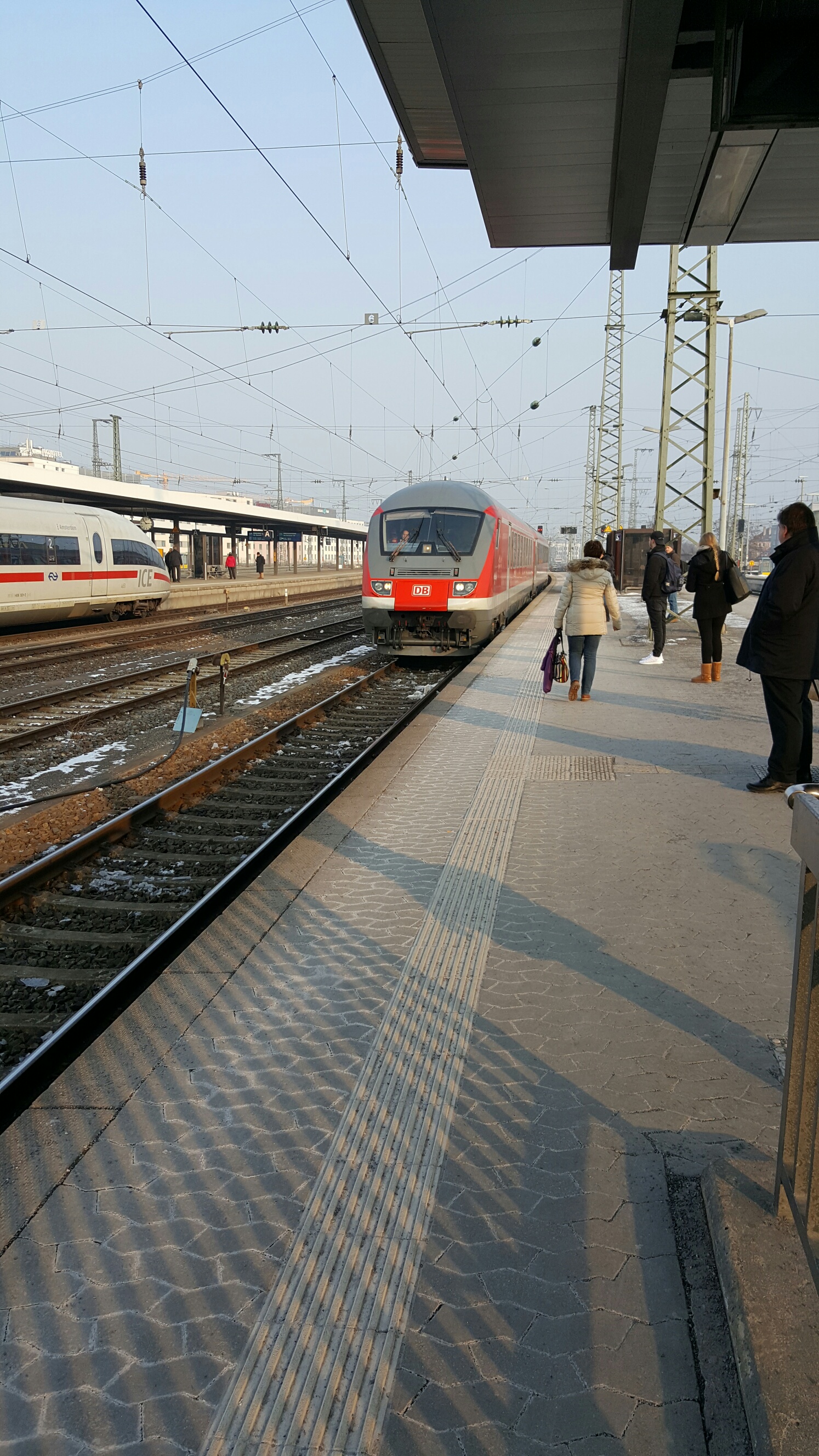
The Shuttle Munich-Nuremberg Today on Arrival at Nuremberg.
But it turns out that was a myth!
On Saturday, I wanted to go to Augsburg with three other persons. So I ordered a Bayern-Ticket on the internet. My eyes almost pop out: it now costs 25 €. A very short time ago, it was 23 €. That means it is more expensive by 2 €, which is an increase of around 9 %.
Well, I can survive that, can’t I? But then comes the other surprise: all travellers sharing my ticket (up to four are possible) used to cost 5 € per person. Now they cost 6 € per person. That is 20 % more.
Consequently, the Bayern Ticket for our small group is now 25 € plus three persons à 6 €, which is 25 € plus 18 €, in sum 43 €. Well, that is no less than the price I occasionally pay for two long-distance DB tickets to Sylt (for instance in February).
Formerly, I paid 23 € plus 3 persons times 5 €, which was 38 €. Consequently, the price for the four of us increased from 38 € to 43 €. Well that is 5 € more, which means an increase of 13 %.
I also admire the “rounded prices” they so easily come up with. To be sure, cents are inconvenient and more and more shops simply round the sum when you purchase products. But simply obscuring the first digit after the comma – after all, we are talking 10 cents, that used to be 20 Pfennige – is a little strange to my way of thinking.
Incidentally, there is also an inflation on special tickets for all kinds of things: with and without local traffic in transport associations, for special regions, between cities or for a maximum distance. This is how they make everything more complicated. And if you include the basic moon prices and the similarly introduced low prices (special offers in long-distance travel), then the price policy of Deutsche Bank gets more and more bizarre.
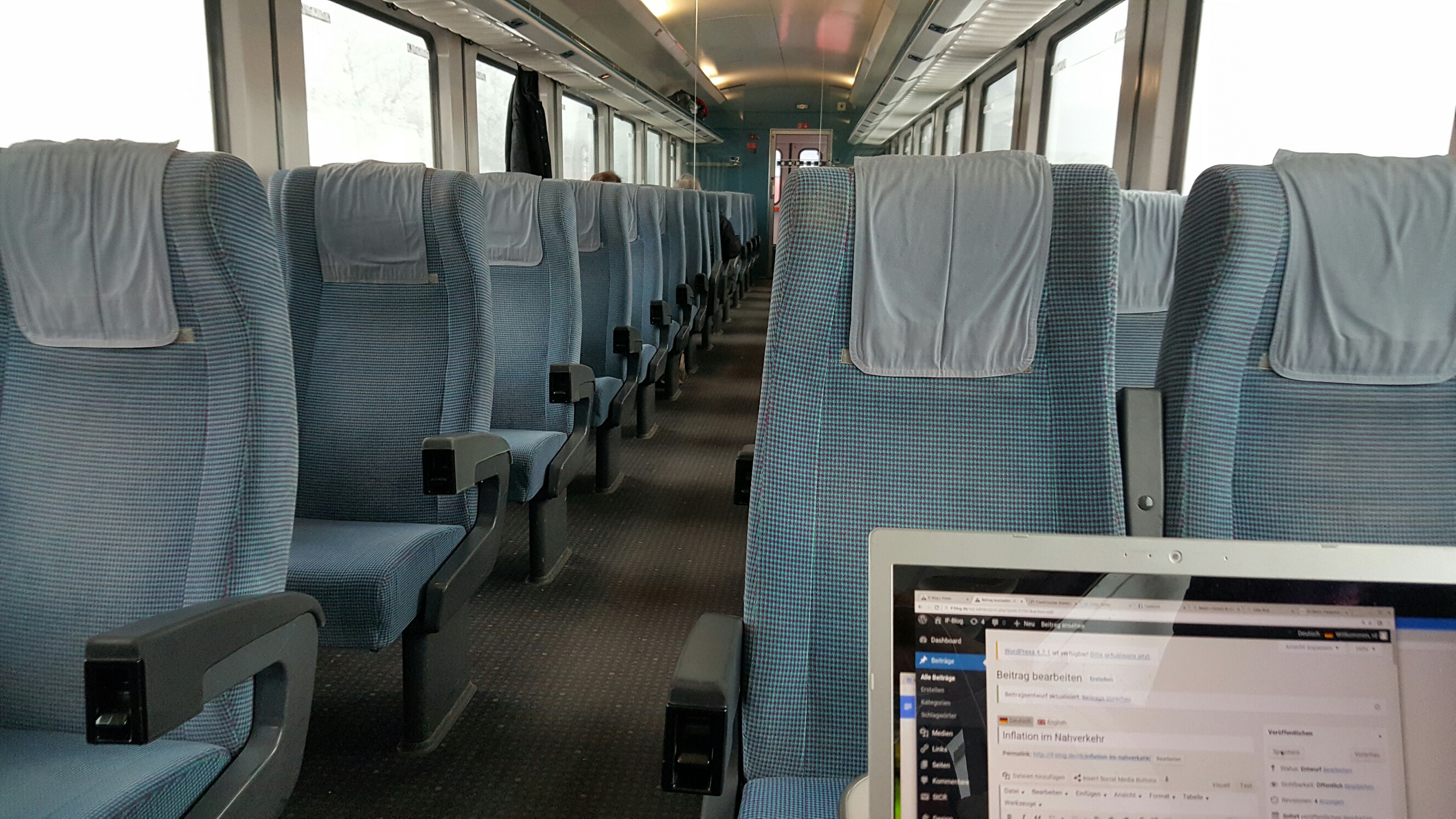
This is how empty the shuttle looks at 4 p.m. – I always carry my chrome book.
However, I only get annoyed once in a while and later continue going places by train, because, for me, there is simply no alternative to railways. Consequently, I am also going to Nuremberg and back with the Bayern Ticket today after having paid my 25 €. After all, the train is a good place to sit and answer all your emails and write all your articles. That is something you cannot do when driving a car.
Basically, driving a car is out of the question for me these days. According to social research, the majority of our people are embittered. I, too, would be bitter if I had to spend one or more hours behind the wheel of car each day. I prefer going by train and enjoy seeing how google waits in front of the A9 traffic jam. It is my morbid delight in the failure of a stupid system.
Going by bus would be an alternative to going by train. But that is not my idea of travelling. I am a little spoiled because of the mostly rather empty DB region trains and do not enjoy being squeezed into narrow busses that are often forced over the streets of this republic in self-suicidal mode by their drivers. Besides, meinBus and flixBus had to cut their networks considerably and drop quite a few connections from their list of destinations, because the venture capitalists who own the companies no longer felt like permanently making up for the deficit.
So here is what I will do: I will continue to go by train and hope that the density of train services with the resulting mostly empty trains will remain the normal state of affairs. …
Incidentally, the German railway is not the only company where these enormous price increases can be observed. You can also find it in public institutions and quality food, as well as with some everyday articles. And in real estate.
Yet now I hear that, allegedly, the inflation rate is still less than 2 %. Basically, I do not believe they lie to us on purpose. But I certainly do not believe the 1,X % – and I think they are not really interested in telling us that our savings dwindle. Which also means that the chasm between the rich and the poor continues to grow. We already have ample opportunity to see the consequences and can speculate on more of them to come.
RMD
(Translated by EG)
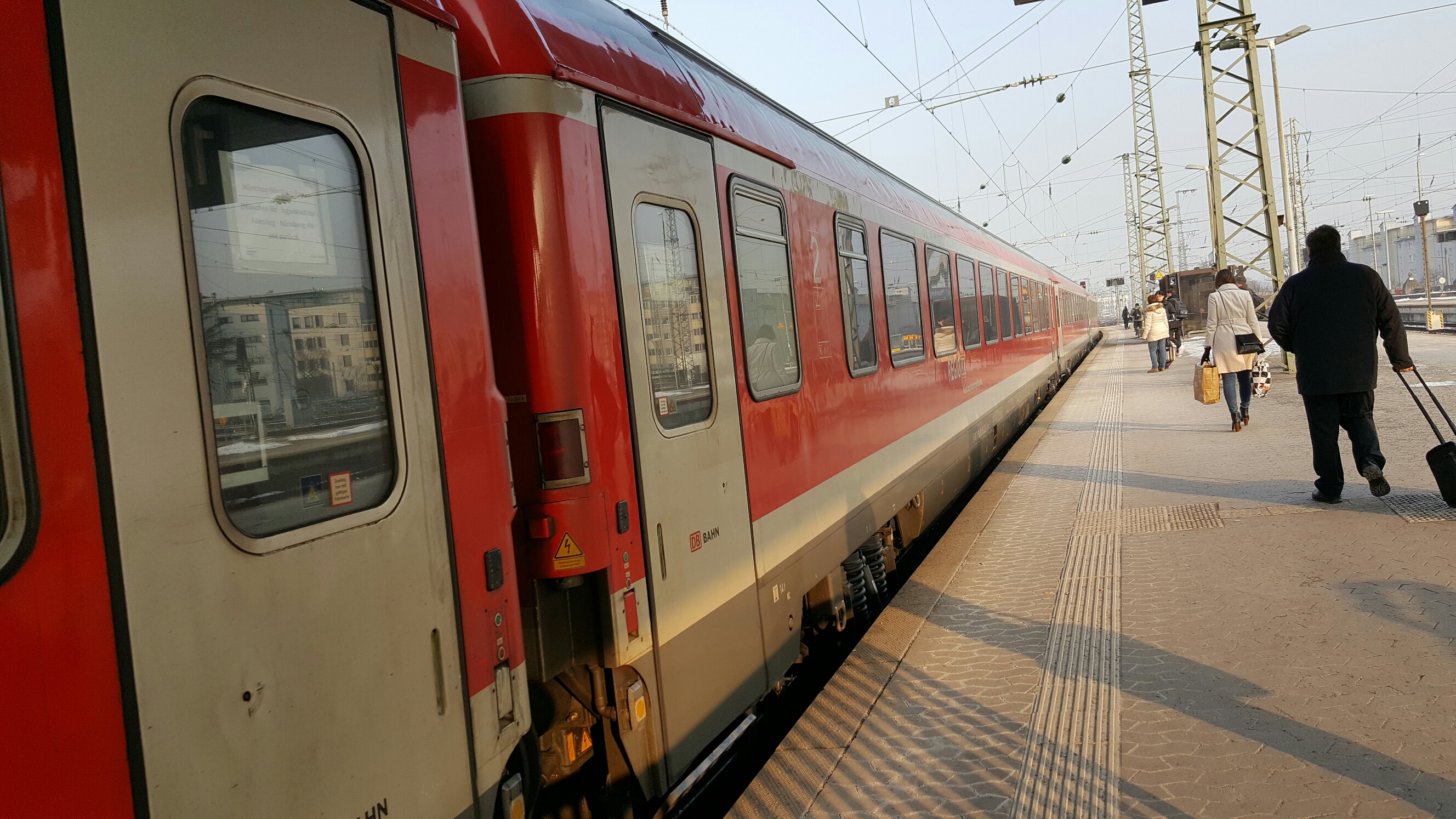
The shuttle to Munich on January, 23rd, 2017 at Nuremberg Central Station, platform 12.
Roland DürreThursday October 27th, 2016
#Digitalisation – The Filter Bubble“.
 We live in times of irresponsible blabber. I feel it with special intensity whenever I hear how even self-appointed prophets speculate about digitalization. How much nonsense we have to read. Then, I also notice how many persons jump the bandwagon, uncritically repeating what they have heard or read. Thus they promote fear at places that will only deflect from the real dangers.
For me personally, the “digital change” is just the continuation of the change that has been caused by technology in the age of the complete electrification of our planet (or something similar). Since I myself experienced said change and was even part of it, I often try to contradict all the nonsense I often hear repeated by individual persons.
For me, for instance, a “driverless” car, be it a truck, bus or car, is nothing other than technological progress where iron is replaced by IT. Basically, the new vehicles simply do without tracks, instead using IT in order to reach their destination without a driver. That is far from witchcraft – it is simply engineering.
A harmless example of how panic is created is, at least so I see it, the much-cited “filter bubble”. In their Sunday speeches, more and more people state that a huge danger is looming because of it and that we are manipulated by algorithms. Here is a text I copied from a Wikipedia article (version of October, 27th, 2016, german)
The filter bubble or informational bubble is a term used by the internet activist Eli Pariser in his book of the same title. According to Pariser, the filter bubble is generated because websites try to predict what information a user wishes to find by using algorithms – based on available information about the user (for instance about his location, history of searches and click behaviour). The consequence is an isolation from information that does not match the position of the user.
So – tell me what is new about this!
I, for instance, have been living my filter bubble since I was a small child. As soon as I was able to read, I went to the library (first the catholic library, later the public library) and borrowed exactly those books that matched my VEIN (values, expectations, interests and needs).
As a reader of newspapers, I soon preferred the SZ over the Münchner Merkur. Later, I learned that newspapers try to write exactly what their readers want to read…
When I was an adolescent, I went to the “Republican Club” meetings, rather than the “Young Christian Party” and fraternities.
This is how, due to my limitations, I maneuvered myself into my private “bubble”. At the time, the radio got me out of it. At Silvester Evening, for instance, there was the Lach&Schieß, coming up with totally new ideas and unheard concepts and thereby drawing my mind towards completely different issues.
What used to be the radio in the form of “public broadcasting” is now the internet. I communicate with other persons, read their blogs and, once in a while, even listen to their PodCasts. In that respect, I am a little old-fashioned, because I actually still do some reading, not wishing to run around with headphones all the time. But even my behaviour will not have an influence on the future. Consequently, audio will win against the written word when it comes to knowledge transfer and exchange of opinions.
This is how I see and do many new things on the internet. Because, basically, the internet is not just google and facebook. Above all, it is about persons who blog and podcast their evaluations and their lives and who provide me with many ideas that, indeed, counter my prejudices and remind me to be tolerant. And this is how I learn to respect and appreciate opinions and persons that and who I just used to dismiss without any good reason.
My friends are like me in that respect. I feel rather well living in that bubble. I could not care less about the algorithms. Nor do I see a great danger in them. More often than not, I get the impression that the internet is made to be the big culprit just in order to camouflage how massively we are controlled by manipulation and lobbyism. Because it actually makes you more free and autonomous, thus being a danger to prevailing structures and systems. Consequently, they also do not like the idea of freedom of the internet and see to it that online freedom is torpedoed with all possible arguments – no matter how stupid.
RMD
(Translated by EG)
Roland DürreThursday October 6th, 2016
Work and Retirement? Money!
Basically, I do not want to work or get retirement money. All I want is: earn that funny stuff!
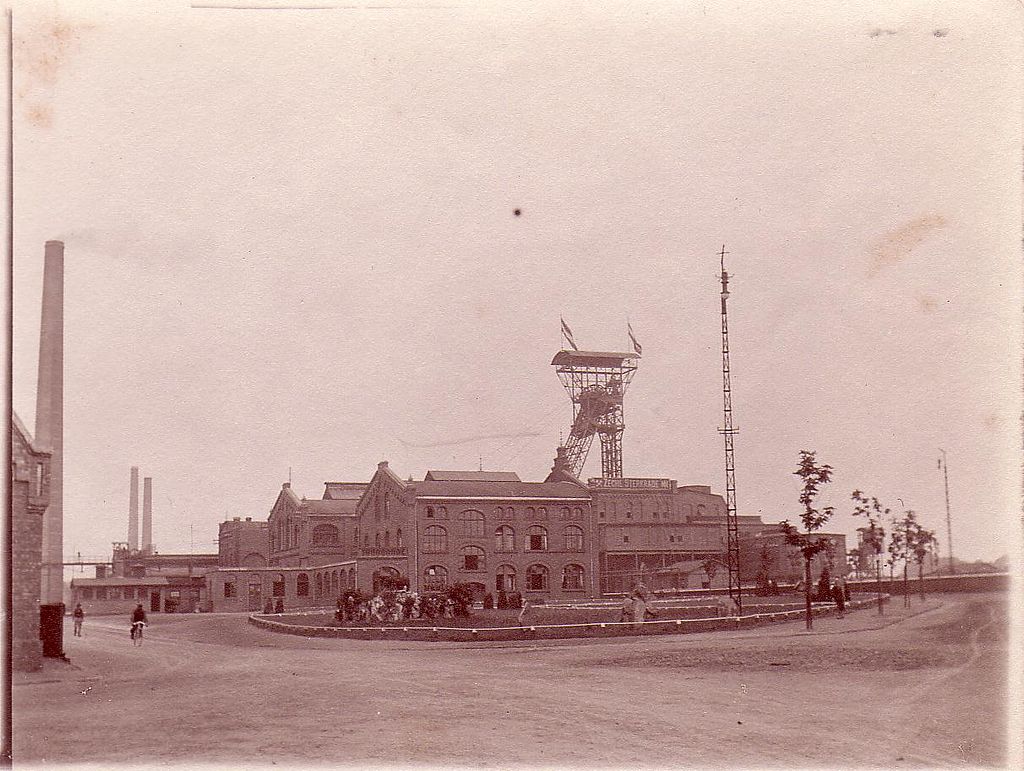
Zeche Sterkade / Sterkade Colliery. This amateur photograph was taken by an apprentice coal mining engineer, Charles Sydney Smith, of Derby, England, on a visit circa 1910-1913.
Digitalisation.
Currently, I travel a lot in order to promote Digital Transformation. My role is both active and passive. This means that, once in a while, I talk about it and, but far more often, I listen to what other wise persons have to say about it.
Whenever I hear presentations and speeches on digitalisation or the coming change or its consequences, it strikes me how they always also talk a lot about “jobs”.
In particular, they talk about jobs that will soon no longer exist. It seems to me, however, that nobody seems to really and precisely know what is going to happen to these jobs.
Dark Future.
And they also say that the future will not at all look very bright for most people – especially if they live in developed societies. Perhaps – and that is not really a surprise – those are also the moments when they mention and even demand the unconditional basic income.
Whenever I hear the word job, I come up with “heretical ideas”. It is a central factor of my life that, basically, I never wanted to work. To be sure, exciting tasks have always fascinated me. After having worked as a baby sitter, private tutor, for a hauler, as a night parking attendant or for a cleaning service, my “job” when I was in my early twenties was “programming” – which has also always been my hobby.
Everybody talks about jobs and the unconditional basic income.
No, I did not want to work. And I also did not want a job. What I wanted was earn money. I wanted enough money to provide my family and myself with a nice standard of living. And I wanted it as easily as possible and without having to work too hard. And I also always wanted enough “leisure time” in order to do things that were important to me outside my “craft”, such as “family” and “life as such”.
So I asked myself what is the best method of earning money in this country. Legally, there are probably only two ways:
As an employee.
Either you are working for a firm – then you get a salary. You will have an employer and (at least) one disciplinary superior person – just take a look at the strange vocabulary. And, more often than not, you will then also be part of a rather strange social system.
Self-employed.
If you are not an employee, you have to do something that is billable. Then you will be self-employed and get the chance to be a little less dominated by the employer system – which in itself is already quite valuable.
So there are the categories “employee” (there used to be another category “labourer”) and “self-employed”. You can be self-employed either by working freelance or by founding an enterprise. Living totally by myself as a freelancer seemed (too) much of a risk, so I decided to look for a partner and found a company. . Because the idea of being employed was really boring.
The legal status.
If you want to found an enterprise, you have to decide upon its legal status. One possible option is the civil law association. Among those are the ordinary partnership and those partnerships that lawyers, tax experts and counselling companies, etc., often establish. If I intended to found another firm, I would probably favour one of these.
Other options are the classic private limited company and its modern brothers (Europe private limited company, UG, …), the cooperative and the incorporated company. Mixed forms are not really relevant in this context.
Besides the employees and self-employed, there is a third group: that of public officers. However, I will not dwell on this group because a) they are the minority and b) they are a totally different group as far as the extremely high pensions are concerned.
So here is what you want to know about retirement money. The employees – supported by the employers – pay into the social insurance in order to later receive retirement money. The retirement money system is based on solidarity and, like all systems of this kind, it is rather ambivalent. Everybody thinks they pay too much and receive too little.
Retirement money.
Retirement money is often considered a bad deal because it seems to have a sub-optimal price-performance ratio. What is often forgotten is that, when disruptive events occur – as for instance WW-2 or the re-unification of Germany – the retirement money was often the only system that continued to provide the people with what they needed, regardless of the disruptive circumstances. It did not fail.
Besides, the poor price-performance ratio is not something that only the retirement money suffers from. It is also true for private measures you can take, such as saving money, life insurance or the ill-fated federal-private construct of the Riester pension. The strong instrument “company retirement money” of former times as a valuable supplement of the federal retirement money has by now turned into something of the past.
Social Insurance.
More and more people want to work freelance in order to avoid the high social insurance payments. The government and the retirement insurances do not like this at all – which is why the threshold is rather high. And in doing so, they make rules and laws (like the AUG) that put enormous pressure on the freelancers, sometimes even force them into illegality. Both the law and its treatment are full of contradictions and there is a lot of uncertainty. It is truly atrocious.
But then, there is also an absolutely efficient and legal method to avoid having to pay social insurance – even if it might seem absurd. All a freelancer has to do is find a few comrades in arms and found an incorporated company with all the individual persons becoming managers of the company. Then they will not only be exempt from social insurance, it will even be forbidden to them. Mind you, this is totally legal and probably invincible in to the current state of the art in jurisdiction. Basically, this is totally illogical for people who use their common sense.
Fewer and fewer high quality jobs.
The outlook given by many wise persons I listened to tells us that tasks that require a high degree of training will become fewer and fewer and that the “service proletariat” will grow considerably. Migration through the different education levels will become less and less likely. This means that in the future the highly qualified persons will come from the upper social classes more and more often. They are also typically those who stand to inherit. They will not need income and consequently can just work “because that is what they like” and invest time to do the nice things in life in order to really benefit later. Or perhaps not.
Working for free.
And more and more persons will seem highly qualified yet work for free. I mean people who do not take money for their work. And I am not talking all those who work in an honorary basis in clubs and our society. Neither do I mean the young persons who are exploited during what we call practical training.
What I mean are young and old people who do something for the future without having any kind of contract and without writing an invoice. I, too, am one of them. As I see it, I move a lot, trying to help people and enterprises on their way towards happiness and success.
But I am not doing it for the money. Instead, I do it because I hope and know that I will get a lot in return. And because I know for certain that all the contacts and knowledge I gain will one day bring me true money, which means that I will benefit financially, as well. For instance when I invest in a start-up and then can write a huge invoice for a true added value I created. And this is how work becomes an exciting and nice game.
I know a number of persons who do the same. They are often younger than me. They perform super for free. Because they know that, sooner or later, there will also be a financial reward. I also know young entrepreneurs who take the establishment of a start-up very seriously and want to promote this step with a huge amount of enthusiasm. Yet they could not care less where the money will come from – for instance because they have inherited enough money.
Not a bright future?
This is what I expect the future to be like: more and more poor persons who, by doing menial jobs, can barely manage to make ends meet and fewer and fewer persons who, with or without income, really enjoy what they are doing and get richer and richer. If I am perfectly honest, I must say that such a future gives rise to many questions and really worries me.
Here are some recipes for success:
These are the best ways to earn money:
- Always give more than you get!
and - Break patterns!
I will soon write another article, including a recommendation by Gebhard Borck how to best determine your own price (value). …
RMD
P.S.
If you are interested at all, I would suggest you read the Wikipedia articles on Industrialisation and Digitalisation.
The picture is also from Wikipedia. The copyright is with – Own work by uploader (own original personal amateur photograph by ancestor). It shows the coal mine Sterkrade, the picture was taken around 1910–1913, free under CC BY-SA 3.0.
Roland DürreMonday July 18th, 2016
Reformation, Revolution, Transformation, Future – All is Fine – Provided it is Digital.
Everyone talks digitalization. So do I.
I even give presentations about it. Because I get the impression that there is a lot of confusion around. Although the topic is not really news.
For me, even the very term “digitalisation” is not a good choice. Here are the terms I consider relevant: communication, networks and information.
Information exchange means you generate information by thinking and then you exchange the information through saying out loud what you thought. There is an analogy with language. You can put language into written words – then it is “digital”. That is trivial. The relevant factor is how fast and how intense the spreading and exchange of information takes place. And this is where technology and its development start playing a role.
Let us just look at the latest development of humans:
After several attempts, the “humanoids” managed to walk upright about two million years ago. That was the requirement for the “humanoids” turning into “homines sapientes” around 200,000 years ago. Still being hunters and gatherers, the humans had their creative phase and started to leave Africa around 125,000 years ago. 60,000 years ago, homo sapiens really got under way and developed language until 10,000 years ago.
The spoken word is volatile. Whatever someone said could be heard only once. Consequently, they invented stories and handed them on by word of mouth. They included redundancies in order to reduce errors during the transmission process. There were attempts at drawing pictures along with the messages, but that was only a partial success. Consequently, it was only logical that, a few thousand years after the spoken word, the written word came. And this is how, about 7,000 years ago, they invented script.
In old Egypt, they told stories in temples using a symbol language that strongly reminds me of images. They were carved into sand stone and coloured out. Later, lighter materials, such as papyrus and paper, came. Along with technologies such as the printing press and the forcing set. And later, the information technology, like all technologies – was made electronic. Initially, they used copper (cables) and wireless technology.
Coding was also improved, for instance with the use to simple alphabets and digits. “Algorithms” and “technologies” for processing language and all sorts of information into the digital form were developed all the time. It is quite simple to show that all symbols can be represented digitally. This fact was an important requirement for computer developers, because, basically, the easiest way for them to work is using zeroes and ones. But that was a totally normal technological development.
Incidentally, written symbols and thus written language for transporting information was initially used for “business purposes”. Consequently, it seems to me that business is the “mother of all things and inventions”, rather than “father war”. War is just a special kind of “business” – and a very despicable one at that.
Written language makes knowledge available over time and space and creates networks. The rare books of Galileo Galilei travelled Europe and met the ideas of Kepler. Progress and technology was developed in cities. Because that is where the various disciplines met. Later, the cities started building networks and progress gathered momentum. And then the entire world became a network. Initially through letters, books and magazines. Later, newspapers and books were replaced by IT technology, just like oil lamps and the tallow candle were replaced by electricity and the light bulb.
Information networks brought us the so-called “industrial revolution”. And “digitalization” is only the continuation of this development. Both the speed of networks and the amount of knowledge have increased and continue to increase, which means that the process gets faster and faster. It is all part of the Anthrozopän (the era of humans – Anthrozopän). They do not really know when to define its beginning, neither can anybody tell where it will end and what will come after.
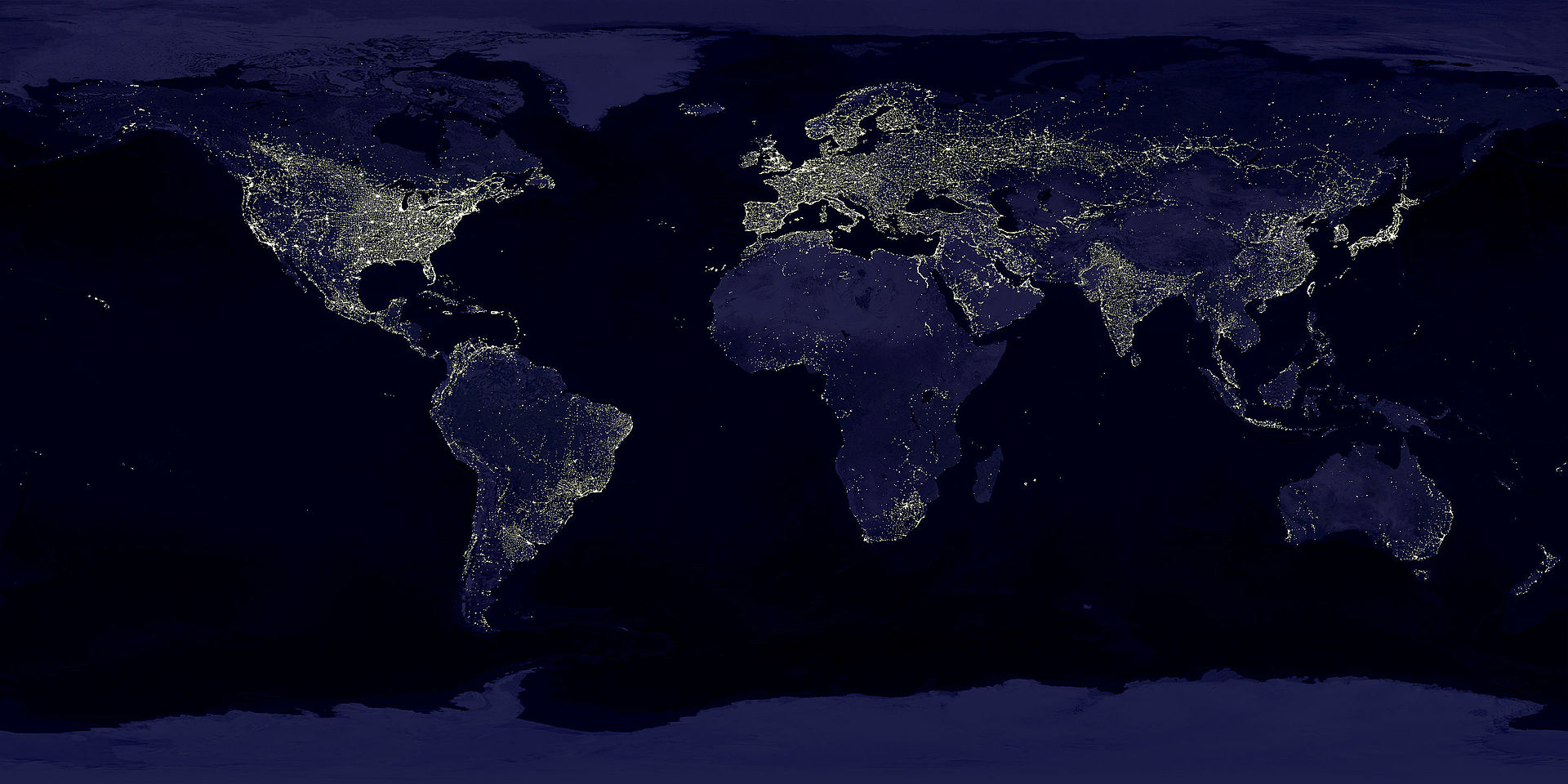
Satellitenaufnahme der Erde mit sichtbar gemachter Lichtverschmutzung.
Satellite image of the earth with light pollution made visible. You can see what a huge influence humans have on our planet (picture taken from Wikipedia).
I would prefer if we characterized the current phase of humanity using terms such as networks and information. Digitalization is a weak metaphor for what is currently developing. But “digitalization” is “in” and terms such as “information era” are “out”.
And everybody wants to be a front-runner in order not to be left behind. In Bavaria, for instance, we have a Zentrum-Digitalisierung.Bayern (ZD.B), other German states already start introducing similar institutions.
And you can read endless numbers of pamphlets on digitalization (mostly with nonsense written in them) and attend many events. As a general rule, neither is any use to you. A short time ago, I attended the TechDays in the Munich Tonhalle. It was truly a festival of speculations and I am sure that, if anything, it increased the prevailing degree of confusion..
In the German Wikipedia version, I can recommend the article on Digitale Transformation (Digitale Transformation). It gives a concise summary of the current state of affairs. There are also some contributions, such as Computerisierung, Informationszeitalter or even Digitale Revolution (Computerisierung, Informationszeitalter, Digitale Revolution), all of which are “nice to have”, but basically you do not need them. There is also an “English” „digital business transformation“ article – I hope they will soon change it to become a feasible “digitalization in public offices and in business” article or something similar.
Let us just consider “digitalization” as the continuation of “industrialization” and as part of the evolution on our planet in the time of Anthrozopän. Incidentally, there is now a Special Exhibition (Sonderausstellung) in the Deutsches Museum with a few things absolutely worth seeing. But you should be careful about getting a guide who will not punish the group by telling them half-truths and voicing personal opinions.
RMD
(Translated by EG)
Roland DürreTuesday June 28th, 2016
BREXIT
 Well, here is some personal comment of mine on the, as I see it, disgraceful BREXIT discussion.
- The persons who went to give their opinion in GB decided. They probably do not like the EU and, to them, the disadvantages for their country seem more obvious than the advantages. It is something you cannot rationally discuss anyway, because there are too many pro and con arguments on too many different levels. You cannot weigh them or put them into metric systems, either. When all is said and done, this is about emotions, which means the decisions are gut decisions.
- The outcome of the vote, however, should be accepted by all, both the extra-wise ones in the EU and those who voted in favour of GB staying in the EU. And in particular those who could have voted but did not. If now the entire world starts feeling morally superior to the Brits, then this is, in my opinion, the opposite of appropriate.
- Also, you should not forget that neither the British Government nor the British Parliament are strictly obliged to act according to this referendum. In other words: so far, nothing happened. And, as so often in politics, nothing will happen. The only thing that will probably happen is that the money flow comes to a standstill – or perhaps it will be camouflaged differently Now they do a bit of cheating – and with every single day that goes by, the topic #brexit will become more and more remote. Only a few thousand EU functionaries will try to find a solution that makes it possible for the British Government to not lose face before their voters and at the same time for the EU not to take serious damage. It will all happen as was shown to us when they discussed the TTIP behind closed doors.
- Personally, I do not believe the EU is an important or even critical factor for Europe’s future. Well, it is simply an extra administrative office. I am far more concerned about the NATO and the numerous national and nationalistic tendencies. They keep extending the NATO, not taking into consideration the worries and fears of our neighbours. I sadly miss a discussion on this issue. And it is quite possible that national interests will be promoted, rather than minimized, due to the current state of affairs.
- Looking at the EU as an economic unity, I am disappointed.
- As an economic unity, the EU, and in particular the EURO, perhaps had a positive impact only for Germany (as the leading nation) and a few small countries like Luxembourg (as financial centre of Europe’s concerns and banks) or Estonia (as the gateway to Russia). All others are more or less on the loser’s side.
- Even in privileged Germany, we have huge problems, such as the pronounced polarisation between the poor and the rich (more and more poverty, making up for more and more extremely rich persons) or when it comes to education. This, too, is probably one of the developments the EU is responsible for. And that, for instance, Spaniards have to go to Germany if they want to survive economically is just bizarre. In other cases, they talk of economic refugees who must under no circumstances be given asylum. We all agree that humans must not be discriminated against because of the colour of their skin, their gender or their religious beliefs. But they may easily be discriminated against because of where their passport has been issued – systematically and in a very differentiated way.
- I think a region has the right to contest central attacks by concerns or ruthless dumping prices. Whenever in history they tried to balance the powerlessness of those who suffered injustice by subsidies, they usually failed or achieved the opposite of what they had intended. And in the end, it always led to unjustified personal gain.
- For me, it seems particularly sad that the power of the lobbyists seems to have grown at all levels in Europe. They are now in a position to control all of Europe.
- Looking upon the EU as a shared living space gives me a sense of failure. I witness no end of regulations. Today, small enterprises, especially in the crafts, are threatened in a way that was hardly ever so drastic, at least as far as West Germany is concerned. Many things have become worse, rather than better: for instance the mobility concept in the public transportation sector. To make up for it, they now started an unbelievable charm offense in favour of individualized traffic with the combustion motor, probably on the instigation of Germany. The EU was not even able to standardize network mobility over the last few years. Your simple smartphone user will notice this whenever leaving his home region. There is no doubt that politics look at the advantages for the capital, the concerns and the banks. They totally forget that they should be serving the people. And the EU functionaries are basically system agents who are, first and foremost, concerned about their own well-being and money – often even more so than most of those on the national levels.
- Looking upon the EU as a political unity, I am disappointed. Just look at the example we just witnessed with the impossible behaviour and the completely non-existent solidarity when it came to refugees. Besides, who is responsible for our state policy when it comes to Russia, etc.? All I see is dangerous deficits. Here is another provocative note: As globalization continues, the only confederation that should prevail is the UNO. Because problems will be more and more global, rather than regional.
- The political structures and the arrogance of the EU functionaries absolutely remind me of such grey systems as the Comecon. We are all well aware of what they brought us. Allegedly, there was a time when there was only one brand of bread produced in the entire USSR and most of its vassals…
- Is it really such bad news if GB will become a number of smaller systems? Isn’t that the logical consequence of a development they already initiated in soccer a long time ago?
- History as I personally experienced it teaches me that, basically, after a big system collapsed, all parties concerned were happier than they had been before. I cannot talk about the Roman Empire, because I do not know about it. But I know not a single Slovene, Croatian or other person from the formerly big Yugoslavia who mourns its demise. I went to Yugoslavia in the early 1970ies and can easily sympathise. During my bike trip to the Black Sea, I met a Serbian who said that some persons in Serbia will now have to kiss their dream of a Great-Serbian Empire good-bye. . The situation is similar in Czech Republic and Slovakia – I never met anyone in Prague or Bratislava who wanted the ČSR back. And there are precious few who actually lament the fact that the aforementioned Comecon and the USSR no longer exist. I know quite a few ex-GDR citizens who could not be less enthusiastic about having the old systems back. Permit me to be a little polemic. If the FRG were to disintegrate in a reasonable way, the Bavarians probably would not be totally unhappy, either. But then, even those counties that are, at least financially, totally ruined – such as Berlin-Brandenburg – would probably stand a chance at getting a little healthier, instead of sitting down and collecting alms from other counties for eternity. Speaking of which: eternity might actually be a short time, because regardless of what most politicians assure us of, the situation in the communities and counties all over Germany keeps deteriorating (basic needs, infra structure, education, incomes,…).
- On free movement: I hear all the time that free movement for EU citizens is a huge advantage when it comes to choosing your place of work and residence. And that the Brits destroyed the future of the “young generation” because now they cannot work in the other European countries as easily. I am not sure if a social system with the dimensions and diversity of Europe can function at all. I am sure some control is necessary. Here is an example: In China, most of the people would like to live in Peking. Of course, that is not possible. Consequently, people who want to live in Peking have to meet certain requirements. For instance, they have to have graduated from university or document ample riches.
- Another advantage often stated in favour of the EU is that we have no border controls. I would gladly accept border controls if that meant we do not need the total digital control state. Intelligent border controls (see railroad or airports) will not cause queues, either.
- Last not least: I do not like a Europe of nations all of which are prepared to sacrifice freedom for security and where quite a few look more like dictatorships and corrupt systems with fascist tendencies than functioning democracies.
Final remarks:
I am for diversity and against stupidity. I am worried that huge systems might promote stupidity. Consequently, I am in favour of a EUROPE of connected and linked regions who will gladly and voluntarily integrate themselves into the federation. Meaning: a EUROPE that follows the rules of subsidiarity.
I dislike a EUROPE that dances at the puppet stings of concerns and business interests. I dislike a EUROPE that is reigned by party oligarchy and first and foremost follows lobbyist interests. All of whom use fear as the main motivator for business transactions.
I want my EUROPE to be administered in an agile, open and slim way. It should respect human rights and individual/private affairs, decide in an ethically responsible way and, where necessary, be prepared to give up property.
My dream is of a social, humane Europe that fights radically for peace and will not export weapons to any place in the world. Of a Europe that seriously lives like it understood the message that our planet has already been destroyed to a huge extent. And that we cannot continue to destroy our environment and nature, which also goes for our microcosm. I mean a Europe that will not subsidy environmental sins (kerosene), that will do without irrational, gigantic projects (S21) and that will promote quality on a broad range. I mean a Europe that, at long last, forgets its ideologies and dogmata, like that “all problems can be solved by growth”, that “life is basically a fight of all against all” or that “children need to be educated and people need to be punished for their sins”.
Consequently, I am glad that the Brits courageously voted for the BREXIT. Regardless of the fact that I found the prejudices and what was called self-evident – both of the BREXIT supporters and their opponents – often rather stupid and incredibly hypothetical (speculative). Both sides claimed the right to predict the future and justified their assumptions with arguments that I found simply ridiculous and criminal.
We will probably have to get used to the fact that the scale that measures dishonesty in political agenda is open at the top. Still, the vote for BREXIT is a strong signal. It sends the message that we cannot continue as before. Perhaps it will bring movement into politics and make the ladies and gentlemen a little more thoughtful. But then, I am rather sceptical. The citizens will probably have to do it themselves.
But I think the first reaction of the EU partner governments is also quite wrong. They said the exit has to happen quickly and it must be guaranteed for all times (!?) that they can never re-enter. That strongly reminds me of a family where one child wishes to move out and parents who do not like the idea threatening the child with the information that he or she can never return. Fifty years ago, such behaviour was absolutely normal, I experienced it more than once.
RMD
(Translated by EG)
Roland DürreWednesday June 22nd, 2016
Agile and Flexible – ARCIS VOCALISTEN – now à cappella – June, 24th, 016
On Friday,
the arcis-vocalisten
will sing in the Himmelfahrtskirche in Munich Sendling,
I am last-minute advertising this unique concert, but not only because tickets are still available. Above all, I point you towards this concert because it is going to be n absolutely unique experience. One that you will not wish to miss!
One specialty about it is that it is sung a-cappella, which means there are no instruments, let alone an entire orchestra to accompany the singers. Naturally, this is much more demanding for the singers, since nobody plays along with what they are supposed to sing.
Another specialty is that there will be a world premiere:
Markus Fritz is himself a member of the choir. He is also the composer of the work
„De Tranquilitate Animi“
after words by Seneca!!!
You will also hear the “Missa in F Major” by J. G. Rheinberger and the motet Opus 74 No. 1 by Brahms, as well as a few Kaminski songs.
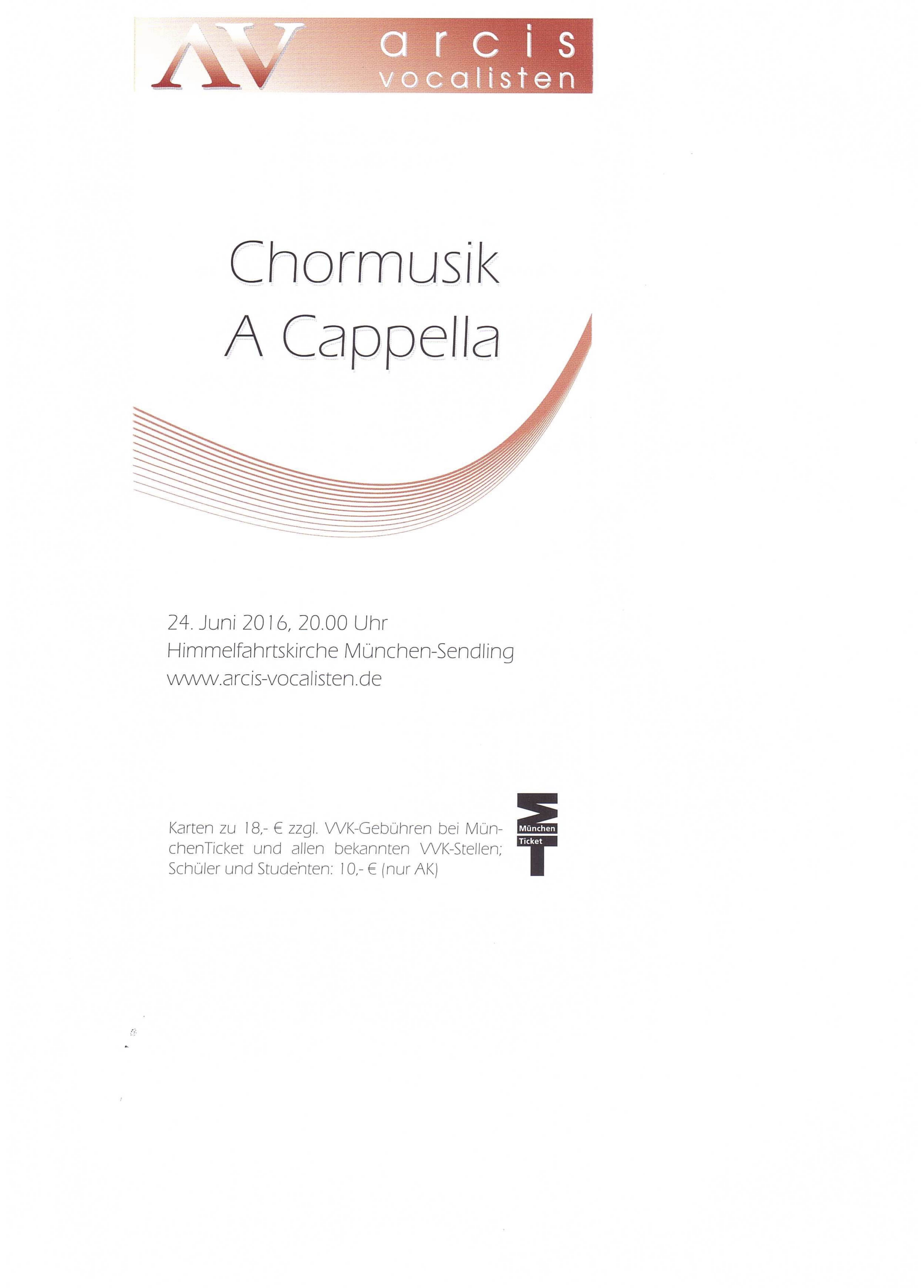
If if would not be staying in France this Friday, I would definitely be among the audience.
Not only, but also because Evelyn (EG) sings in the choir.
RMD
(Translated by EG)
Roland DürreTuesday June 14th, 2016
Microsoft Buys Linkedin – spontaneous contemplations.
Just a few ideas about the deal …

Contemporary Ganesha statue
Well, this news came as a surprise to me, regardless of everything else:
Microsoft buys Linkedin for 26 billion dollars.
The reason for my surprise, among others, was that, basically, this looks like a fairly low price. After all, a “German” enterprise allegedly offers more than 60 billion for an enterprise that some emotionally consider a “criminal rat shop”.
There might be good reasons (Gründe) for Microsoft to make the deal. I, too, estimated that Linkedin was a little of an underestimated outsider among the really big internet players.
And I also thought the buying strategies of Linkedin, for instance when taking over video2brain and other great enterprises such as slideshare were rather conclusive.
Now, it looks to me like all these activities were just meant to make the bride look a little prettier and thus make more money.
My first question when I heard about the deal was
Why do the customers of Linkedin (an enterprise) not get a vote when it comes to selling Linkedin (that same enterprise)?
And I immediately had to correct myself
Well, the customers do have a vote – all they have to do is remove their account!
If all the customers were to do just that, the whole affair would soon come to an end. Except that, if radically realized, such behaviour would mean leaving all these systems. From A to Z. In other words: you would personally have to disappear from the virtual world. And that is not an option for me.
When all is said and done, you come to the conclusion that it is not just the virtual reality and not only the internet enterprises. Instead, this is all also about my real life: how I live, what I eat, my mobility, my clothes, my energy level.
Consequently, I will reduce my ideas to one question:
What economic system are we in if, according to Prof. Otte, a threshold value of more than 6.1 billion US dollars was moved over the last year through “merging and acquisition” (M &A) world-wide, which is a record number?
And my question gets more precise:
How is it possible and legal that an enterprise can accumulate or get this kind of money and that it can happen at such speed?
I know a book by Georg Zoche, with the title World Power: Money (Weltmacht Geld). Of course, money is power. Consequently, it makes me very thoughtful how concerns can become so rich (=powerful). Mind you, this is happening at a time when our planet slowly but certainly dies and humans kill and torture each other. Because they are poor and consequently become victims of war entrepreneurs.
I am sure you all remember scene 4 of the first act in Shakespeare’s drama »Hamlet« (written around 1600):
“Something is rotten in the State of Denmark.“
RMD
(Translated by EG)
Roland DürreSunday June 5th, 2016
Vacationing on our Planet: the Cyclades
Today, Barbara and I woke up in Adamas, the harbour city of Milos. It was the eighth time we slept on our trip. The first time was on noisy Piraeus, then we went to the isles. We spent two nights on glamorous Santorini, three on the quiet island of Folégandros and two more on Milos. Much of the time was on the water, where we used three big ships and went on short trips on three smaller boats. Especially on Folégandros, we also did a lot of hiking.
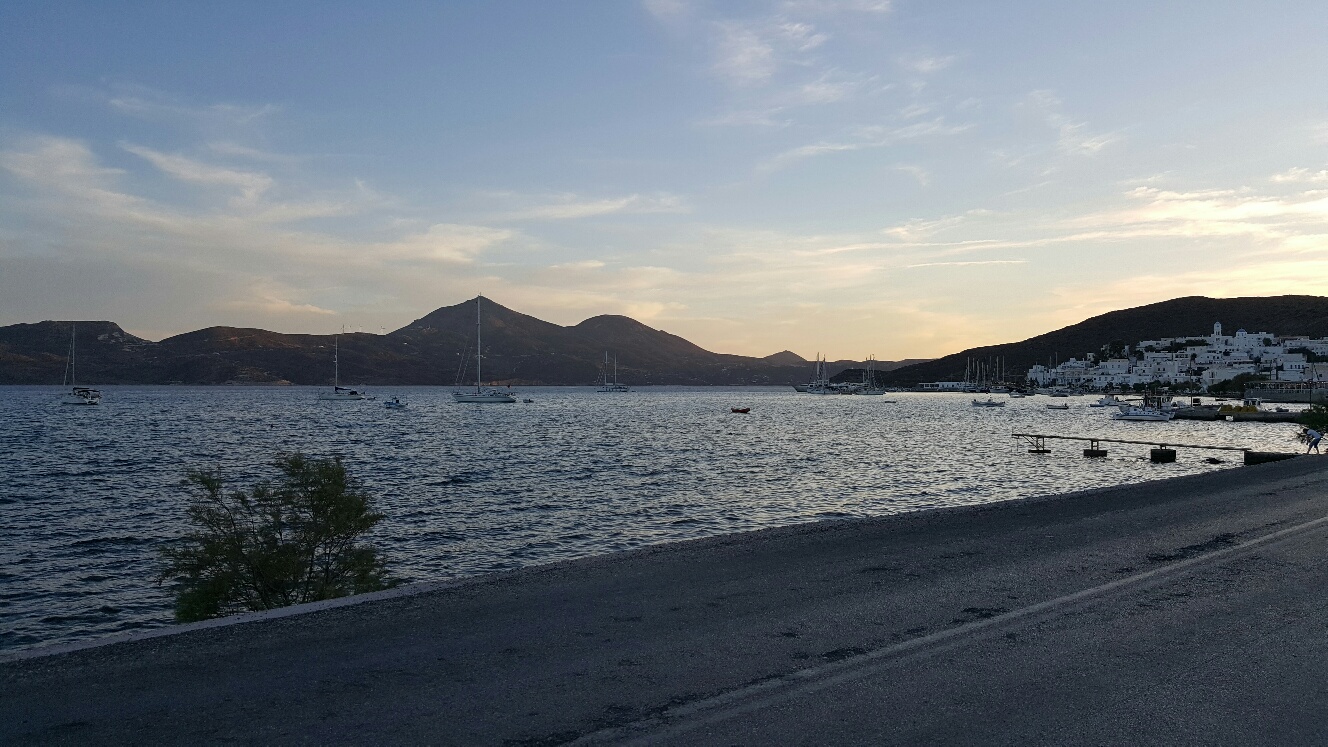
Milos was also a place where we had wonderful hosts, which is true for the entire journey, during which we spent our time with very agreeable people. I was surprised about hardly ever meeting Germans. Yesterday, we were again the only Germans on a trip on board a ship with fourteen persons from France, Great Britain, Island, Canada, Italy, Spain and New Zealand.
Today, at 14:05 hours, we will go to Serifos, where we want to spend two more nights before going back to Piraeus and then taking the underground train to our last overnight stay in an Athens hotel before boarding our train back to Munich.
It was an agile and slim trip, with little luggage and the simple idea that we visit a few Greek islands on the Cyclades. Barbara had prepared well, but she had made no actual plans except the flights out and back in and the first hotel in Piraeus. The entire route of the journey materialized on the way. For example, when we left Munich, I did not even know that Folégandros exists. But then, the recommendation by our landlady in Santorini was so unmistakable that we simply had to go there. And as it turned out, a ship left on the next morning. …
Under the Greek sun, I had an idea. As we all know, some people call such a trip “vacation”, so here is what they wrote: “Let us meet again after your vacation “. Well, fact is that what I did here is exactly what I do at home: I was on the move all the time, although not with my bike. And I learned, worked, wrote articles and enjoyed life. And I tweeted. Yesterday, I spent 11 hours on my Account rolandduerre (https://twitter.com/RolandDuerre):
Insight
My life is one long vacation on this beautiful planet earth – some kind of travel&work on earth.
#ponderings on #the meaning of life
I cannot get rid of this idea, which is why I will now relate it to you.
Isn’t my entire life one long “vacation” on the planet earth?
It has now been 66 years for me here as a resident. I was welcomed in a very friendly manner. However, as I remember it, the next few years were those during which I was to be educated, schooled and directed towards being a good and high-performance person. I even had to sleep in a (medical) cast – in order to correct my “Morbus Scheuermann“. That was when my joy about being a child was over. I was unhappy, because they wanted to convert me into something I did not want to be and neither did I understand it. I often heard the sentence: “If you continue in this way, you will end up a total failure!“ Luckily, I “continued in this way” at least to some extent. And in retrospect, I should have done more of this “remaining the same”. And what followed then were fifty more or less happy years. Now considerably fewer years remain to me than I have already lived. For instance now, during our Greek journey.
I am absolutely determined to enjoy the few remaining days of my trip through the Cyclades as much as the years that probably remain in my life. But I am just as determined to use them well. For happiness and for my project PEACE (FRIEDEN).
RMD
(Translated by EG)
Roland DürreSunday May 15th, 2016
The Mobility of the Future – Augsburg – May, 21st, 2016 (barcamp)
 #AktMobCmp
In the last few weeks, the topic “active mobility” suffered from too little attention by me. Instead, I was busy doing something about #FRIEDEN and DIGITALE TRANSFORMATION, seeing my grandchildren and my mentees, giving a little support to start-ups and attending to private interests such as riding my bike through Italy. And much more.
I am truly sorry about this, because I keep receiving news and new information that show how badly we need to do something:
- The fine dust pollution in all the cities of the world is extremely high and still rising.
- Due to the ever smaller size of pollutants through modern technology (we are talking nano dimensions), they are more unhealthy than ever.
- The climate catastrophe gets more real, closer and ever more threatening.
- Our autonomy in life is restricted, our way of life is more and more determined from the outside.
- This is how, controlled from the outside, we sacrifice what is important to us, giving it to foreign institutions that manipulate us and put their own interests above ours.
- The metrics of money and profit are onmi-present and rules the entire world and all areas of life.
- The way how huge concerns manipulate us and rule over us gets more and more outrageous.
- Fear becomes the determining drive of a strongly increasing irrationality in society and politics.
My conclusion:
As far as I am concerned, I am fed up with the new dishonesty and evil double morals. We need a huge transformation that begins with our cognitive perception. Mobility is an ample metaphor for the current development and the fact that transformation is absolutely necessary. It shows all the things that go wrong and how we badly need to change our opinions and habits for our own good.
The next chance to do something is in exactly one week! On May, 21st, 2016, the next Camp für active Mobility #AktMobCmp will be held in Augsburg. Since it is during the Bavarian Pentecost Holidays, the organizers cut the camp down to one day. They are happy to welcome all visitors …
On this day, the interests and needs of all participants will be very intensely discussed in the format of a barcamp. The “part-givers” will share their knowledge and leave after a day of shared realizations, ideas and plans, not to mention all the new friends they will have found.
So here is my personal plea to all the “friendly persons” who want to take responsibility for the future: try the Augsburg.#AktMobCmp. If it is only your inertia that keeps you from attending, please overcome your “inner weak self” and come! Register here.
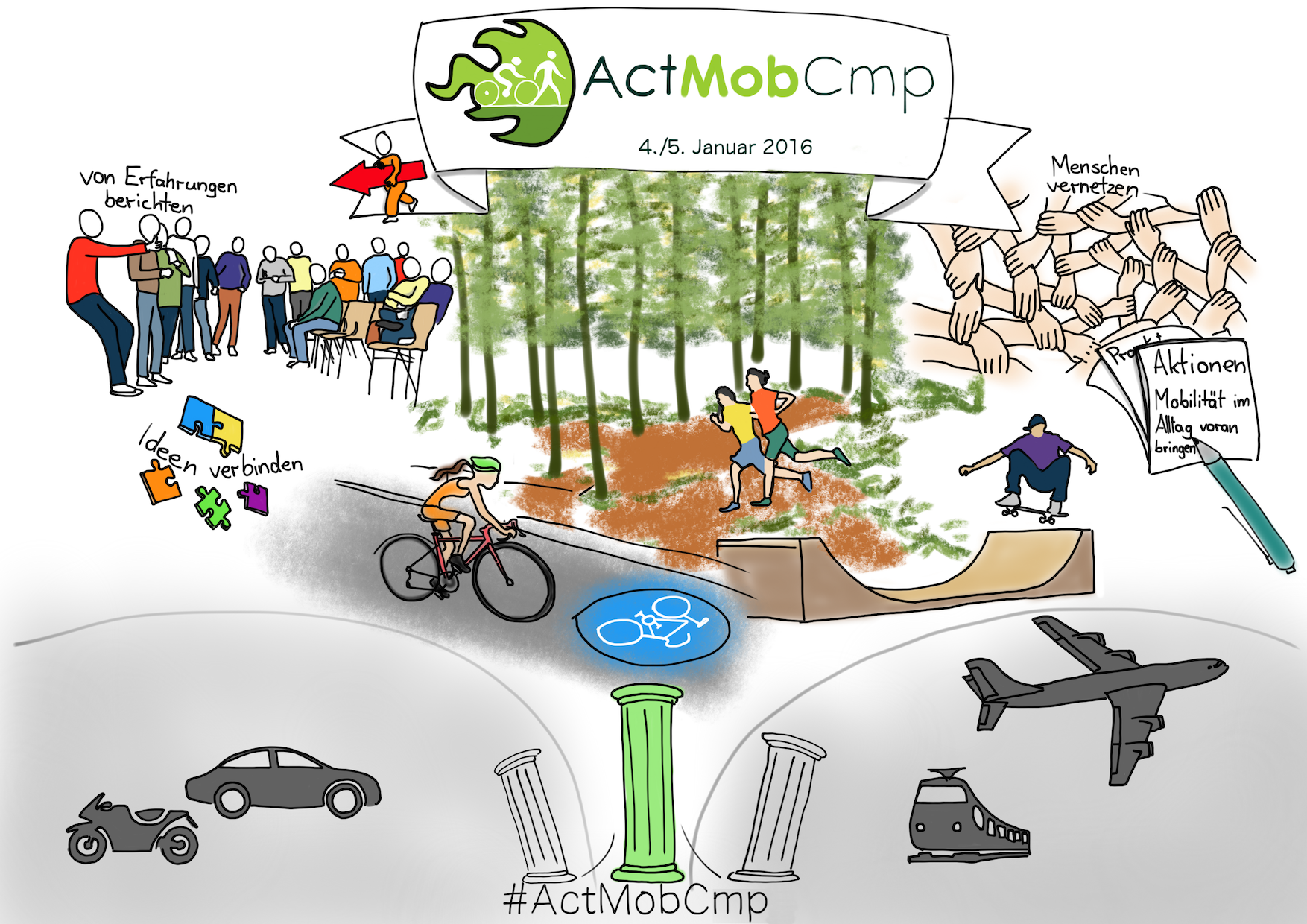
Donated by VisualBrainddump (Christian Botta & Daniel Reinold) Click on the image to enlarge.
Early last year, we started with a very nice camp in Unterhaching.
We will continue in 2017 – probably on January, 5th and 6th, again in the Kubiz Unterhaching.
Starting in September, our preparations will gain new momentum. We will do some massive advertising and invite many people and institutions we know well by now. And I guarantee that this barcamp will, again, bring many persons together, be extremely enjoyable and bring fundamental additional knowledge.
RMD
(Translated by EG)
Roland DürreTuesday May 10th, 2016
Future, Evolution, Transformation & Digital!
One week ago on Saturday evening, we started on our way to Italy, leaving the train on the next morning in Orvieto. It took us three days to get to the congress venue at Castel Gandolfo by bike. Riding our bikes to the Albanian Ocean in the south-west of Rome was a great preparation for the international
“10th NETWORK MEETING OF THE PETER PRIBILLA FOUNDATION (MAY, 4th – MAY, 6th 2016, ROME)” I was lucky enough to be part of.
The workshop was intense and challenging. Consequently, we spent the day afterwards being truly at leisure and indulging in luxury in Labico. Subsequently, we rode our bikes through Italy for three days. The first leg was from Labico to Terracina (around 80 km). Then we continued to Nettuno (about 75 km). From there, only about 50 kilometres were left to ride to Ostia, which meant that we arrived there early in the afternoon and had plenty of time to see the ancient Ostia by bike and generally enjoy Ostia.
During the three days riding through the provinces of Roma and Latina during the wonderful Italian early summer, I had a lot of time for contemplation. It was a truly special meeting.
Tomorrow, our voyage will be at its end. We are going to Rome. There, the night train that is supposed to take us back to Munich by Thursday morning is already waiting for us. Let me write down a few memories of today’s meeting.
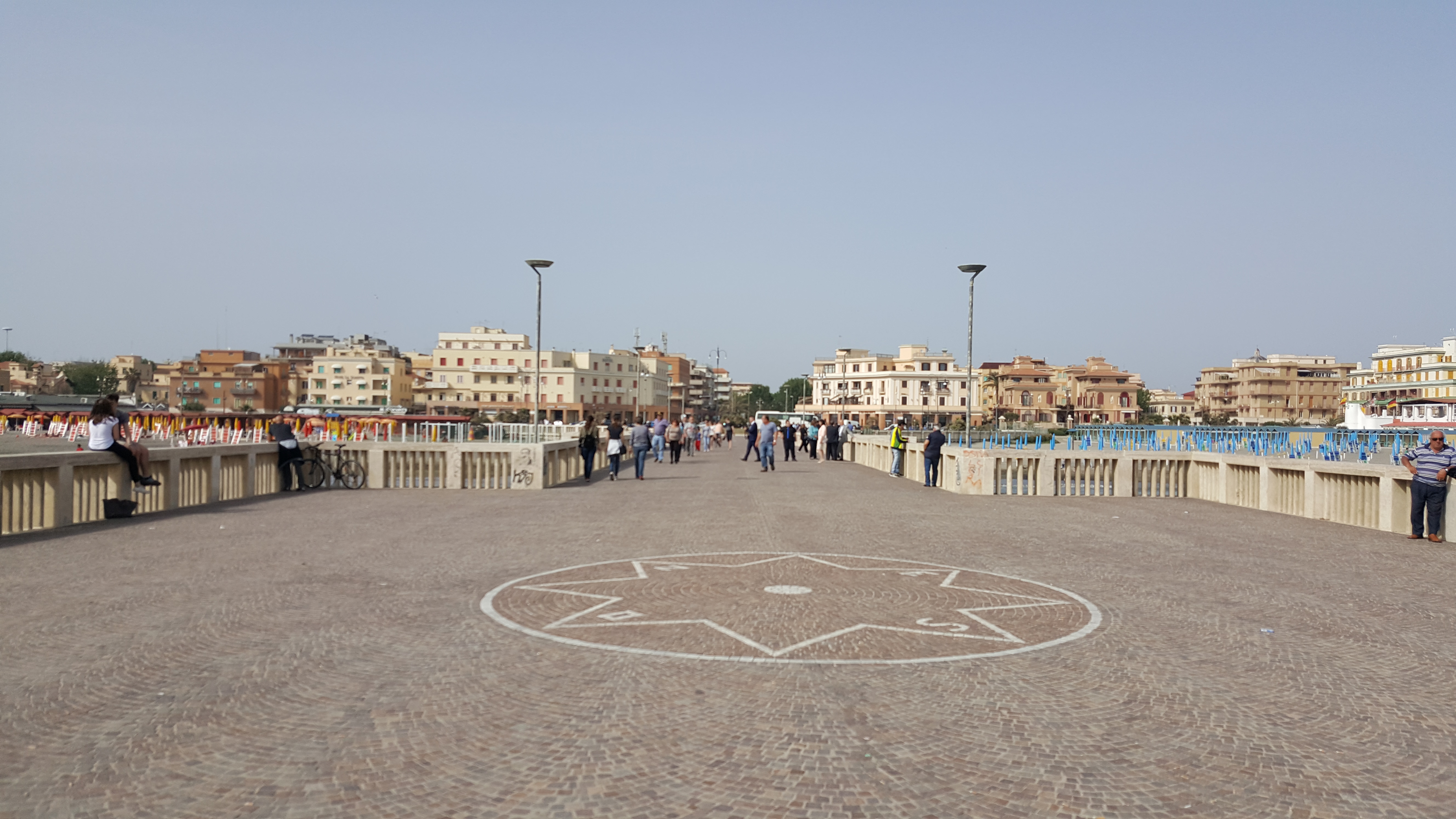
Lido di Ostia, picture taken and scenery admired from the central ocean bridge :-).
The meeting was sponsored by the “Pribilla-Foundation“ and about “Digital Transformation“: After all, this is a transformation that concerns all of us ever more, making us aware of change that is happening and growing at rapid speed.
The workshop was opened with an impulse presentation by Manfred Broy, who is the director of the Bavarian Digital Centre (Digitales Zentrum.Bayern). He gave a precise “sweeping swipe” on “digitalization”. Based on exciting facts, he pointed out to us what is currently happening. I was allowed to give one of the three (3-minute) short responses to the presentation. Here is a short version of what I said (with a few additions, because three minutes is actually quite a short time):
“The digital transformation will probably have a massive influence on the evolution and our future. It might even help on the way towards finding the necessary great transformation humanity needs badly.”
I came up with a theory on all the terms marked in this sentence – that is: I formulated my “basic beliefs”. Here they are:
- Future
As I see it, the future cannot be predicted!
That is also the first theory formulated by the great and unfortunately already dead management scientist Hans Ulrich from St. Gallen who revolutionized the theory of management in the 1980ies with his essay “Eight Theories on Change in Management”..
It may well be possible to predict the future correctly once in a wile if you use the tools of science and your common sense. That is: you might receive a “message from the future”. Yet you will never manage to correctly interpret said message.
To me, the future of humanity can be described using the metaphor of a boat on a river. The river is in the “white area”. The boat moves down the river.
You can measure the speed at which the river flows and also, for instance, the stream gradient and other data. But still, all those data will only give you limited information on what is going to happen. Using a spy glass to look into the distance will also only be of little help. It is not predictable how the river will continue on its way (will it become broader or will it find its way through a narrow gorge and become a torrential river, will there be a bend or a waterfall or will it suddenly disappear totally underground?).
And in this metaphor, we do not even know if humanity is the boat or the river (or maybe just a swarm of fish?). - Evolution
Evolution is useless. Perhaps it tries to make sure there will always be life, but we do not know why and for what purpose.
As I see it, evolution cannot be controlled – just like the future is not predictable. Basically, we cannot install a “steering committee” and tell them ”Please control evolution!”. It simply will not work (just like, incidentally, it does not work with huge enterprises and social systems). - Transformation
I think in a next step, evolution will have to and will undergo another huge transformation. This is necessary if humanity wants to survive. It will come, disregarding the question of whether humanity will continue to live or not. We know nothing about this transformation, except that it will bring basic change and come as a huge surprise. The time for this transformation is ever nearer. It will probably happen within the next few generations. - Digital Transformation
It would be nice if digital transformation could become a positive driver for this great transformation. I see quite a good chance. Even now, the world changes through digitalization – and in my opinion said change is for the better.
The friendly persons build networks, the combination of digital + social makes it possible to cooperate constructively in a way that was hardly possible in former times. Thanks to the “digital” world, something like “enlightenment 2.0” develops. To me, this looks to be more important than the “buzzword” of “industry 4.0” which, after all, is only “normal” technological progress.
What remains is the question: how can we contribute towards digitalization changing the world in a positive way?
Of course, I do not know the answer. It is my belief that we should not talk too much but instead act. Every one of us should act in his own specific way, following his personal inclination. And we all should do it together and connect with all the ”friendly persons” in our society – for instance those persons I actually met in huge numbers at the nice meeting in wonderful surroundings!
RMD
(Translated by EG)
P.S.
During the meeting, I mentioned a book that might actually help you a little to understand how totally different even our “small” children think – and how helpless the ancient concepts of thinking and teaching and education have become.
(Re-Invent Yourself! A Declaration of Love for the Network Generation by Michel Serres).


