
Roland DürreThursday February 16th, 2017
In 1985: object-oriented – Today: agile, digital, lean, open, social.
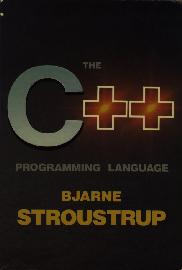
In the autumn of 1985, I was the first to bring this book to Munich after having bought it at the Uniforum fresh from the printing machine.
A short time ago, I retrieved it. It reminded me of having been at Uniforum conferences with friends of mine in February 1985 (Dallas, Texas) and in 1986 (Anaheim, California). It was great. In those days, the Uniforum was the one and only UNIX conference in the USA. We were thousands of enthusiastic visitors from all over the world. I experienced a huge atmosphere of dawn at the time.
There was also a small sensation. Copies of the very new book on C++ by Bjarne Stroustrup (see left on the picture) right from the printing machine were delivered in the middle of the conference and sold directly from the palette. I bought a few of them and took them home. They were probably the first C++ books to ever reach Munich.
This brings to mind: in the 1980s, I constantly gave presentations on software development. At the time, the change in programming was the central topic, and the catchword used most often was OBJECT-ORIENTED.
I also wrote quite a few presentations on “OBJECT-ORIENTED” for IT managers. Among them was a “high-up” at Siemens AG in UB D at D AP (or was it already SNI at the time?). He was asked to tell his “team of leaders” what exactly OBJECT-ORIENTED meant. Afterwards, he said the presentation had been well liked – but it certainly did not really make a difference.
Today, everybody programs object-oriented. In fact, it is even a little too much for my taste.
Later, I gave up my “programming career” and became something like an “entrepreneur”.
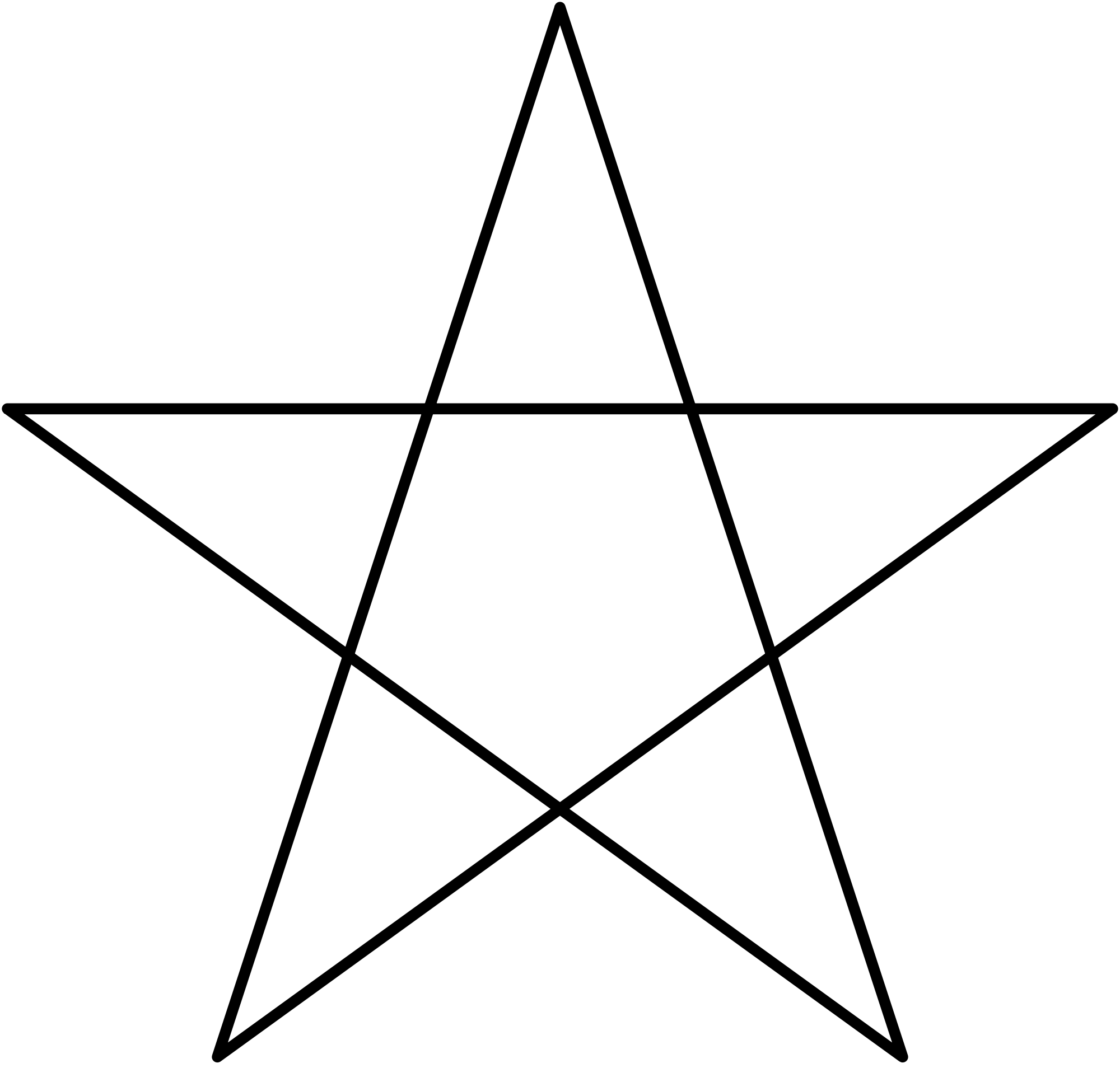 Now I was no longer preaching the gospel of technology. Instead, I spoke about leadership and management. And in particular, I talked about the “smart” pentagram that consists of the terms “agile”, “digital”, “lean”, “open”, “social” and how they interact.
For instance, I related why courage and joy in those working for an enterprise is also a central requirement for economic success. And I also told the people how necessary mutual respect and appreciation of each other are (not only) in an enterprise. Why meeting at eye-level and shared participation and responsibility are the basic requirements for innovation. And why humans are not resources. And how change can only happen in an agile environment.

“Pro Agile“on the DOAG Podium /Yearly Conference in 2013.
I explained why processes, rules and bureaucracy are obstacles to the necessary change. I also explained what a huge damage Taylorist developments cause in an organization and how much waste (as opposed to “lean”) is created by an overwhelming administration and the rising bureaucracy in an enterprise as a consequence of those developments. And that it is totally useless to have endless meetings.
And that departments such as “human resource”, “customer relationship management”, “marketing”, “legal service” etc., basically do not guarantee the success of an enterprise. In fact, they come closer to endangering it.
And that the young and well-educated persons of today prefer working in an enterprise the central element of the culture of which is trust.
I can easily give you good reasons for all I said. After all, I myself was part of the scenario when we software developers made a (as I see it: central contribution) towards a new understanding of work that now spreads more and more to other sectors (#newwork). And this is how it helped to change the world.
I wonder if my call for “agile, digital, lean, open, social” as a “smart” pentagram will do any good? I am not sure.
I also got the impression that my audience mostly saw it in the same way. In fact, it would make me happy if we in the German Industry were to talk less about industry 4.0 and more about entrepreneurial culture. Be it 2.0 or 5.0.
Even the big bosses must understand that our enterprises and we ourselves can only survive well if we are prepared to question what we used to consider certainties and to change what we were used to.
Of course, I understand that it hurts to question hierarchies, cherished sinecures and structures you have become used to. Especially if you are the boss. But please keep in mind: we no longer live in the times of Henry Ford’s conveyor belts and even the prime time of the Chicago slaughterhouses is coming to an end.
RMD
(Translated by EG)
P.S.
I took the star from the central media archive Wikimedia Commons.
Roland DürreWednesday February 15th, 2017
Entrepreneur’s Diary #119 – Your Personnel Records
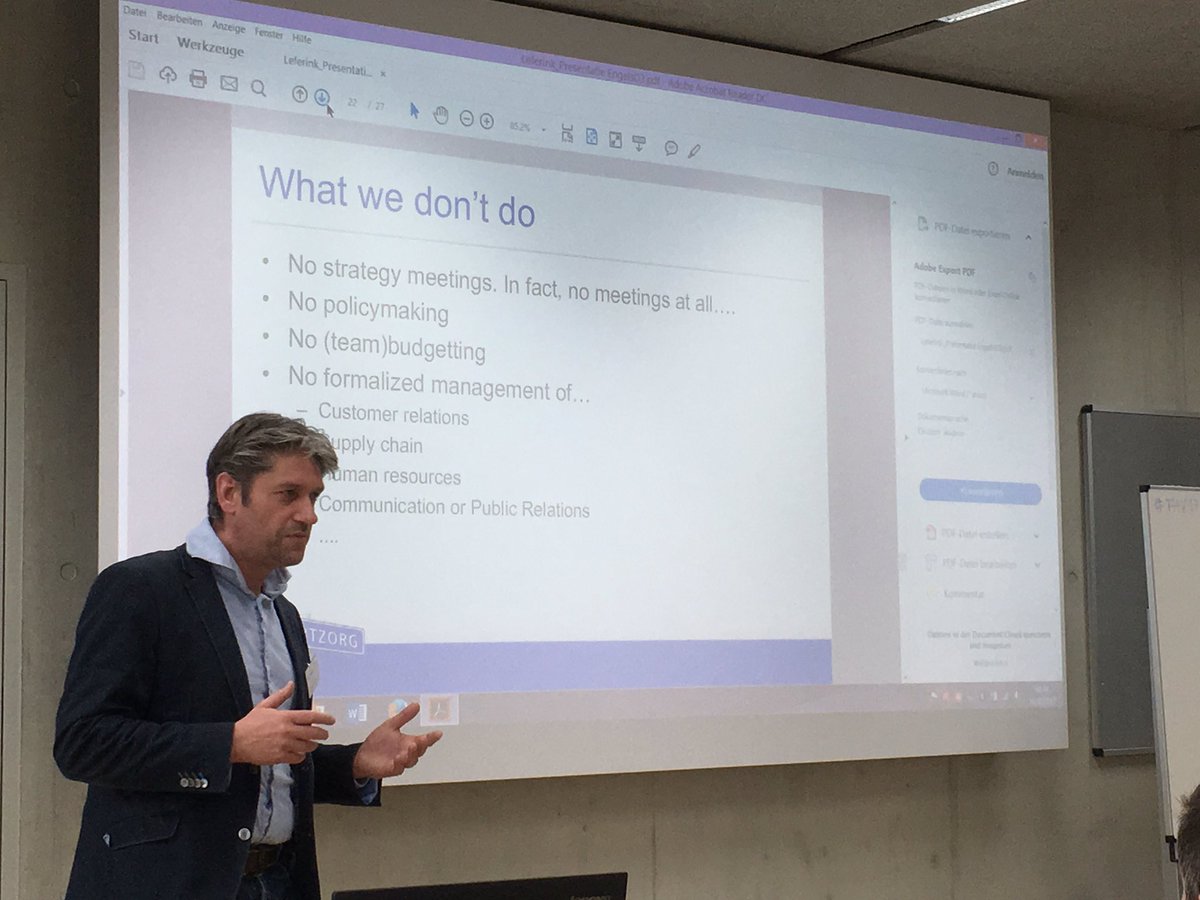
Ard Leferink for buurtzorg in Stuttgart at #fav17 (agile)..
Last week, on the Forum Agile Administration #fav17 in Stuttgart, Ard Leferink of buurtzorg was the Key Note speaker.
On the evening before, he had told me that buurtzorg has no HR-Department (human resource), just like they have no marketing department, no sales department, and, naturally, also no CRM System (Customer Relationship Management).
Well, I actually know a few companies that have no human resource department. As a general rule, however, those are small enterprises with a number of employees that does not exceed the two-digit scope. In the Netherlands alone, more than 10,000 people work for buurtzorg. Well, I guess that can be considered a little bigger, can’t it?
Yesterday, I discussed this with an entrepreneur I am good friends with. He immediately replied by asking: “So what do they do with their personnel records?“ To which my reply was the question: “What do you need personnel records for?“
I actually believed – and have believed for some time – that in an enterprise that is agile and based on trust, personnel records are as unnecessary as a personnel department, not so speak of a “director personnel”. For the administrative processes (paying the salaries, …), a list of employees with very little information would absolutely suffice. Everything else is unnecessary “overhead”.
But before I give you reasons for my opinion, I will describe for you all the things a personnel record consists of.
- As a general rule, the personnel record is started when an employee is hired. That is old knowledge as it has been handed down over the centuries.
- When a new employee is hired, a master data list is made. It contains all the data about the employee necessary for realizing the working procedure, such as his/her birthday, sex, social security and retirement number, religious belief, etc. The work contract is added and sometimes the (successful) application letter with the CV and diverse diploma (school, education, academic grade). And, of course, the protocols of one or more job interviews is filed here as well.
- Then the personnel record is updated all the time by adding:
- All extensions of the work contract;
- All goal-oriented agreements;
- Organisational changes,
- Gratifications and social support (costs for child-care);
- All documentation pertaining continuing education; (the many “private educational measures” that, for instance, a software developer is doing all the time are not part of this);
- Documentation of sickness and health insurance; In Germany, all employees who have been sick for more than three work-days have to bring a doctor’s testimony. To me, this looks like a method for creating work and money for doctors – I never knew a doctor who did not write such a testimony when asked by the patient,
- Special events (change of marital status…) and activities (presentation, …) will also be written down.
- Protocols of yearly evaluation interviews and all other relevant discussions;
- Interim job references;
- All “disciplinary” things such as misbehaviour and/or written warnings;
- In former times, positive letters were also kept in the personnel record. For instance if a colleague received a special tax-free payment because of a jubilee (company employee) or the birth of a child. However, now that these are no longer tax-free, there is less motivation for the employers to pay any special gratifications.
- Today, less agreeable data are also part of the personnel record. They suggest a strange concept of humanity. Because humans, too, are now considered a measured object. For instance, we find the results of strange tests (Score-Cards as results, for example, of the Reiss-Methode), as well as “psychological” reports about the employee’s personality and numbers that indicate his performance for the enterprise. I do not know if this is legal, but I know it is done.
(In some companies, they have agreements that state what may be added to the personnel records and what may not be therein. And the works committee controls in regular intervals).
If someone has been an employee for many years, then this report folder can become quite extensive. It might weigh a few kilograms. If you have a hundred employees, you need quite a bit of storage space. That is why you have to have a digital HR application. And, incidentally, you will also get quite some problems with “privacy protection“.
Because, by definition, IT systems are not secure. To be sure, the drawers with the personnel files in locked rooms were not very secure, either. I actually remember some creative employees who managed to get the keys. And I also remember a personnel file lying around on the desk of a “boss” overnight. But in those days that was not a problem.
In IT, you have to introduce processes that define who can read what under what conditions. It has to be documented. And again, you have one of those coffin nails that will do damage to an agile and slim enterprise and give you yet a little more bureaucracy and administration.
In other words – everything you do not really need is something you better avoid!
Incidentally, the dialogue with my friend continued. His reply to my question why you need personnel records was (after some hesitation):
“For writing references?“
Indeed. As we all know, in Germany the employer has to write a reference for an employee when he leaves (or whenever he wishes one). That reminded me of when and how I used to write letters of reference. Here is what I did:
First and foremost, I asked the employee to write down everything he did for the company and mark which of those things were important to him. Then I took this input and added my own knowledge and estimation, before finishing with one of those famous phrases taken from a book that lists all the relevant phraseology.
But I only ever took a look at the personnel folder when I needed a birthday for wishing someone many happy returns.
RMD
P.S.
For more articles of my entrepreneurial diary, click here: Drehscheibe!
Klaus HnilicaTuesday February 14th, 2017
Woebegone Europe – What Exactly Is It?
 At the moment, nobody can probably say what kind of construct the so-called ’Europe’ is. Economically, it does not look too good, its crisis countries struggle against increasing unemployment rates, it is politically divided and the citizens and elites have become more and more each other’s enemies because, after seven years of Euro crisis, they now see themselves confronted with a refugee stream from Africa and the Near East that does not look like it will end in the near future.
Is this the demise of this ’European Artificial Concept’ European Union (EU) and currency union, where none of the governments that are part of the whole is capable of showing us a uniting narrative – which means that the stupid shouting of rightist disruption mushrooms is being slurped up by an abandoned citizenry like Grail Messages?
Or is this diffuse concept EU doomed because all its borders have to stay open? Since, as the German Chancellor – who simultaneously writes into her subjects’ annals that a 3,000 kilometre-long border as Germany has it cannot be controlled anyway – tells her citizens that otherwise the Euro will have failed. Just like the EU with its 14,000 kilometres of borders, cannot be expected to control them all?
And those who think they know better and tell people that ’Schengen ’ should under all circumstances have been adhered to and that the exterior borders should have been protected are told that, after the interior borders had fallen, they perhaps learned nothing at all from the world financial crisis that, too, was initiated by the Americans. After all, did anybody care about the Maastricht Rules when the individual governments hastily saved their banks because the economic control mechanisms had failed – or that is at least how they interpreted it – and, consequently, everybody had to return to the ’primate of politics’ as a matter of course?
And that is how we are going to continue, no matter what! As it is, the safety packages and soft budget limitations are an excellent tool for keeping the interest rates of ’Mr. Draghi’s EZB’ low and even for, without any shame, indebting ourselves even more without having to deal with the intricacies of debt reduction and structural reforms as the usual dumb asses demand!
What a pity that parts of the population and the EU and currency union get more and more dissatisfied regardless: masses of them run towards the leftist parties in the south and towards the right extremists and national conservatives in the north and east, instead of at long last becoming wise and taking their example from good old Germany – this is true for the euro crisis, the refugee crisis and the energy revolution! It would be quite easy, wouldn’t it?
Even if there might be the danger that the occasional wisecrack who believes that Germany, based on well-meaning, will actually do the wrong thing due to its uncoordinated policy, thereby threatening to destroy the peace project of a unified Europe. One of those wisecracks is he historian Heinrich August Winkler. He says: It is part of our German responsibility to kiss inflated moral egos that especially progressively inclined Germans world-wide possess good-bye. It is an erroneous belief that we, if necessary even all by ourselves, have to realize the good things. It must not become our lives’ lie!“
Hm – how confusing! This is definitely not what our Federal Chancellor thinks?
But maybe the man actually has a point?
KH
(Translated by Evelyn)
Roland DürreSunday February 12th, 2017
The Unavoidable Unpredictability of the Future!
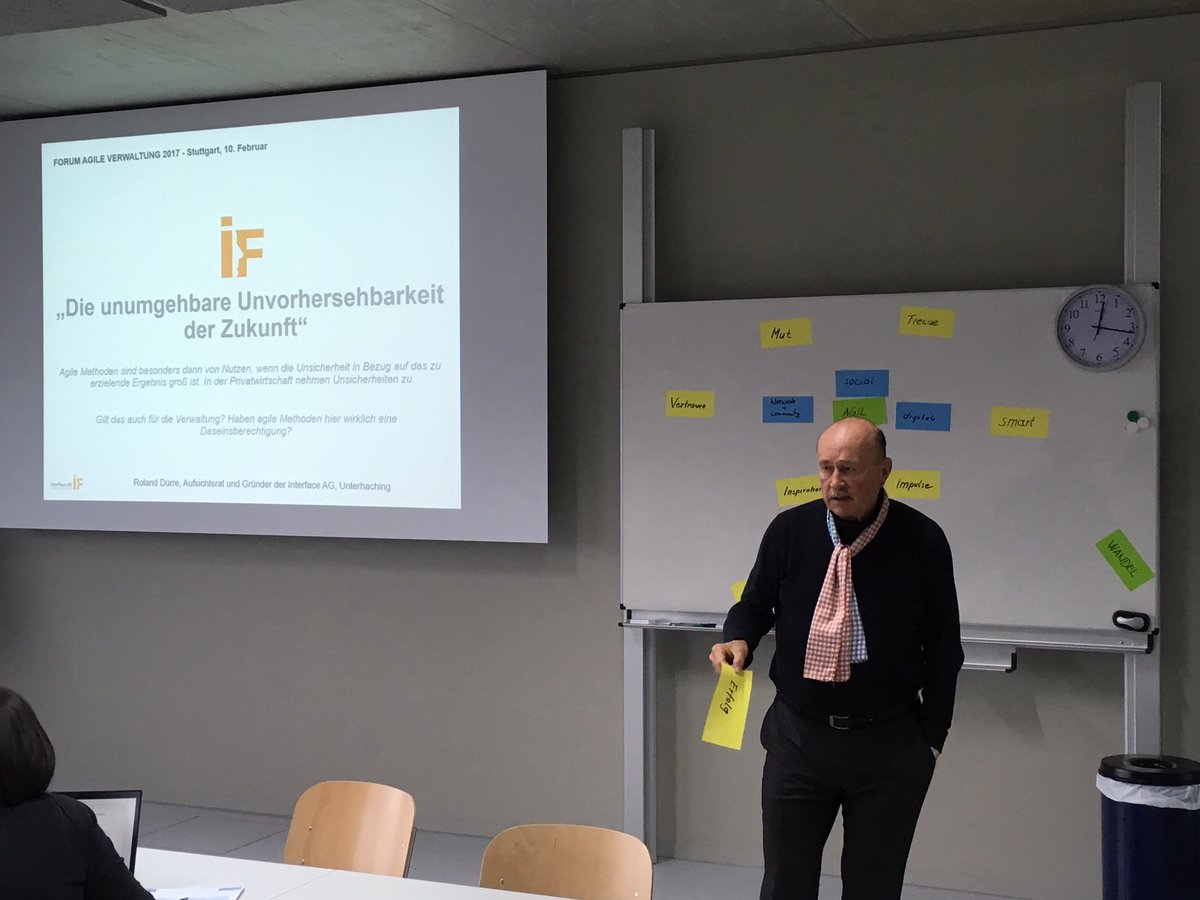
Many thanks to Jan Fischbach, master of agility and my photographer.
On February, 10th, I gave a presentation for the FAV (Forum agile administration) at the Stuttgart Hochschule der Medien. The audience was terrific and I would like to take this opportunity to express my special gratitude. The twitter tag was #fav17 – it is a convenient way to find more information about the workshop.
My presentation was about the “unavoidable unpredictability of the future”. The title is not originally from me – and the same is true for the following sub-title. Nonetheless, I tried to stick to the pre-defined ideas:
Agile methods are especially useful if the uncertainty about the desired goal is huge. In private businesses, uncertainties increase. Is that also true for public administration? Do agile methods really make sense in this sector?
As a service for those who watched and those who were not there: a summary of my presentation. It is a little shortened and sometimes just in catch-phrases.
I started the presentation with an outlook and by explaining terms that seemed important to me. So the first thing I did was pin a cross with five words to the white-board: in its centre stood “agile“, flanked by “digital“, “social“, “newwork“ and “network/community“. I defined the terms and explained how, in my understanding, they belong together.
Note:
When I give a presentation, I am always a little nervous initially. In Stuttgart, I forgot the important terms lean and open. The next time I talk about “agile“ I will start with the central “smart“ cube “agile“, “digital“, “lean“ and “open“. And I will add “social“ to build a pentagram.
For instance, in #newwork I collect all the efforts we make towards giving work a more humane appearance that help us “not to suffer from burnout” even in our modern working world. It is all about consideration, cooperation, appreciation and participation. These are all values that movements such as “Augenhöhe“ (the Film), common good economy, intrinsify.me, “democratic enterprise”, “EnjoyWork“ and others demand. For me, “smart” includes the combination of “digital“ and “social“, with digital being the basis for “network/community“ and “agility“ doubtless only having been re-invented in the “digital world“.
However, the digital change (digital) is only the logic continuation of the Industrial Revolution and consequently the ever more accelerating technological progress. The acceleration of the development is no surprise, because thanks to digitalization, we have more and more powerful tools; what follows is that digitalization is the basic cause for the very fast drastic social change.
I supplemented this image by adding the two terms “courage“ and “joy“ – as a prerequisite for a successful (work) life –, along with the two terms “give impulse“ and “inspire“ as the two central agile means of leading (see below). And then I evened it all out by adding “trust“ (left) and “change“ (right). Finally, I wrote “happiness“ and “success“. After all, it is my goal to make other people – be it audience or mentees – at least a little happier and more successful
After that, my presentation had six steps. Here is a description in catch-words.
- AGILITY
I introduced the “Agile Manifesto” as it has been written by software developers and talked about the influence of IT on technology and our society. It was important that it became very clear how agility is not just a method, but a “philosophy” or “way of living”.
There is no ideological discourse about, for instance, whether “scrum” or “the waterfall method” (V model) are better. Agility is such a natural, basic and so very human concept that both methods can be useful, depending on the individual task.- The medieval cathedrals, as well as the Rome Colosseum were built in an “agile” way: Builder, master and craftsmen met (networking).
- Not agile: Daimler Museum (only new computer speed made it possible to build it, otherwise the static could not have been calculated. But then fire regulations intervened).
- How agility got lost: The industrial revolution changed our view of the world. After having seen the Chicago slaughterhouse, Henry Ford got the idea to produce cars, too, in the assembly line. His huge plants had a great need of workers that were not available. At the same time, many farm workers lost their jobs due to more machines in farming. However, they were “stupid”, not even familiar with the concept of “time”. Consequently, the caste of engineers had to regulate everything. This is how the “caste of engineers” developed. They had to do the mental work for their slaves in all respects. A hierarchical system, paired with extreme division of work (Taylorism) became the formative organizational structure for enterprises.
- Example: Werner von Siemens, born 1817: he organized his enterprise (Siemens) following the model of the German Army.
- Another factor: time is a special commodity. As soon as it is over, it is gone. Now, all of a sudden, it is measured. In units, like kilograms! Note: sailors knew no schedules. They were only introduced for postal coaches. Only steam ships and the railway made schedules possible. This is how people came up with requiring “shared time” in common areas.
- Before the industrial revolution, clocks were mostly used for navigation on the ocean. Now begins the time when they dominate (rule over) life.
- In the plants, there was a common time. To make sure the rhythm was not interfered with, you had to leave your watch at the gate. If someone retired, his farewell present was a watch. “They returned the time to the people”.
- Before the industrial revolution, nobody had a feeling for time. As early as 1900, there were only few countries with a shared time. For planning, the parameter “time” is extremely important.
- In an agile world, communities take the place of organizations Example: movements such as #newwork versus unions.
- In an agile world, the needs of the customers have priority over the contract: Example S21 – the plebiscite was positive because the people had understood that facts had been set – simply because contractual obligations had been caused by those who had signed the commissioning.
- Fake agility A good example for this is the car as master of all individualized traffic. Having a car without a driver will not make you free. What happens if all automobile drivers realize this and want to become “agile”? They say that, if that happens, the economy will collapse. However, this is nonsense, because innovation is creative destruction.
- AGILE LIFE
As a general rule, agile persons are less fearful. Because fear happens between your ears. Usually, agile persons know the moment when they have to stop weighing arguments and instead should start and try things. Agile persons know that all they have is certainties, rather than truths. They are prepared to first give trust (“first give, then take”).
Agile persons enjoy their work more and are more modest and happier. Perhaps they are also more humble and grateful. There is a rule: the more fear, the less agility and vice versa. A superior serenity is the pre-requirement for agility. It grows if you live an agile life. Consequently, agile persons are usually happier and more successful. - FUTURE
In the last two decades of the last century, people and managers believed you could predict the future. All you have to have is enough information and then process it in a precise way. That would make it possible to develop valid scenarios for the future, too (for instance through think-tanks).
And then you could come up with the right solutions and decisions in a totally rational way. This is how they believed an enterprise (and a public office) could become a determining system that gets input and gives output – and how the management could be controlled optimally through simply adjusting the right screws.
What an antiquated point of view! The future cannot be predicted. But then, how are you supposed to plan and control the future if you cannot see it?- In his 1982 “Theses on Change in Management”, Hans Ulrich (the founder of the St. Gallener Management Model) states in his first thesis: “The future cannot be predicted!“
- In St. Gallen, business scientists ask themselves how managers can ever make the right decisions à priori if it is often not possible to determine à posterio if a decision was right or wrong (Definition of decision: its consequences are serious and it is made under uncertainty).
- Vuca (volatility, uncertainty, complexity, ambiguity) All of a sudden these terms appear as abbreviations for the “real world”. But has the world not always been like this?
- Futurology: I, too, am guilty of having believed analysts (Diebold, Gardner), especially when they confirmed my own assumptions (prejudices). Almost in all cases, the predictions were wrong: Here are two examples that were detrimental for me, as well: Bildschirmtext (BTX) and Print on Demand (PoD). In those days, the market predictions were totally wrong. Entrepreneurs who believed in them made the wrong investments.
- There are two personal friends of mine who are worth listening to: Klaus Burmester (@foresight_lab) and Lars Thomsen (future-matters.com/lars-thomsen/). They are both probably among the world leaders in research about the future. Klaus is a twitter recommendation. (#FF). Matthias Horx (www.horx.com/) is rather famous, but I do not personally know him.
- On Lars and predictions about electro mobility: Several years ago, during a bike meeting in Sylt with entrepreneurs, managers, counsellors. It was about innovation and change, also e-mobility. Lars fascinates us all with his presentation on e-mobility. Two years later, almost 20 % of all the participants are proud owners of a Tesla, but all his prognoses were totally wrong.
- Incidentally, the definition of futurology, according to Lars, is the extension of trend research. Based on this, futurology becomes the search for the Tipping Point (https://de.wikipedia.org/wiki/Tipping-Point) in technologies.
- My conclusion is: futurologists are not much help when it comes to predicting the future.
- The innovation as advertised by everybody can best be described as “creative destruction”.
- The reform that is so often called for is nothing other than “non-violent change“.
- And more and more buzz words are making their rounds:
Transition, Transformation, Revolution, Disruptive Changes, Anti-Fragility, VUCA … However, none of those are really new and agility is the only concept that can help.
- The DIFFERENCE between ENTERPRISES and ADMINISTRATION
Enterprises will die if they cannot cope with change. Especially in IT, there are many examples. Some enterprises “only” go bankrupt. Others leave behind them – even if for many years they privatized their profits very successfully – huge damage that will then elegantly be socialized (see EVUs – for many years they had been the DAX heroes – now they try to move the remaining problems, such as nuclear plants, to the public sector).
Public office and administration cannot melt away either after having failed to adapt to change. After all, life in the community will continue. Consequently, the public offices – also due to their political and social mandate – have to cope with all change.
But then, how is the survival of public administration supposed to work without an agile concept as its underlying idea? A concept that has an agile philosophy as its value orientation and that develops and lives an agile culture… - DRIVERS of CHANGE
The understanding that future and change are not predictable grows. Even today, planning fails more and more often, in surprising dimensions. (many big IT projects, S21, BER). You are probably correct if you assume that change will be more frequent and more intense in the future. The trend seems to confirm it. In many areas, we see an enormous acceleration, the speed increases all the time and will continue to do so.
Some drivers of change could be:- What is demanded of politics/society; Trump, “laws” that have to be immediately put into action …;
- Economic Change; Car industry, export downfall, excise tax …;
- Infrastructure & our habits; Mobility consumer behaviour, …;
- Determining factors; Rising interest rates, more poverty, …;
- Disruptive events; Refugees, the climate (warming and cold, water and droughts,…) epidemics, war (terror)???
- Technology; smart solutions, virtualization, electrification, passports as app;
- And much more.
- DIGITAL and CHANGE
Digitalization as the high-speed continuation of the “technological progress” has only just begun – and the same is true for the social change caused by it. Cultural technologies, such as “being able to do calculations (by heart or on paper)” disappear. Machines are now “intelligent”.
Using “intelligent machines”, we can build machines that otherwise could not be built – and they can themselves build yet more intelligent machines. Thus, the technological acceleration caused by digital progress will continue to grow. “Pandora’s box” is probably a nice metaphor for digital technology. The box is on the table. The table starts vibrating, the box begins to wobble. Before you know it, the lid will be askance and something crawls out of the box. Because there is plenty brewing inside the box. Soon, the lid will fall from the box and the box will topple over. Its content will spill all over the table. We do not yet know if all the things that spill out are caterpillars that will become beautiful butterflies. Or if they are evil worms that Medusa sent us?
Well, my hopes are on beautiful butterflies.
That was my presentation. Since the audience seemed to like it, I will probably give the same presentation a few more times, perhaps a little modified with the focal points “agile mobility” or “agile enterprise”.
RMD
(Translated by EG)
Roland DürreTuesday February 7th, 2017
Hacked By XwoLfTn …
Logo of the Chaos Computer Club, the most influential association of hackers in the German-speaking world. Security questions are their main field of interest.
Now it happened:
IF-Blog has been hacked. For the second time. Here is what happened each time: The headline is overwritten – and so is the text. The last time, it was my article America Firs that got under attack.
The headline was replaced by
Hacked By XwoLfTn
and the entire content was overwritten by
Hacked By XwoLfTn – Tunisian Hacker.
Before that, it was my EURO story (EURO-Geschichte). With the same result. The headline and the content were the same as this time.
I was able to reconstruct both articles, which means I am glad that nothing worse happened. But you can see they actually exist: evil guys on the internet. The Chaos Computer Club (CCC) – which I hold in high esteem – is again correct. And so is my friend Hans Bonfigt.
Unfortunately, I do not yet know if we are talking an individual person who wants to annoy me or another Bot doing damage. Looking at google and realizing how many blogs are affected by the same effect, I rather fear the latter.
As soon as possible, I will now install the latest wordpress version. And I hope that helps. And if any of you are wordpress experts – or even better: if any of you know what exactly happened, I would be grateful for any advice you can give me!
Many thanks in advance!
RMD
(Translated by EG)
Roland DürreMonday February 6th, 2017
AMERICA FIRST
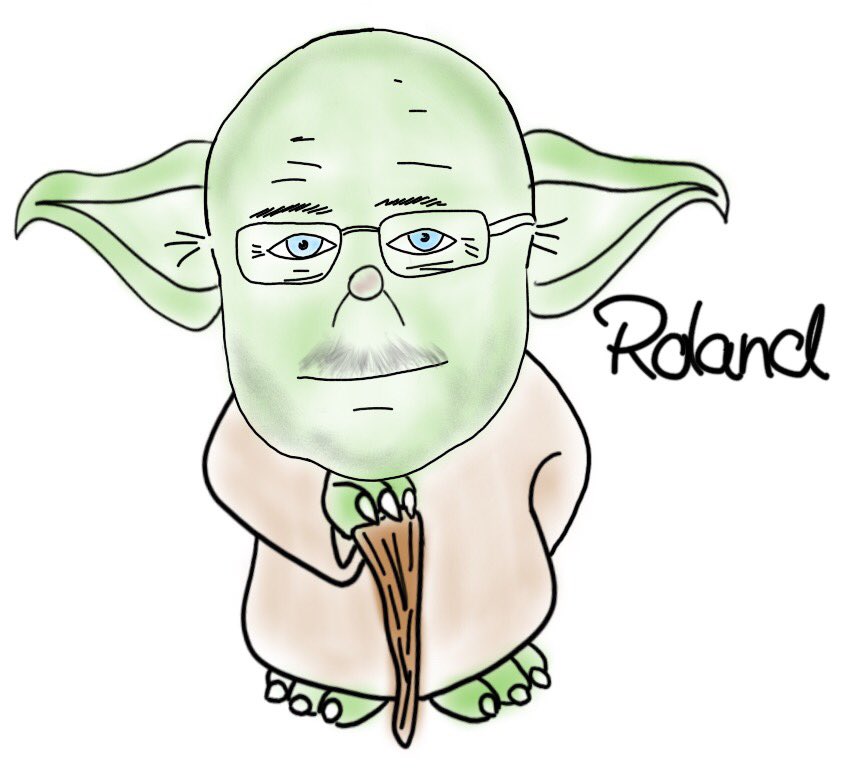
Roland at PMCampDOR (© Visual-Braindump).
The current US president said it again and again. As I see it, he said it a little too often, because for a US president, “America FIRST” should go without saying. Of course, the USA must come first for a US president. And nobody would criticize “America FIRST” if the man who keeps saying it were not Mr. Donald Trump who, even to my way of thinking, acts slightly irrational.
Even for humans, it is true that you first have to care about yourself, before you can think of others. How can anybody who does not value his or her own self appreciate others? That is why masses of persons in the sense of a social system, too, first have to think of their own well-being.
Consequently, I like the slogan “America FIRST“ as a behaviour-oriented value much more than a USA that considers itself a boorish world policeman and also acts accordingly. For instance, I do not understand why Trump’s predecessor, Obama, who won the Nobel Prize for Peace, ordered his soldiers to drop a total of 26,171 bombs in seven countries in the year 2016 alone (as the US expert for foreign policy and national security, Micah Zenko, says on the website of the think tank “Council on Foreign Relations“). And I do not understand why nobody in this country protests against it. Maybe it is because we are the third biggest weapons exporting country of the world – and because in this country everything that creates jobs is per se a “good thing”.
I am not a powerful president. I am only a simple private and retired person who likes to blog. Consequently, I am thinking about what is “FIRST“ in my life.
I live in Neubiberg, which means one would assume that I say “Neubiberg FIRST“. But somehow or other, I still feel more at home in Unterhaching, Riemerling and even Ottobrunn than in Neubiberg. All these locations are situated in the south-eastern affluent suburbs of Munich.
Consequently what I say is: ”Upper Bavaria South-East FIRST“
I often ride my bike and like using public transportation. Consequently, I yell
“New Mobility and as few combustion motors as possible FIRST!”.
I want a maximum quality of life. And since Munich is so near, I also yell:
“FIRST less traffic noise and pure air in and around Munich!“.
I also wish to live healthy and not have more plastic on this planet. Consequently, I say:
“exercise and health FIRST!“.
and
“healthy food and no plastic FIRST”.
Now I leave my micro-cosmos. I live in Upper Bavaria, but I grew up in Swabia. So now comes a softly spoken “upper Bavaria and Swabia FIRST”.
However, “Bavaria FIRST” gets stuck in my throat. One of the reasons is that a large part of the weapons exports come from Bavaria, which, for me, is a total no-go.
I definitely have no breath left for “Germany FIRST”.
For me, the gigantic government buildings in Berlin are first and foremost a gigantic symbol of power. Everything smells of reign and bourgeoisie. This also includes the parliament with its many luxury limousines that sit in front of the building with their motors running so the chauffeurs will not get cold.
The Chancellor’s Centre with its wide rear expanse is not my world, either (the same is true for the Bavarian Government Central Building in Munich). There are more things in Berlin that I do not understand. For instance the new German Secret Service building. It will be the biggest governmental building ever built in Germany. All those things are not what I would feel comfortable with. So, naturally, there is no “Berlin FIRST“.
In my perception, Europe is even farther removed than Germany. So you will never hear me say “Europe FIRST“.
If there is anything I would wish to say in a really loud voice, then it would be
“Peace and Humanity FIRST
and
“Humanity and Tolerance FIRST!“
If, one day, there is a peaceful and free Europe of regions as part of one world where a common-good economy is practiced and where we have no wars, then I will yell “ONE WORLD !“ and “Europe FIRST!“
But only if politics and the economy make the people and the common good as their first priority.
RMD
(Translated by EG)
Roland DürreSunday February 5th, 2017
Democracy & System
Not Democracy is the Problem, but the Underlying System.
A short time ago, I had a facebook discussion with my esteemed friend Detlev about this topic. Because I believe in democracy. But I think the underlying system it no longer any good. What we badly need is a structural reform.
After all, times have changed. What was considered “normal” at the time of the industrial era is no longer normal now. That is true for your workplace (#newwork), for enterprises and also for politics.
We no longer need winners. Emperors, “bog bosses” and centrally established officers (CEOs) are “out“. The same is true for a party “taking over the power” or a system that “gains power”! Because the power must remain with the sovereign: the people of a nation. And it cannot be taken by anybody else.
But first: our dialogue. Detlev is a master of the word, he had posted a great theory:
Detlev:
The liberal democracy is the most sensitive creature of the world. Nurture the baby!
 Roland:
The problem does not lie with democracy but with the underlying system. I no longer want to vote for parties. Instead, I would like to decide between two options of how to deal with important topics that have been prepared in responsibility and following the idea of social consensus. Without any influence by lobbyists. I want to elect people who then actually work towards the reform. As responsible “coordinators”.
In former “democratic systems”, we had to elect a person who then had to decide what happens. This was true both for a chancellor (FRG) and the president (USA).
But now we no longer need “leaders”! The time of the “centrally established officer (CEO) is at its end in business, and we also should kiss it good-bye when it comes to the organization of our nation (politics).
 Detlev:
“France, liberate yourself of persons.“
Those were the words of Anarchsis Cloots in his “call for the human species“
Then Jules Michelet instructed them to establish the government:
“Everything is done by the masses, the great men contribute little. Those who are allegedly gods, giants, titans just deceive us through their greatness, because they maliciously step onto the shoulders of the docile giant: the people“.
That was after the Napoleonic catastrophe. In its wake came a government characterized by a constitutional body that met regularly. And today? Again, France has a presidential system. Roland, why do you believe that it might work out this time? Just because we now have the internet? Or do you believe human nature has changed? I wish it were so.
Roland:
I coach a number of young persons and start-ups. And I notice all the time that they have actually made progress compared to former times. Yes, people change!
Detlev:
Very well, then let us try to prevent presidential systems from happening, especially those with a strictly authoritarian concept. Where shall we begin?
Roland:
First and foremost, I am going to write an article where I will integrate what you said. Your formulation and demand “prevent presidential systems from happening!“ alone is already a remarkable mental progress.
My conclusion:
To nourish something also means to reform it. For instance, I can easily imagine that it is no longer the purpose of democratic elections to bring a person or/and a party into power. Instead, its purpose is to distribute tasks.
For instance, you could elect persons who get the mandate to work towards possible solutions that might be acceptable for all if a social problem needs to be solved (with problem being defined as a state of affairs that cannot be left as it is). Maybe such a body could be the new parliament. It should work following the rules of the “Art of Hosting”, the “honest discourse “ (see: Habermas) and similar concepts. And then it should present the people the solutions they found.
We – the people of the nation – decide which of the solutions they presented us is the best. And if we like none of them, then the gentlemen in the parliament will just have to come up with something better.
It goes without saying that all and any influence through third powers of any kind (aka lobbyists) must be forbidden. Naturally, that also includes religious and similar.
I will no longer need a government in the traditional sense of the word with earls and knights. A well-trained administration is far more important. It must do exactly what the parliament has offered as solutions to problems and what the people have decided. And it must also execute all other important decisions that draw their legitimation from a democratic vote.
Dear Friends:
Prevent Presidential Systems from Happening!
RMD
(Translated by EG)
P.S.
I would wish to have plebiscites in a very direct democracy. Switzerland is a good and very successful example for a “better democracy”. To be sure, even here there is still potential for optimization.
The often heard argument against plebiscites that they sometimes also end in irrational results is easy to counter. If you have ten traditional decisions, you will probably mostly have five poor ones. If you have ten plebiscites, then the number is maybe one in ten.
Well, even the best system will not work totally without mistakes. Only when omniscient machines rule us can we come to that state of affairs.
Roland DürreFriday February 3rd, 2017
A Story About the EURO History.
Europe is More Than the EU (and the EURO).
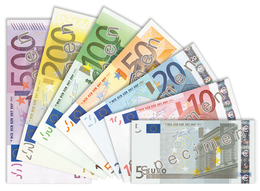
After all, we no longer have the five-hundred Euro bill – regardless of the fact that the currency is losing value.
Last Tuesday, I went to the Café Luitpold where I attended an event the title of which had been advertised with the sentence you can read in the heading of this article (up to the brackets; what is in there is mine).
Harald Lesch had been invited as the star of the evening, but unfortunately he had to cancel at short notice. His replacements were two “Europe experts”.
Regardless of Harald Lesch not being there (in fact, he had been the reason I registered for the event), it was an interesting evening, especially because the nonsense they all talked was very refined. Mind you, we are talking people who in our country are considered the elite in science. To be sure, it is sometimes annoying if you have to listen, but for me it is also a morbid joy to listen to refined nonsense.
The two gentlemen on the podium started with Ancient Rome and some of their theories were really rather absurd. For instance, when someone in the audience asked if the downfall of Europe perhaps had something to do with losing our spirituality and religion, the answer was that the true danger for Europe was not from atheists but from agnostics. The offered explanation was that a fanatic atheist finds it easier to understand a strict Islamic faith than an agnostic.
Which makes integration easier.
That was my “Oh-my-God” moment.
My friend Sigi was also at this event in the nice coffee shop in the noblest part of Munich. After the presentation and discussion, Sigi told me a story that sounded quite familiar. Because I had often told it similarly – but never to Sigi.
To make up for it, let me tell you that Rudi Jansche told me the story as early as twenty years ago, albeit in the future form at the time. It was before the EURO was introduced and Rudi was one of the top managers of a relevant English concern in Germany that had a lot of power in the rest of Europe and also in the FRG. And I often wondered where my mentor Rudi had gained all this foresightedness.
I will now tell you the EURO story (Sigi’s and mine) as I myself experienced it:
 In the early 1960s, I was in France as an exchange student. They still had the French Franc. My French was not yet very advanced and I was a little confused to see that a sports jacket, for instance, cost 100 (cent) Francs. And my host said that he had payed ten thousand (“dix milles“) Francs or “dix milles balles“.
The riddle was soon solved. They had had a currency reform in France shortly before my visit. The “nouvel franc“ had been introduced. It equalled 100 old Francs. People could continue to use the old “francs“ as “centimes“. Basically, all they did was drop two digits. Many people, however, still spoke and had the mental concept of the old Franc, regardless of the products now being priced in the shops in new Francs.
For more information about the French “currency reform”, Wikipedia – here is an excerpt:
On December, 27th, 1958, the introduction of the Nouveau Franc (NF) as of January, 1st, 1960 was ordered. One NF, since 1963 officially only termed Franc (F), equalled 100 old Francs (anciens francs). The old Franc coins could still be used as Centimes. In everyday life, the old Francs continued to be part of the language for decades.
This Wikipedia article is absolutely worth reading. It gives you a good idea about the French inflation.
I have a vague memory that there was a time when one Deutsche Mark (DM) bought you more or less one nouvel franc (NF) – or vice versa. However, that time was soon over. It only took a few years for one Deutsche Mark to buy you three Francs. And matters continued in this way.
It was quite a surprise for me to see how with every visit in France the baguette got less expensive (for me). After all, its maximum price was regulated by law and apparently the state paid to subsidize it. Just like it surprised me that, even after several visits in France, I remained “le boche“ for some French people. Some of the families that had formerly been friends with my host family actually started to avoid them because they had opened their homes to a “boche“ and also – which was even worse – had sent their son to Germany, where the arch enemy lived. The good news is that, regardless, I soon found many young friends in France.
 Our family (with my parents and my sister) mostly went to Austria on vacations. I still fondly remember the Schilling. It was truly an adventure to have the turnpike opened for us at the border and to drive through and then use a foreign currency. We were in a foreign country!
The Schillings – both the 1-Schilling coin and the 5-Schilling coin – looked beautiful. I remember that one DM equalled roughly seven Schillinge. This never really changed very much.
Both the vacations with my parents in Austria and my French exchanges were soon a thing of the past. Having escaped the parental home, I more and more often chose countries like Italy or Greece.
 This is how I learned about Lira and Drachmens. Those were totally different kinds of currencies. The bills were greasy, the coins reminded you of GDR money and they were worth practically nothing.
In Italy, I was surprised to notice that the pizza got cheaper by the year for me, regardless of the fact that, nominally, it got more and more expensive in Lira. It was similar in Greece. For the owner of DMs, it was paradise. Unfortunately, those times are now long gone.
From the perspective of the Italians and Greek, it was not so great. For instance if they wanted to buy a Mercedes. Except that, as soon as they had the bank agreement for the credit to buy the car, said Mercedes was already more expensive. And that meant they would then buy a 2CV, R4 or Lada instead.
And then the EURO came. And everybody was happy. The German industry and the international concerns were enthusiastic, because now they all could sell a lot more. After all, now there was a shared domestic market with a shared currency. So you could really get under way and either destroy or take over the remaining local competition, depending on what seemed most advantageous for your own business.
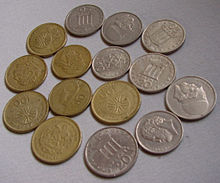 Initially, the Italians and Greeks were also quite happy. After all, the prices for the nice German automobiles remained stable. Now you could afford them, just like you could afford so many more of the beautiful things the German and international concerns flooded the country with.
I was the only one who was not happy, because now, the Pizza and the Gyros was more expensive than before in Italy and Greece. Formerly, whenever we rode our bicycles over the Alps to the Mediterranean Sea, the general rule was that staying overnight got less and less expensive the further north you travelled. That is no longer true today. Now the least expensive places to stay overnight are in Bavaria. It gets more expensive in Austria and continues in the same direction in Italy.
Naturally, there was a downside to the EURO. The beautiful cars from Germany, like many other things, had been bought on credit. And while the German industry was all fascinated and sold record numbers, some countries were destroyed by their debt. It was no longer possible to “heal” through devaluation. The only things that remained of the nice Euro straw fire were inflation and less income.
The creditors wanted high interest rates from these weak countries and got them, too – and that caused additional pain. Just like it is always painful if you are already bankrupt and have to pay a lot of money without getting anything in return.
However, the EZB, the EU and the International Monetary Fund saw reason. They lowered the interest rates and bought the trash bonds in order to avoid the great “catastrophe” of state bankruptcy of one or several member states.
That seemed to save many European countries, not only in the south. But it was especially beneficial for the biggest of all debtors in Europe: Germany, i.e. us. Our reward for agreeing to it was that we no longer had to pay any interest. We would not otherwise have let it happen, because, naturally, our motto is “Germany first“!
This is how we won twice over: first our industry took total advantage of the shared market thanks to a shared currency – and then we no longer had to pay any interest for our national debt. All of a sudden and in a wonderful and smart way, we suddenly had a balanced national budget.
My friend Rudi foresaw all these things. But the responsible government under the great Chancellor of the re-unification did not.
Even if that government had not wanted the EURO, that would not have helped. After all, even at the time, the government, along with the entire EU, did whatever the industry said. And the industry wanted the EURO. Incidentally, that was also true for the other EU countries. Or, to be more precise: they wanted to do away with the DM, because the dominant role of the strong DM had been a constant annoyance for them for a long time. And the only way to get rid of the DM was the introduction of the EURO.
And now we have a problem. I very much look forward to hearing what the new miracle candidate of the SPD has to say about it. After all, he supported this line in the EU parliament, didn’t he?
Now he must and will again talk German: Germany first. After all, there is no second German politician (with the possible exception of the Great Bavarian) who learned better from Trump how to “popularize” the people.
He, too, will have nothing to fight the current system of party and lobbyist oligarchy with, nor will he want to. But I am sure that he will manage to promote his own so unbelievable career. And now he dreams of becoming Federal Chancellor.
Well, that is fine by me. It probably will not make the slightest difference who reigns in the Berlin of megalomania. Merkel alongside Schulz or Schulz alongside Merkel. The only certainty is that Mr. Gabriel will remain Federal Minister of State (due to secret understandings – the main tool of current policy).
Consequently, nothing will change about my story. It will end like so many fairy tales: and if they did not die, they will continue to govern.
Supplementary comment: From EURO fans, I hear all the time that it is so much nicer to travel these days. The disadvantage of having to change money is a thing of the past.
That is an argument I do not understand at all. In the also not so good old days, I always had travellers’ cheques on me. I had to change them in the country of destination. It was probably total nonsense, but my super-ego ordered me to do it.
Today, however, money is only an accounting unit and the conversion from one currency to another is one of the easiest tasks for our “digital world”.
But then, the EURO happened and now we have it. I would really have liked to ask the two Europe experts if they considered the introduction of the EURO useful for the idea of a new shared Europe or if it was detrimental. I never got the chance to ask that question. I cannot answer the question, but I assume it was more detrimental than beneficial.
Now, we not only have the EURO, but also the zero interest rate. And there is a continuing rise in national debt for European countries that is still covered by the EZB and the International Monetary Fund. That is a situation about which nobody can predict how long it will work out well.
During our last PM Camp, Gerhard Wohland said that a problem is a state of affairs that cannot continue. Nobody has a solution to our problem. Perhaps there is no solution. Consequently, those responsible in Europe will just continue in the same way as before. What other choices do they have?
For me, however, Europe is so much more than the EURO. And I believe it is totally irrelevant when and how it will explode. After all, it is only an accounting unit that will then be replaced by new and just as virtual accounting units. A good administration will be quite capable of doing that.
To be sure, this will be yet another situation where you will get winners and losers. Most likely, the rich ones will again be the winners and the poor ones will be the losers. But that is something we are more than used to and so we will continue until there is the next bomb.
And that sounds like logics of history to me. Perhaps the bang will come soon, because the world has far greater challenges to master than your average currency crisis.
RMD
(Translated by EG)


