
Roland DürreThursday November 6th, 2014
Political Education – FES and HSS
Political Education – FES and HSS
Political Education (Politische Bildung ) is still something sponsored by the current Federal Government yet forgotten often and by many. And perhaps it is also anachronistic. After all, the real process of forming your opinion no longer happens in the parties and their “foundations”, but in barcamps “on the streets”.
I know two foundations with close connections to a party: the parteinahe Stiftungen, das ist die Hanns-Seidel-Stiftung (HSS – CSU) and the Friedrich-Ebert-Stiftung(FES – SPD). Both of them invite me at regular intervals and once in a while, if the topic looks interesting to me, I actually attend.
Incidentally, the difference between the meetings organized by the two groups is that the HSS is better organized and the meals, too, are very delicious. At the FES, you mostly get no meals and the organization is not quite as perfect. Perhaps that is one of the reasons why the CSU has such a huge majority in Bavaria while hardly anybody votes in favour of the SPD.
On Tuesday, November, 4th, I accepted an invitation by the FES (SPD). They showed the film “WORK HARD, PLAY HARD.”. It is a documentary by Carmen Losmann about our modern work life I have wished to see for a long time. Moreover, they had promised that the producer Carmen was to be present herself.
I wanted to meet her in person in order to tell her about the project “Augenhöhe”.
In a nutshell: WORK HARD, PLAY HARD is a great film. Considering that it is a documentary, it is extremely exciting. And the Arena (Hans-Sachs-Straße 7, 80469 München) Cinema in the wonderful Glockenbach-District was absolutely the best setting. And Carmen Losmann, the producer, was also there, as promised.
Afterwards, there was a discussion that had both strengths and weaknesses. For me, it is always hard to have a confident discussion after an exciting event. Regardless, it was a nice evening. Especially because Carmen was able to give us her evaluation of the status of our economy in a very charming and striking manner.
However, we had to leave rather quickly, because, after all, the cinema had to switch to its normal business. Due to the flow of incoming cinema-goers, it was not possible to have a discussion with persons who had struck me as those with the reasonable arguments during the discussion. In fact, that is something I would have found truly useful.
Well, but this is only meant as a feedback for the organizers. Perhaps, next time, they want to make a reservation for a few tables somewhere in the neighbouring pubs and thus motivate the audience to continue with their discussions?
However, the event was also remarkable in that the “old world” truly was lit up again. On arrival, you had to sign your name on a list. As opposed to some data-security protagonists, I have no problem with this. As I see it, I should actually be prepared to stand by it and accept that all the world might know about me attending an event of the FES – which is close to the SPD and unions. The same is true when I accept an invitation by the competition (HSS).
When he welcomed us before the film started, the presenter said the signature was necessary because the FES, as we all know, is an “opinion-forming” organization and as such federally subsidized. Consequently, in order to continue being eligible for subsidies, they have to document that “now politically educated persons” (my wording) attended. Incidentally, said presenter was a freelance “dialectics trainer” who often works for the FES and some unions. Well, we all have to make a living, don’t we?
In my opinion, these subsidies of “political education” should either be terminated, or else they should give the money to those who work towards developing social context. And I know quite a few well-attended barcamps and similar events for citizens where many people meet, regardless of the fact that they do not show such great films and serve such delicious meals as the HSS.
These days, much is done to remember the times of “we are the people”. It is quite possible that the reigning parties and their appendages in the Federal Republic of Germany will soon also hear the call: “we are the people”.
First and foremost, however, I am happy to have made new acquaintances and found new insights during this evening. In my next posts, I will include the occasional idea from this beautiful evening.
RMD
(Translated by EG)
Roland DürreWednesday November 5th, 2014
Festive Advent Concert
So here I am again, advertising the wonderful sound of the Arcis-Vocalisten choir. Let me cite:
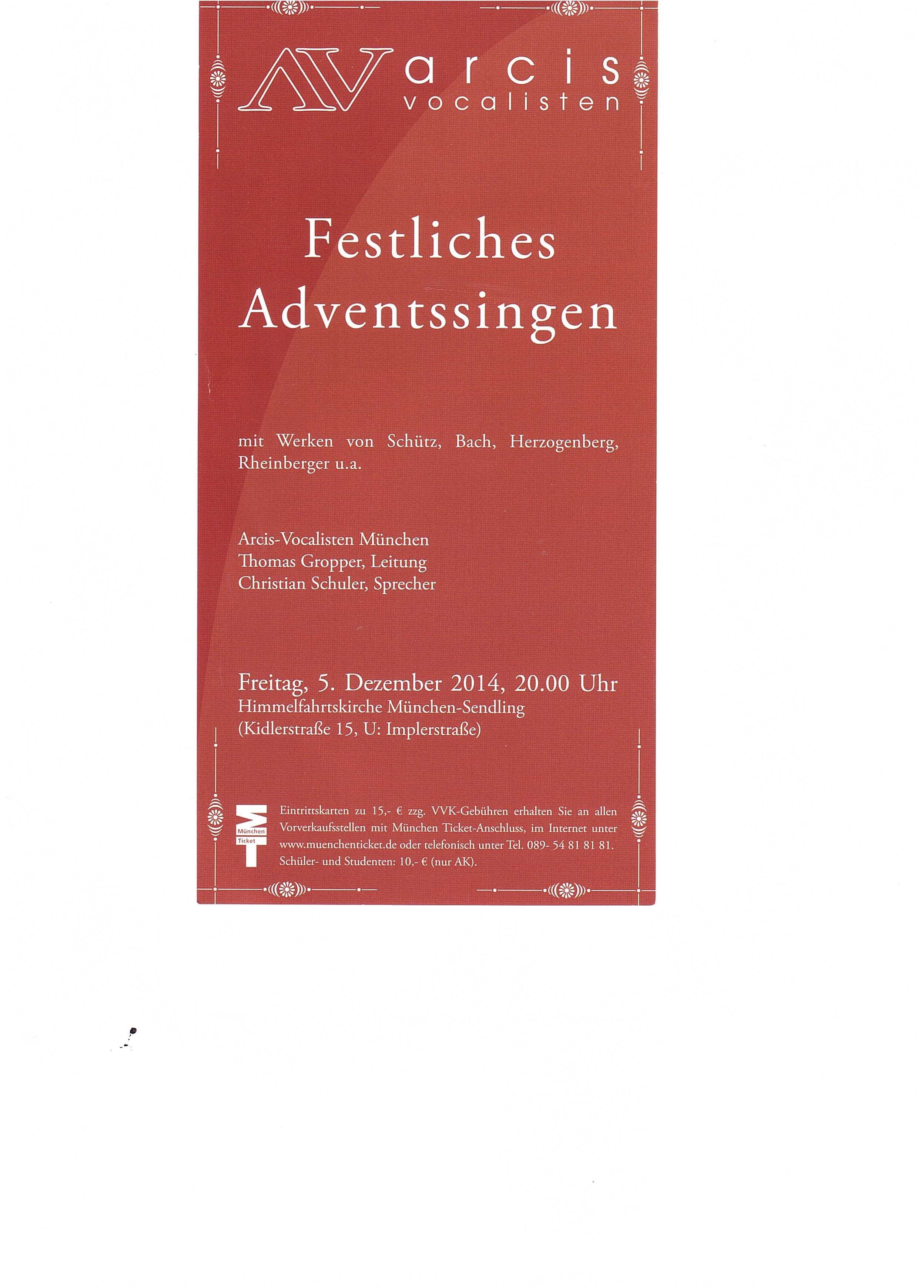 Beyond all the pre-Christmas turbulence and hectic, Evelyn (EG) and the Arcis-Vocalisten München under Professor Thomas Gropper, who are well-known for their expressiveness and creative power, this year again invite you all to come and experience a musical event. You will witness how the contemplative advent charm and the pleasant anticipation directed towards Christmas awakens.
The range is from traditional tunes and works by baroque composers such as Michael Praetorius, from chorals of Bach’s Christmas Oratorio and festive choir pieces from Handel’s “Messiah” to trips into romanticism as in the “Gloria” of the mass for eight voices in E flat major by Josef Gabriel Rheinberger.
With their advent concert, the Arcis-Vocalisten present a selection of impressive works all of which have established their reputation as “classical” advent and Christmas vocal music with just cause. The music reflects the formative emotions and the charm of this very special time of the year from hopeful and trusting expectation to joy about the Christmas miracle.
RMD
(Translated by EG)
Roland DürreMonday November 3rd, 2014
brandeins in November (and October)
I enjoy advertising “brand eins”. After all, I sometimes also browse through other economics magazines, such as the Manager Magazin or the Wirtschaftswoche. And I am always newly horrified to see what useless things they write.
In those magazines, it counts as sensational to report the transfer of a managing director from one bank to another. Except that this “highlight” really does not play a role in the life of the enterprise. And the really interesting facts, for instance who did the headhunting and how much said head-hunter earned doing the deal, will not be found …
brand eins is a truly good, probably the only, alternative. And mind you, it is not just the focal points which are always important for an entrepreneur and manager. On the whole, the mental concept in the sense of “future”, “innovative” and “common sense” is what makes all the difference.
Trust
With the slogan All Under Control!

Failure
according
to the motto you will be wiser after having tried or the worst that can happen is that it is not a success!

Trust is central for every enterprise. And failure is something you have to accept in life.
🙂 I enjoy giving people presents for Christmas – and not only for Christmas. But then, what to give people, since everybody has all they need. And I definitely do not wish to add to the heap of rubbish.
Which is why I already look forward to the Christmas edition. Again, I will use it to make a present to many people. Especially for those persons who are important in my life and who do not yet know brand eins.
These people will get something very nice which is not costly and yet mostly very much appreciated by the recipients of the gift.
RMD
Roland DürreSunday November 2nd, 2014
Wasn’t the Last Millennium Totally Crazy?
In the last century, before the turn of the millennium, everything was different.
In those days, managers still believed in the predictability of the future. What is more: they were convinced that growth is something that can continue endlessly.
People living at the time had the impression that everything can be done and that, thanks to technology and progress, all problems can be solved. After all, humans as the crown of creation felt they were omnipotent – far above the animals. And they believed everything can be controlled.
The motto was: faster, higher, bigger, further and more comfortable.
Engineers and technocrats were in charge. A life without cars was unthinkable. Individual traffic with heavy vehicles and a combustion motor, also for individual persons, was a self-evident human right for everyone – just like the short vacation in the “DomRep” or in Thailand. A society was considered “developed” if the poor, too, could afford to buy a car!
Weekend trips to London or Madrid, just like short vacations to New York or Abu Dhabi helped the people to overcome their boredom in a mundane fashion. Consumption was the method you chose in order to give yourself importance and buy happiness. Regardless, stinginess was considered cool and money was the new religion. Using this concept, it was quite easy to destroy the world.
Professors at university taught us that good managers will never have to react. Instead, they will always act. Because the good ones will see into the future. Just like, in 1968, the chain-smoking and therefore constantly coughing driving instructor, who, due to his looks, was nicknamed “Old Death” had taught me that a good (German) driver will always foresee what will happen in the next second.
The universities also taught us that a manager always has to be free of emotions and personal feelings. Decision making science recommended that, first and foremost, we always collect enough information. Afterwards, you had to evaluate and analyse them absolutely objectively. Only after this step, you would then have to decide in a very rational and logical way, without all emotion. And while doing so, you have to ignore intuition and heuristics as deceptive factors.
This was also the reason they gave why a “normal woman” had no business in management. Because women – with very few exceptions – are just too much driven by their emotions. Obviously, women in “high” management positions were the exception from the rule. And those who were actually looked like men.
Textbooks also said that an organization is good if and only if the highest manager is able to control the entire system as he desires by “adjusting just a few screws”.
Consequently, the companies oriented themselves at military ideals when forming their organizational structures. Hierarchy was the standard, only very few ultra-modern enterprises were bold enough to try a matrix cooperation and even fewer were courageous enough to try “cooperative leadership”. Terms such as self and network organization were out of the question, just like transparency and agility were feared. Everything was dominated by “simple-mindedness instead of diversity”, rather than the “wisdom of the masses”.
Taylorism, moralizing processes and globalization were held to be the success recipe for the economy and to guarantee prosperity for the entire world. All the big enterprises aimed at world market leadership at all times. At the same time, the exploitation of humans and all kinds of resources grew geometrically.
On the other hand, the mass was considered a primitive mob. Citizens were said to be stupid and taken for fools. Marketing manipulated the masses, lobbyism removed their interests. Those who voted in a democracy were considered election-booth fodder. Their wish for peace was overruled with invented and hugely propagated anxieties.
Those who reigned, along with the governments knew a lot better what is good for everybody. They even drew up laws which ignored existing judicial practice and constitutional rights. This is how the citizens were spied on and made fun of in masses. More often than not, this happened in order to satisfy interests and demands of foreign power or powerful concerns.
In extreme cases, even courts of justice were declared no longer responsible. In their place, obscure arbitral courts were instituted. Citizens who had violated tax legislation were severely punished. At the same time, the exact same countries created “tax oases” for concerns.
And worst of all was: the governments believed they could shape order in the world with wars and create peace with weapons.
Well, I am happy that those times are now over.
RMD
(June, 20th, 2030)
Roland Dürre
CANZONE 11
I often tell you about Arcis-Vocalisten concerts. Evelyn Gemkow (EG), who is responsible for our blog translations into English, is a member of the choir.
However, there is another “singer” among the IF author team: Axel Maisch. He has been friends with me for a long time and works at InterFace. A short time ago, he joined the vocal ensemble CANZONE 11. They were founded by Tanja Wawra in 2011 and are now 16 female and male singers from and around Munich.
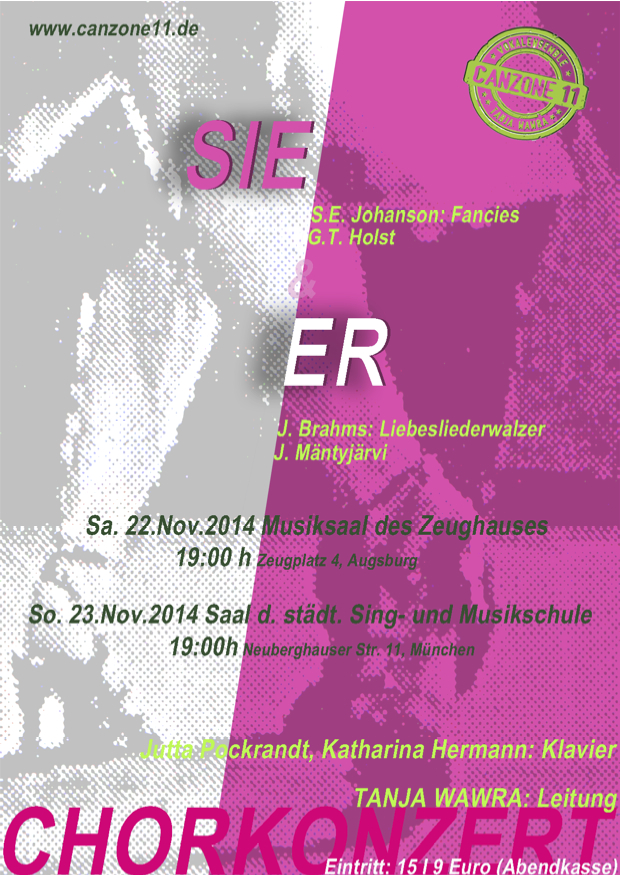 In their new concert program, CANZONE 11 chose the meeting of the sexes as their focal topic! It is all about
“her & him”
After all, the inexplicable and often so tragic meeting between man and woman has inspired the poets of all centuries to write the most wonderful words, to paint the most charming pictures and to come up with the wildest metaphors.
Consequently, it is more than understandable that composers, who draw images with music and interpret words with sound, could not resist taking up the idea. They filled it with sound and never stop interpreting it anew.
The core element of “her & him” are the love songs by Johannes Brahms, in addition to works by S.E. Johanson, G. Holst, J. Mäntyjärvi and Nils Lindberg.
The concerts will be on November, 22th, (in the Augsburg Zeughaus) and November, 234rd, (in the concert hall of the “städtischen Sing- und Musikschule”).
For more information, click here for the Canzone 11 website Canzone 11 or enter Facebook (https://www.facebook.com/Canzone11).
RMD
(Translated by EG)


