
Roland DürreThursday November 14th, 2013
Tweets on Twittering and Blogging #193
Here are my tweets of last week on:
Blogging and Twittering, Wisdoms and Rules:
131121 If you have the itch, you will like to rub – also true for twittering and blogging. #Twitter #Blogging #Wisdom
131122 Holding the ladder makes you just as guilty as the thief – also true for twittering and blogging? #Twitter #Blogging #Wisdom
131123 Those who have most of the votes have most of the rights – also true for blogging and twittering? #Twitter #Blogging #Wisdom
131124 Blowing your nose too often will make it bloody – be careful when blogging and twittering. #Twitter #Blogging #Wisdom
131125 If you cut the rose, you will have to accept that it will prick you – also when twittering and blogging. #Twitter #Blogging #Wisdom
131126 Those who threaten you will not kill you – also true for twittering and blogging. #Twitter #Blogging #Wisdom
131127 Honesty makes secrecy unnecessary – also true for twittering and blogging? #Twitter #Blogging #Wisdom
There is a new tweet each day. See twitter.com and “follow” RolandDuerre!
Enjoy!
RMD
(Translated by EG)
P.S.
I took the proverbs from Alle deutsche Sprichwörter.
Gastautor(en) Tuesday November 12th, 2013
Stepping on Virgin Soil.
A friend of mine sent me the following story “from the internet”:
On the planet Virgin Soil, the mainland foundation Transmissio, also known as TCP/IP, surrounded by the ocean communication, has been built. Around this foundation, various islands rise over the water of the communication ocean. The streams and rivers all flow into said communication ocean, which means they are all connected.
Virgin Soil researchers found out that the mainland foundation, along with the islands, has layers which, as time went by, rose higher and higher.
The most important and biggest of those islands are Mailanesia, Usenetasia and Minor-Complaint-City. Apart from those, there is also Efteponia, Telnetia and several others. Almost all the islands are or have been inhabited. As usual, the peoples of Humanum drifted apart over the years and now they speak different languages.
The cultures and behavioural codices of Mailanesia and Usenetania are closely related, so the people living in both islands can mostly understand each other. Whenever they want to talk with someone from the other group, the Mailanesians use SMTP, whereas the Usenetanians use NNTP. Both peoples speak languages which – apart from dialects – are rather similar to the language Mailanesians and Usenetasians use when communicating with each other in their own dwellings.
Some of the Mailanesians live rather lonely lives and have contact with only a few other Mailanesians. They are called “One-to-One-Mailanesians”. Other Mailanesians have contact with many of their fellow citizens, which gives them the title “One-to-Many” or “Listo-Mailanesians”. Consequently, the rules the Mailanesians gave themselves outside the SMTP culture are rather few and far between. The One-to-One Mailanesians decide among themselves, the Listo Mailanesians mostly leave it to a higher authority to come up with rules or to occasionally remind them of rules that had been agreed upon.
With the Usenetanians, it is different. For them, the public system and protection against alien intrusion is important. So their culture, called “NNTP”, created many places with identical design, which guarantees that an error at one place will not cause the entire public system to collapse. Instead, it can always switch to other places. For the Usenetanians, it is important that their culture and their many locations are not owned by anybody and that any person at all can join at any time. In order to be able to understand each other and exchange ideas, they made rules which make it possible for everybody to reach each of their locations and to be a free citizen with equal rights of their island.
However, we must admit that the population of Usenetania has now suffered from a dramatic demographic change for some time. This is not true to the same extent for some individual, remote Usenetanians who settled on small islands and, although still nurturing the NNT culture, no longer have any connection with the proper Usenetarians.
Minor-Complaint-City is an island the landscape of which is far more broken than that of the others. There are numerous layers and summits, all of which, of course, are based on the same series of layers as the other islands. However, the higher you climb, the more the structure will differ – and on the top layers of the mountains, the differences are rather significant. The Minor-Complaint-City culture is called HTTP. It is a place where they like it sharp and colourful. There are uncountable places and locations, but the public system and reachability is not as much of an issue as in Usenetania.
Every clan has its own place and its own special niche and an outsider will not find it easy to find it. This is how, in Minor-Complaint.-City, many dialects developed and nowhere near every inhabitant can start contacting any other inhabitant of his liking. Besides, the inhabitants of Minor-Complaint-City are not very interested in questions of ownership on their island, which means that they do not come up with so many prevention regulations concerning the closure of places or the restriction of their freedom. For them, the meaning of the word “freedom” tends towards being permitted to camouflage their own identities. In fact, the latest fashion is the “digital Burka” – which they call “locking mechanism”, because they found out that they are spied upon by unwelcome guests who never asked permission. Incidentally, they share this experience – along with the annoyance about it – with the Mailanesians.
Another characteristic of the people living in Minor-Complaint-City is that many of them believe they are the only inhabitants of Humanum and there are no other islands on the planet. In fact, some inhabitants of Minor-Complaint-City actually never leave their mountain. They expect others who have a question to come and climb their mountain. After having made this special effort – for which, more often than not, you need special equipment – you will find them a fairly friendly people. Provided the guest takes pains to speak in their dialect and does not belong to the aforementioned “unwelcome guests”.
So much on this. In my opinion, it is rather nice and you might find it easy to continue in the same manner. I looked for the source and found out that it is by Sabine Baer <baerks@t-online.de> in the Newsgroups: free.de.piratenpartei. The subject is “Post Card from Virgin Soil”.
RMD
(Translated by EG)
Elwood P. Dowd
Subcontractor
 Winston Churchill said something like: “Democracy is a poor system, but it is the best system we know.”
In a democracy, the people (demos) are who have the sovereignty (kratie). In theory!
The key to the sovereignty are the elections. The people vote in favour of ideas, concepts, a philosophy. The majority will win. So far, so good.
But the people also elect persons. They are subcontractors who are supposed to implement the ideas, concepts, philosophies they have been elected for. The people delegate the sovereignty. Now, the subcontractors reign.
Those who have the power will do what they want to do. The people do not count. Herds of cattle, driven to the polling stations? Having to accept anything?
What is the difference between industry and democracy?
In industry, subcontractors are bloodied. In democracy, the subcontractors are those who do the bloodying.
Where did we go wrong?
My friend Harvey says:
Your method of demanding truth is an interesting one – the adjustment of metaphors.
Normally, the masterminds of a democracy, for instance the French revolutionaries, worked with a family metaphor: Fraternité, brothers, brothers to the light.
This is supposed to signal blood relationship, close proximity, maximum trust.
In doing so, they had found a reply to the animal metaphor as declared by Hobbes:
One person is his neighbour’s wolf – which is the opposite of brother.
You use an entrepreneurial metaphor, which is supposed to prove that you are not a leftist sentimentalist, but a rational rightist.
The subcontractor is absolutely consistent after having started with the entrepreneurial metaphor.
Whatever serves to guarantee success is right.
Be it the free sale for an entrepreneur, or the execution of the people’s wishes in a democracy
From the animal metaphor via the family metaphor to the entrepreneurial metaphor.
Nietzsche says that truth is a mobile army of metaphors.
There comes a time when we can no longer prove anything with ratio.
That is when we will believe in images which are supposed to verify our ideas.
Some believe in the animal inside us, others in the family person,
You believe in the entrepreneur.
Now who has the best truth?
Oh, my dear Harvey, what paths are you taking? There is only one truth, but it lies hidden in a haystack of lies. Humans are notoriously lazy, so they take the surrogate for truth: belief. It has the same effect as a drug.
Those who do not like belief will take doubt. It is an even more potent drug, because you will not get rid of it. Least of all by ratio!
All you can do is strengthen or weaken it, using images.
There is a method behind it and, according to Adorno, it works “like a tank on the open wound of doubt.” (Elwood P. Dowd).
(Translated by EG)
Roland DürreSaturday November 9th, 2013
My Presentation “Change in Management” Now Available as a Video
On October, 24th, I spoke at the University of the Armed Forces. Since what I talked about is extremely important to me, I had the presentation video-taped and published in Youtube. Here it is:
Enjoy!
RMD
(Translated by EG)
Ulf D. PoséFriday November 8th, 2013
Babbling and Language
How our way of talking about things developed.
We live in times of irresponsible babbling. As a consequence, we prostitute ourselves totally shamelessly, wasting our cerebral cortex. It is particularly obvious if you look at famous persons. And we like listening to them, because the linguistic sub-standard these famous persons display gives us a feeling of superiority without having to prove that we actually are superior.
We live in a remarkable era. We no longer distinguish between linguistic symbols and mental symbols. Consequently, we no longer fill our linguistic units with mental symbols, but with emotions. In return, we no longer have to take any pains: instead of quality, we get sentimentalism. We no longer painfully try to find the right term as Adorno told us to. We pretend to have enjoyed a good education, but in reality, we are no longer wise or intelligent. A person is intelligent if he or she is capable of concentrating, of identifying rules and of setting priorities. Consequently, there are actually people who have enjoyed a very good education, but still they are rather stupid in terms of intelligence.
This means that intellectual honesty is currently taking a rather prolonged bath, a pronounced time-out. It is something we must not allow to continue. After all, we do have responsibility, don’t we? So let us look for answers. And let us find them.
Here is what we need to take into consideration:
- Language can heal.
- However, language can also disturb and destroy relationships.
- Language can kill.
You have to be aware of this. And you should never feel saturated when having eaten from the tree of insight! Unfortunately, however, I sometimes get the impression that the tree if insight seems to have withered.
Language can be a very powerful thing. Five words suffice for moving the world:
- En arche en ho logos (In the beginning, there was the word).
- Ceterum censeo carthaginem esse delendam.
- Nevertheless, it does move.
- Unite, proletarians of all nations.
- Do you want total war?
- Nobody wants to build a wall.
- I give you my word of honour
Language can kill. It can ruin your dignity, especially if what you judge is the people, instead of what they did. And if you functionalize humans. If they are no longer the final destination of what we do, but a means to an end. However, it seems that, for some, dignity is only a verb in the subjunctive form.
An ethical misunderstanding
Many persons, in particular professional speakers, also known as key-note-speakers, live according to the motto: what good will wisdom do if you cannot present it wisely? You just have to say it in the right way!
Well, this might be an ethical misunderstanding.
Why not look at the core of language together? Because if you want to understand the core of something, you need to stop just poaching the periphery.
Isn’t it surprising how inaccurate our language has become? We use the same vocabulary, but hardly ever mean the concept on which these words are based. We have become linguistically incompetent to a high degree. Basically, this is easy to explain. We live in a world of languages. But not right from our birth. First, we grow up in a world of concepts, in a world where, as toddlers, we often do not know the exactly fitting words for many notions. When we are small children, we hear many words, but we do not yet know their meaning.
When a human is born, he or she cannot yet speak. But from the very moment of entering the world, they are surrounded by notions. They know exactly what a pacifier is. The only thing they do not know is how it is called. Small children learn notions very quickly, they know exactly what the essence of an object is. They know without words. Slowly, they will then later develop language, which enables them to give a name to a concept. Now they can express what they have known for a long time. Why are parents surprised if the linguistic ability of their children explodes, usually with their second year of life. Mind you: this is not witchcraft. Some of the concepts have been learned by the children a long time ago. All that was missing were the corresponding words..
Initially, children grow up with mental concepts. They only learn the linguistic symbols around the middle of their second year. Why do I point this out? There is a simple reason: during our lives, we learn so many words from the world of linguistic symbols that many persons no longer care to actually distinguish between the corresponding concepts and the mental world. Consequently, we are happy to use words the content and meaning of which is no longer clear to us. We no longer compare them with the content of these mental symbols.
Since we lost the mental concepts regardless of still knowing the words, many people seek a substitute for said mental concept. Since humans are very creative, they will soon find what they have been looking for. Instead of mental concepts, humans use their emotions as a full surrogate.
More and more often, words are filled up with emotions. Consequently, humans swim on an ocean of emotions as soon as they say anything. The more this happens, the less they will actually be interested in the actual meaning of the word.
The consequence is almost tragic, or at best comical. We no longer know what words mean, but still we use them in order to justify what we do. Why do we do this? Because it is convenient. It is a lot less strenuous talking about emotions than taking all the pain of analysing what lies behind a concept, what actually is the meaning of a word or what is its underlying concept. Such intellectual honesty is not very comfortable.
So what we actually need to do is become small children and learn to fill words with their semantically correct content, giving them meaning.
Unfortunately, however, fewer and fewer people are interested in concepts, let alone intellectual competence. They rely on their emotions, following the motto: “Why would I accumulate knowledge, since I already made up my mind, anyway”. Consequently, they talk opinions without the substance those opinions should be based on and try persuading people. This is how they infect other persons with opinions that can hardly stand up to a critical test: words free of content will become convictions, and as soon as many persons share these convictions, we conclude that they must be correct. We no longer examine them – which means that the significance of an argument, too, will be lost.
If you have ever studied philosophy, you will soon have heard that this science basically is about two questions:
- Question Number One: Why is that so?
- Question Number Two: How do you know this?
If you are an honest person, you know that all those who strive after competence in knowledge will be able to answer to these two questions.
Consequently, what we are talking here is linguistic competence. It is the basis for decision competence – and it means:
- Before you make up your mind, inform yourself about the facts.
- Ask yourself if you can actually give the definition of a word.
- Ask yourself if all you have is a feeling or if you actually know something about the situation itself.
- Only comment on things where you know and understand the meaning of the word.
- Ask back if there is something you do not know or understand.
- Be delighted if someone wants to know how you mean something or what exactly is your idea of something.
Babbling and stupid talk
Why don’t we just shut up when all has been said? Some people suffer from Logorrhoe (talking diarrhoea). One millilitre of insight is embedded in one ton of words.
Isn’t it both amazing and embarrassing that, today, important and central words of our society are used exclusively for transporting emotions? This means thinking dies, assisted by the flowery phrase.
By now, thinking has come to drown in the language.
In other words: instead of thinking, you just talk. It is important for all kinds of communication in partnerships, in enterprises, and in politics to be aware of the fact that we, today, live in a world filled with flowery phrases with which emotions are transported between places, without any semantics (meaning) or responsible symbols of thought underlying this process. .
The culture of thinking is a pre-requisite for all forms of culture
Even Aristotle recommended to divide humans into two categories: honest ones and dishonest ones. For him, the honest person was the one who actually still knew what he was talking about. This meant that the honest person talked about the things themselves, not just about emotions he felt when thinking of something. An honest person will first tell you the nature of something, before bathing in emotions. An honest person will distinguish between knowledge and opinions.
An honest person can tell you the characteristics of a matter and its semantic content. For the ancient Greeks, it was important to first clarify what they were talking about, before they came up with a decision. The means to this end was the definition. It helps to describe the use of something in such a way that the person who understands the description will be able to tell you what it is.
As late as Adorno, we were told about the hardship of words. I am sure he had realized that we have to accept said hardship if we want to treat the socially important words with responsibility. In a pleasure society, it seems that more than a few people just consider such extra hardship a nuisance. But, mind you, it is a necessary condition if we want to come up with decisions in our society in the fields of business, politics and culture which might actually enable us to solve a problem in an appropriate and professional way.
Why are we living with this state of affairs? When George Edward Moore developed his emotivism in ethics in 1903, we had definitely arrived in the era where ethics was dominated by appetite. Since Moore, it is ethically correct and good if people feel nice when doing what they do. Quite a number of people find it sufficient, instead of asking if what they do is actually good. This emotional mush is hugely responsible for the dishonesty in our language and behaviour.
The second aspect is the affinity towards an ethics of attitude. As soon as an attitude is honest, many people no longer ask if said attitude is coupled with the corresponding behavioural competence. This is how we get an unspeakable pairing of good conscience and incompetence: I am causing misery and even feel well doing so. And to top it, we also created a shock culture that soothes our conscience. It seems to make more sense to us to take part in candle processions than to actually do something. Some people are more moved by the misery in Africa than the misery next door. This is how we suffer from love of the farthest; the love of the neighbour has dwindled. To me, it seems like these are the basic, general characteristics of a new dishonesty.
What fell victim to all these developments is the meaning of the socially important words. Be it democracy, social justice, achievement principle, freedom: all these terms trigger emotions which actually are not covered by the understanding of the meaning of these words. Thus, the most important words in our society are no longer analysed with respect to their semantic meaning, but their emotional meaning. The consequences are semantic crimes and incompetent behaviour – and hardly anybody notices. Let me illustrate this with some examples of our society.
Politicians talk freedom, yet they take away our freedom by seeing to it that the country takes more and more responsibility for our welfare. The fact that this makes our country bankrupt apparently is nobody’s concern. Mind you, I used to believe freedom means you can live your life self-determinedly, rather than being made to do things by those who take the responsibility for your life.
Thus, politicians delight in minimizing our freedom, and they restrict us with ideas such as a vegetarian Thursday, the abolishment of firsts-class compartments in trains, a strict non-smoking policy, etc.
Politicians and unions demand social justice yet they ignore that justice is the strong wish to let everybody practice their own rights. You no longer notice that the adjective “social” counteracts precisely this strong wish. Consequently, what we get is “social whispering”, instead of social justice.
The Nobel Prize Winner for Business, Professor A.F. Hayek, called adjectives such as »social« weasel-words. Their characteristic is that they undermine a term and give it a new meaning which actually no longer has anything in common with the corresponding noun.
And here is a last comment on the semantic meaning of social justice. To this day, nobody succeeded in giving a definition for social justice that is both accepted by everyone and correct. Everybody uses it very emotionally for his or her own purpose, forgetting that social justice was originally something the ancient Greeks invented. Its purpose was to fight envy. At the time, the attempt was a failure, the application of the method was terminated.
I see similarities between the usage of the words social justice and democracy. We consider democracy the best of all possible governmental concepts, yet we deny that the very word “Democracy”, as invented by the Ancient Greeks, contains a strong reign of the ’Demos’, which were the upper classes. In fact, it was exclusively invented as a form of government that was meant to bridge the gap between one governmental system and the next. The Ancient Greeks believed the people should never be permitted to reign longer than absolutely necessary. Simultaneously, we today mentally unite the ideas of democracy and liberalism.
In doing so, we totally forget that democracy and liberalism are actually two opposite sides of a coin that exclude each other. Liberalism will always want as much freedom as possible and only as much force as is absolutely necessary. Basically, democracy and liberalism are two totally different affairs. Yet the combination of the two has become such a matter of course and so dear to us that we no longer think about the meaning of the words. We can no longer imagine them separated from each other. If you take a critical look, you will discover that quite a few of the things we consider undemocratic are only illiberal.
On top of this, we forgot that, in our liberal democracy, freedom and equality actually exclude each other. They are opposites. Any form of equalization will automatically limit any form of freedom. We are not equal. The lack of clarity about the semantic meaning of the word democracy will eventually end in us no longer seeming to be able to critically judge if in our democracy our constitution is adhered to. After all, our constitution does not state that parties should govern us. It says: ’the parties are part of the people’s process of finding their political opinions’. It does not say anything about reign. Basically, this means that the whip principle is against our constitution. Well, nobody is worried by this, but still it violates our constitution.
And then the big parties are surprised about the people starting to deny them their votes. Before talking democracy, it might be a good idea for our politicians to inform themselves about the meaning of the word.
Unfortunately, our business heads are no better, either. Here is an example: the economy fights for a system where the achievement principle should dominate and yet they ignore that the achievement principle is an ideal-typical socialist wage system originally demanded and introduced by Karl Marx. In this system, the market and usefulness play no role. The achievement principle is a wage system where the employees are paid for their actual performance. Achievement is either the degree to which pre-defined goals have been reached or the number of tasks fulfilled in a certain time. So far so clear! But is achievement really what our wage system is based on?
In former times, it was rather simple: if you wanted to work, you offered your services on an employment market. You work had a market value in relation to others who offered the same service. Now this work was purchased by enterprises on the employment market. They did that because they assumed the work they bought might be useful. Work had a utility value. If the degree of usefulness increased, the employee received better payment, because you could actually let him share the benefits of increased usefulness. If the usefulness decreased, the entrepreneur no longer wanted the employee; he gave notice to some of his employees. The wage system was the market-value-usefulness principle. To this day, the entrepreneur uses the expected achievement as a determining factor when it comes to calculating your wages! Which means that the usefulness, rather than the achievement, determines the value. Consequently, it is certainly extremely emotional, yet semantically total nonsense.
As the examples show, it is high time to demand semantic honesty. Let us, at long last, speak about the matters themselves, rather than about the emotions such matters trigger. It will pay. Otherwise we will have to admit Bernhard Shaw was right when he said: some people are only prepared to die for something that is sufficiently unclear for them.
Ulf D. Posé
(Translated by EG)
Roland DürreThursday November 7th, 2013
Philosophical Exercises in India
On my journey through India, I see my daughter preparing for an exam in philosophy. In order to test my competence, she asks me questions out of her textbook. Here are a few examples:
”What use is Philosophy?“
I cannot spontaneously think of a proper answer. Rather than saying something wrong, I tell her I do not know. Consequently, she tells me the correct reply her textbook offers:
”Philosophy teaches us where we come from, where we are headed and who we are“.
But that is not true, I think. If you read this definition precisely and literally, it is actually totally wrong. After all, philosophy will not give any meaningful answers to these questions. To me, this definition looks at least “pre-Darwin”. Let me take a closer look at the three factors mentioned.
”Where do we come from?“
Don’t we have sciences, such as anthropology, biology or the evolutionary sciences, that describe the development of humans from “humanoids”? Would it not be better to lean on archaeology or the research into human history, rather than philosophy, when trying to answer that question? Even “religious history” might be helpful. And, if you look at it in absolute terms, even physics – when dealing with the Big Bang. Along with her natural partner: mathematics.
”Who are we?“
This is another area where I see little room for philosophy. I would rather try to find my answer in psychology, neurology and perhaps sociology when we are talking society.
“Where are we headed?“
When I was an adolescent, there was a time when I wanted to research the future. Those were the days when I was an enthusiastic reader of science fiction. I believed it might be very exciting to at least come up with potential future scenarios in the form of possible variants from the “cybernetic” understanding of complex processes in the present and past. Later, however, I ended up studying mathematics.
Allegedly, today we have such a thing as futurologist science and management. Mind you, a short time ago, a “futurologist manager” (who, incidentally, earns good money on the job) told me that futurologist science is basically a misunderstanding, because the future is something you cannot research. But you can certainly “manage” it. I cannot comment on that, except that I know “futurologist scientists” who also earn (quite) good money with it.
As you can see, we have lots of scientific disciplines dealing with us humans and our lives. I like calling them the “life sciences”. And as always, I believe they should cooperate with and supplement each other.
But then, what is the mandate of philosophy? In my opinion, it should sharpen the human mind. And it should teach us how to question everything in a wise way.
Philosophy should be an applied science. The professors should wish it to be so. They must manage to equip as many people as possible with the tools they need for developing their own, high competence in judgement.
With this in mind, I see philosophy, above all, as a science that needs to educate humans. We need it in order to be able to find a reasonable balance between our individual and the collective needs. In order to give us the competence for more often judging correctly than wrong and thus make our behaviour and decisions more often good than bad.
In recent years, at least in Europe, philosophy was the carrier of enlightenment. For me, this is one of its most important tasks. In the future, philosophy must continue to strive for enlightenment. It should teach us to ask questions. Because enlightenment can and will never be finished.
🙂 On the internet, they would say that we in Europe are currently living through “enlightenment 4.0″.
Philosophy is about striving for insights through thinking. Consequently, philosophy will also always be about morals and ethics. Perhaps it can push the negative sides we currently find in the religions a little to the background. It is possible that philosophy can help humans to find their own and human God, or else the divine element in themselves.
If philosophy managed to achieve this, it would be a wonderfully useful science. A science which can leave the ivory tower it locked itself into. Consequently, I get angry when I see how thoughtlessly philosophy is defined in Bavarian school simply as the science of the “where do we come from, where are we headed and who are we?”. That is oversimplified.
Even if this almost religious definition of philosophy in the textbook is only meant metaphorically, it does not make any sense. Stupid sentences are far too often excused with the statement that, after all, they were meant “only metaphorically”.
Because you cannot develop absolute truths and morals from stories created through the collective thinking of humans and their hair-splitting and one-sided interpretation. That is what happens in religion and it is exactly what philosophy should avoid.
RMD
(Translated of EG)
Roland Dürre
Tweets on Twittering and Blogging #192
Here are my tweets of last week on:
Blogging and Twittering, Wisdoms and Rules:
131114 Watching the game is the best teacher – also true for twittering and blogging. #Twitter #Blogging #Wisdom
131115 If you do not tend to the field, you will have weeds growing – also true for twittering and blogging? #Twitter #Blogging #Wisdom
131116 The hunter will also tire – also true for blogging and twittering. #Twitter #Blogging #Wisdom
131117 He who stirs the dirt will also have to smell it – be careful when blogging and twittering. #Twitter #Blogging #Wisdom
131118 If you want to eat the kernel, you have to break the nutshell – also true for twittering and blogging. #Twitter #Blogging #Wisdom
131119 The laugh is always on the loser – of course, also true for twittering and blogging. #Twitter #Blogging #Wisdom
131120 The winner is always right – also when twittering and blogging? #Twitter #Blogging #Wisdom
There is a new tweet each day. See twitter.com and “follow” RolandDuerre!
Enjoy!
RMD
(Translated by EG)
P.S.
I took the proverbs from Alle deutsche Sprichwörter.
Bernhard FindeissWednesday November 6th, 2013
(Deutsch) PM-Forum 2013: Ein persönliches Fazit
Roland DürreTuesday November 5th, 2013
On the Backwaters of Kerala …
… or: our next leg after a beautiful day in Goa
On Saturday night, we were back in Bombay. All the world is partying. It is called Diwali, which is the festival of lights. This is like Christmas at home. There are many presents. Diwali is celebrated festively. Lots of lights are illuminated. You take some time out and meet family or friends. You dress for the occasion and eat something special. And you have parties, both in private and publicly. And you dance. In an English-speaking Indian newspaper, I read interviews done with celebrities where they tell people how they celebrate Diwali.
Everything is like we know from Christmas. Perhaps the significance is also similar. Except that, at home, there are no public parties. But who knows: maybe we will get that in Germany, as well – a huge Christmas Party for all Christmas singles near the Brandenburger Tor.
This night is even more noisy and shorter than the last one I spent in Mumbai. Maresa has to be taken back to the International Airport, her flight to Munich will depart at midnight. After all, she has to go to school on Monday and should have all Sunday in Munich to recuperate. And we go to the national airport on Sunday morning at 4:15 hours, from where we head for Kochi (Kerala).
Due to Diwali, all employees at Bombay check-in are dressed in their local costumes, instead of their usual uniforms. For a change, we are on time and everything goes smoothly.
The flight from Mumbai to Kochi (Kerala) is twice as long as the one to Goa. Maresa went back home. Now there are six of us left. Maximilian’s Chinese parents-in-law have arrived.
In Kochi, the taxi to the “backwaters” is already waiting for us. For the first time in India, we have a driver who hesitrantly asks if we would mind if he did not turn on the „AC“ (air condition). Also, he sticks by the traffic rules, does not take over at the most dangerous places and actually drives slowly. When he calls someone on the telephone, he even stops at the curb. This is absolutely sensational.
On arrival, a huge ship awaits us. It is as big as the steamers on the lake Ammersee. It has three big bedrooms and a canopied salon in the front part with huge armchairs and benches. We will spend the time between Sunday and Tuesday morning on this ship.
This is how we drive through the “backwaters”. It is an endlessly shallow area with many canals, both broad and narrow. In between the canals, there are large areas of cultivated and watered land. In the daytime, a scenery that looks totally new to us passes by. It looks exceptional and yet always full of diversified harmony: palm trees, rice fields in all phases of cultivation, a few houses, nice colours, great images, everything literally glides past.
We spent two wonderfully quiet and long nights on our ship. Those were truly “meditative” days. Like in Goa, we left the hectic of Bombay behind.
This morning marks the end of our boat trip. We went to Thekkady, Kerala by taxi. It is very close to the Periyar Tiger Reserve. Now we will spend two days here in a „Safari-Hotel“, before heading back to a short afternoon in Bombay and from there back to Munich at night. Arrival at Munich airport is scheduled for Friday morning at 6:00 (am).
We will go from the sun into the grey November …
RMD
(Translated by EG)
Roland DürreSunday November 3rd, 2013
brand eins in November
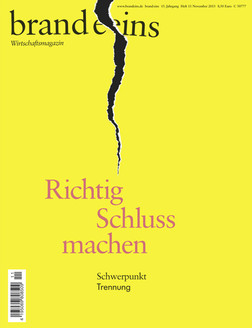 This time around, the “brand eins” edition arrived rather early. Because, after all, it will soon be Christmas. And I assume that they want the “brand eins” January edition to sit underneath as many Christmas trees as possible on Christmas Eve. So the motto was to speed up. Incidentally, “brand eins” is truly good advice if you are still a Christmas present hunter.
I had almost expected the ripping on the title page not to be real. After all, the post-it of the “brand eins” October edition taught me a lesson, didn’t it?
The title “How to Best End It”, along with the “focal point: separation” actually appeals to me. Finding an end and separating is always rather sad.
But I, too, made similar experiences to those described by Frau Fischer in her editorial. My separations, too, were always useful for me. Just remember what a good thing it turned out in retrospect that I first left Siemens and later Softlab in order to find my own responsible path in life.
Saying good-bye to the children when they grew older and started their own lives was always a good separation, just like the imagined relinquishing of freedom when I started family life. Leaving our last house a short time ago was also painful. After all, we had been living there for 23 mostly happy years. Now, however, I live in another, smaller house I am absolutely enthusiastic about.
Last Sunday, I said good-bye – although hopefully only temporarily – to our two cats Minz and Maunz alias Stalin and Lenin alias Joschi and Wladi to be on my way to India and visit my son for travels through India with him and his Chinese in-laws.
And the “brand eins“ accompanies me. Since Lufthansa – at least in the economy class – no longer seems to be as generous with providing daily newspapers as they used to be, I was rather happy to have it in my hand baggage. On such a long flight, I enjoy reading good material.
Consequently, I read about saying good-bye while sitting in the plane. And this helped me a little to prepare for the next separations to come in my life – the big one from my job at the end of 2014 and several small ones that loom ahead. I am absolutely determined to allow nobody to “take me as a hostage” (see page 70). Instead, I want to allow “jumps and separations”.
And here is what I especially liked: my favourite white beer (see title: Unertl) was also mentioned in the magazine. Of course, the Lenovo numbers are also quite interesting, but one might easily write a separate article about those. However, here is what shows best the high quality of “brand eins”: my ever so critical son, too, basically swallowed it up from the first to the last page.
After having spent two years in China, he now lives in India and had never heard of “brand eins”.
RMD
(Translated by EG)


